

miei_materiali Spiegazioni, mappe, schemi... siamo spesso alla ricerca di materiali già pronti, o da riadattare per le esigenze degli alunni che abbiamo di fronte. Metto quindi a disposizione, come molti altri colleghi in rete, alcuni file che possono venire utili per lezioni, esercitazioni, ripassi e verifiche. Altri materiali particolari sono a QUESTA PAGINA ed anche QUI. Le mappe (concettuali, mentali, diagrammi...) e gli schemi di sintesi, ad esempio, possono essere un grande aiuto per gli alunni dislessici, per quelli stranieri ed in generale per tutti per quelli in difficoltà. Le schede sono in genere per la scuola primaria, ma a volte potrebbero essere utili anche per la secondaria di primo grado (medie). A questa raccolta contribuiscono anche altre colleghe.
How to Learn Math: For Students Who is this course for? This course is designed for any learner of math and anyone who wants to improve their relationship with math. The ideas should be understandable by students of all levels of mathematics. Parents who have children under age 13 and who think their children would benefit from some of the course materials should register themselves (i.e., parent's name, email, username) for the course. The parent may then choose to share course materials with their child at their own discretion. What is the course structure? The course will consist of six short lessons, taking approximately 20 minutes each. What is the pace of the course? The course will be self-paced, and you can start and end the course at any time in the months it is open. How will I be assessed? There will be no formal assessment. Does this course carry any kind of Stanford University credit? No.
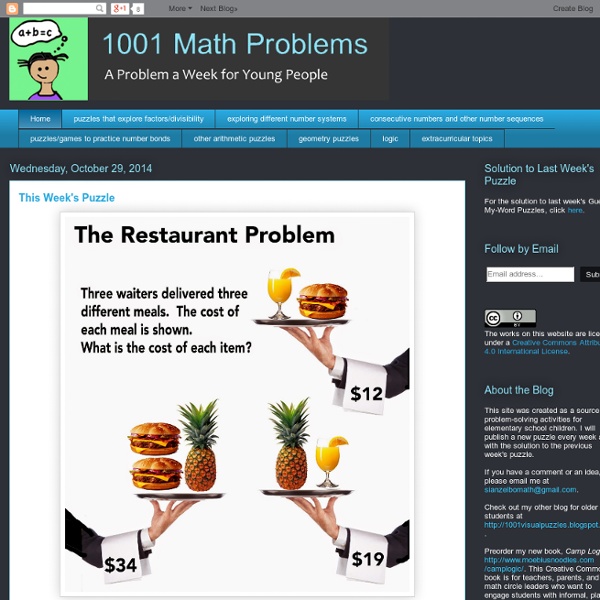
1001 Visual Puzzles Search Properties Everywhere Pre-K-2 This lesson captures students’ interest, provides a review of the primary unit objectives, and assesses students’ prior knowledge. This experience focuses students’ attention on the attributes of objects and rules for sorting them while building vocabulary for describing attributes and for classifying objects. Button Trains In this lesson, students describe order by using vocabulary such as before, after, and between. More and More Buttons Students use buttons to create, model, and record addition sentences. Numbers Many Ways Students work with subtraction at the intuitive level as they explore number families and ways to decompose numbers to 10. Lost Buttons In this lesson and the following one, students investigate subtraction more directly, beginning with the easier “take away” mode. Shirts Full of Buttons Students explore subtraction in the comparative mode by answering questions of “How many more?” Looking Back and Moving Forward Pre-K-2, 3-5, 9-12
Daily chart: The hidden cost of Gangnam Style What humanity could achieve if it weren’t galloping in front of computer screens THE loony music video “Gangnam Style” surpassed two billion views on YouTube this week, making it the most watched clip of all time. At 4:12 minutes, that equates to more than 140m hours, or more than 16,000 years. Problem-Based Lesson Search Engine | Robert Kaplinsky - Glenrock Consulting Skip to content Click here to receive email updates! robert@robertkaplinsky.com Problem-Based Lesson Search Engine January 18, 2014 Share This If you think others need to see this, share it on one of the sites below by clicking on the button. This search engine searches all of the sites below to quickly help you find a problem-based lesson (also called 3-Act Task, mathematical modeling, or application problem): The links below are the pages that are being searched by the search engine: There must be many great sources of lessons that I am missing. If you think others need to see this, share it on one of the sites below by clicking on the button. Follow Me Keep the conversation going. 55 Comments Wow! Leave a Reply
Disegno o costruzione geometrica? Esiste una differenza sostanziale? Sembra proprio di si! Wikipedia ci dice che con il termine costruzione geometrica si indicano l’insieme di operazioni di disegno finalizzate a risolvere molteplici problemi geometrici. Ci avete capito qualcosa? Utilizzando questi strumenti siamo in grado di fare disegni geometrici. Allora, sappiamo che il quadrato è una figura geometrica, ma per non partire in modo del tutto sprovveduto e disorganizzato, dobbiamo rispondere ALMENO ad una delle due domande: Quali sono gli elementi che compongono un quadrato? Cominciamo ad esempio scegliendo di rispondere alla prima domanda: in un quadrato ci sono 4 punti, 4 segmenti e 4 angoli (dimenticato qualcosa?). Rispondendo alla prima domanda, nell’applet, ho disegnato il quadrato n°1. E arriva Lui, il ragazzo sveglio: “Ok, però hai fatto il furbo! OK, abbiamo stabilito che va data una risposta corretta alla seconda domanda: che cos’è un quadrato? OK, ci manca l’ultima costruzione. E tu cosa vuoi fare?
Math Worksheets | Dynamically Created Math Worksheets Would You Rather? | Asking students to choose their own path and justify it Math Fraction Game With this math fractions game, your kids can learn to add fractions the fun way. First, download and print the math fraction game cards, preferably onto cardboard, and in color if you can. You'll find that there are actually three types of cards in the pack. First, there are blue cards with all the fractions with denominators 2, 3, 4, 5, 6, 10, 12 and 15. Well, not all the fractions, of course! Well, with a set of fraction cards, there's a bunch of math fraction games you could teach your kids to play. If you leave out the wild cards, you'll have a set of 98 cards. However, when I made these cards, I was thinking of a more complex game (still simple enough) that will help teach kids how to add and subtract fractions too! So here it is... The goal... To make sets of cards which add up to 1. At the start... Give each player a piece of paper and a pencil. On each player's turn... The player draws two cards. The end of a round... When a player finishes all his or her cards, the round is over.
Geometry: An Interactive Journey to Mastery Today, geometry’s core skills of logic and reasoning are essential to success in school, work, and many other aspects of life. Like other math fields, geometry teaches us how to think. It leads students to uncover new truths based on already established ideas and facts. This systematic way of thinking is essential in many fields. In fact, the great Greek scholar Euclid demonstrated just how much you can do with logic. In short, geometry is among the great intellectual feats of humankind. Botanists use the geometry of triangles to estimate the heights of trees. With its powerful blend of intellectual accomplishment and practical application, it’s no wonder that most schools consider geometry a core subject. Professor Tanton’s excellent teaching style makes the course ideal for those students who have ever believed they’re “not good at math” or have had challenges understanding geometry in the past. A Different Way to Learn Geometry In the first part of the course, students
dy/dan Mathematics This page is a list of mathematics articles in Mathematics and Multimedia. You might also want to check the Post List page which contains the newest posts in major categories. The complete list of posts arranged by month can be found in the Archives page. Complex Numbers Series The Divisibility Series Area Tutorial Series Curve Sketching (New!) The Calculus Primer Series Experimental and Theoretical Probability Series MATH LITE (Fun, Games, Puzzles, Trivia) MISCELLANEOUS Math Word Problem Solving Series Age Problems Motion Problems Vedic Mathematics (by Sanjay Gulati) Paper Folding Set Theory General Information/Miscellany