

Graphic Organizer Worksheets Advertisement. EnchantedLearning.com is a user-supported site. As a bonus, site members have access to a banner-ad-free version of the site, with print-friendly pages.Click here to learn more. (Already a member? Graphic Organizers Graphic organizers (some of which are also called concept maps, entity relationship charts, and mind maps) are a pictorial way of constructing knowledge and organizing information. Increasing Understanding by Creating Graphic Organizers: The process of converting a mass of data/information/ideas into a graphic map gives the student an increased understanding and insight into the topic at hand. The creation of graphic organizers also helps the student generate ideas as they develop and note their thoughts visually. Uses of Graphic Organizers: Graphic organizers can be used to structure writing projects, to help in problem solving, decision making, studying, planning research and brainstorming.
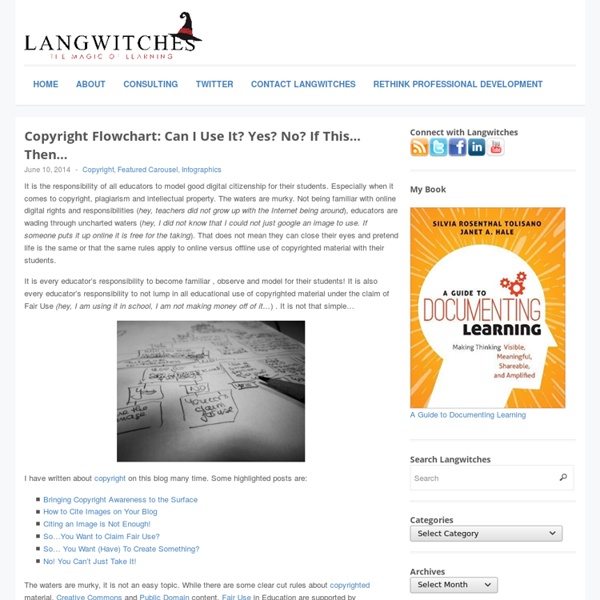
How to Cite Images on Your Blog | Silvia Tolisano- Langwitches Blog When using Copyrighted work with written permission from owner… Used with permission from “name” , URL link to original source and or owner online presence. Ex. Used with permission from Silvia Tolisano When using images licensed under Creative Commons… Image licensed under Creative Commons by “name or username “. Ex. When using an image falling under Public Domain, you are not required to cite the creator/owner of the work. Image from Public Domain by “name”. When using images claiming Fair Use, you have to give full credit to original creator , with name as well as link to original source (ex. Image used, claiming Fair Use. Click to enlarge poster. Related Teaching Students About Using Images off Wikipedia We want our students to start creating... 1. In "Digital Images" Citing an Image is Not Enough! 1. In "Copyright" So... 7.
You are missed — Better Humans “Something feels missing from my life but I can’t quite put my finger on it.” I can’t tell you how many times I hear some variation of that every week. (It’s a lot.) I hear it from tech entrepreneurs who are on the verge of burn out, writers who are experiencing a temporary block, photographers who are making a ton of money working with big brands, and designers who have a full plate of client work. I hear it from friends at Facebook, at Google, and at Apple. After listening to unique story after story, and each person attempting to describe what is happening in their life, it dawned on me that what was missing from every single story was very simple. “You are missing from your own story,” I said aloud to my friend the other day. He paused mid-sentence and thought about my observation. “I have stopped writing,” he said. “How much time do you spend with yourself?” “Close to none,” he said. “You are disconnected from yourself,” I said. 1) Morning pages. This morning I feel… My soul longs to…
An Atlas of Cyberspaces- Historical Maps USENET in 1981. The topology of the BITNET in 1981 (partial map) The NSFNET infrastructure and topology in 1991. (Source : NSFNET postscript maps from | Introduction | Whats New | Conceptual | Artistic | Geographic | Cables & Satellites | Traceroutes | | Census | Topology | Info Maps | Info Landscapes | Info Spaces | ISP Maps | Weather Maps | | Wireless | Web Site Maps | Surf Maps | MUDs & Virtual Worlds | Historical | (© Copyright - Martin Dodge, 2007) Citing an Image is Not Enough! | Langwitches Blog I am thrilled to see so many students creating blog posts and going BEYOND “writing” text made up letters, words, sentences and paragraphs. Being able to “read” and “write” in other media is part of becoming fluent in media literacy. In addition to media literacy, knowing your rights and responsibilities as an ethical digital citizen is a vital part of participating in our digital world. My frustration with educators not knowing about observing copyright when producing content online was expressed in a previous post titled No! Would it be helpful to create “What if scenarios” for teachers and students to follow? Take a look at the example below: A student used an image for his blog post. When we follow the link, we are taken to Flickr, an image sharing platform. The student does not have permission by the owner to copy the image and place it on his/her blog. What should the student do to practice and act like a responsible and ethical digital citizen? Like this: Like Loading...
odrive - Sync all cloud storage in one place Humanize Your Data Normally when we think of data a series of “0s” and “1s” come to mind, or perhaps the twelve digits of an IP address come to mind. Let’s face it, when we normally think of data it’s normally viewed as a series of cold, hard facts. Jer Thorp wants us to change that. Yesterday, data artist in residence at The New York Times, Jer Thorp, gave a speech for TedX, independently organized Ted events, urging us to try and humanize our view of data. What does humanizing data really do? “Because these are our histories…but if we can do this with other data, we can put data into a human context, I think we can change a lot of things. This has the potential to totally shift the way we view data and issues around it and that is what I find particularly intriguing. Related
No! You Can’t Just Take It! | Silvia Tolisano- Langwitches Blog No! You can’t just take it! No! No! No! No! No! No! By “it”, I mean my work, which includes images, visuals, infographics, infoflyers, blog posts, how to guides, text, jpgs, videos, pdfs, etc. My work is licensed under Creative Commons license. On every page on Langwitches (in the footer), you will see the above icon stating Licensed under a Creative Commons Attribution-NonCommercial-ShareAlike 3.0 Unported License. This means, I support collaboration, remixing, building upon and sharing my work AS LONG AS the following restrictions ATTRIBUTION give attribution to me as the original creator (and if I used and credited other work licensed under CC, please give these creators credit to)NON-COMMERCIAL do not use my work in any shape or form to make money, include in a website, book or other form where you receive monetary contributions/reimbursements/etc.SHARE ALIKE if you use my work, you agree to also share your work under the same Creative Commons license terms. Is it: Ignorance? Related
Occam's razor - Wikipedia Philosophical problem-solving principle In philosophy, Occam's razor (also spelled Ockham's razor or Ocham's razor; Latin: novacula Occami) is the problem-solving principle that recommends searching for explanations constructed with the smallest possible set of elements. It is also known as the principle of parsimony or the law of parsimony (Latin: lex parsimoniae). Attributed to William of Ockham, a 14th-century English philosopher and theologian, it is frequently cited as Entia non sunt multiplicanda praeter necessitatem, which translates as "Entities must not be multiplied beyond necessity",[1][2] although Occam never used these exact words. Popularly, the principle is sometimes paraphrased as "of two competing theories, the simpler explanation of an entity is to be preferred Formulations before William of Ockham [edit] William of Ockham (circa 1287–1347) was an English Franciscan friar and theologian, an influential medieval philosopher and a nominalist. Ludwig Wittgenstein
How I Mind Map I’ve been working on a mind mapping post for some time now. It started as a Macworld piece, but I took too long… ▼ Table of Contents Why mind map? When I need to get an idea out of my head, or I need to take that idea and flesh it out, I turn to mind maps. Some people scratch notes, others create outlines, but mind mappers like myself find that the format of a mind map is the most conducive to brainstorming. Outlining is rigid and always makes me feel like things need to be in order. I like mind maps because they let me think non-linearly and because they allow ideas to “grow” in an organic fashion (see Tony Buzan and his “radiant thinking” ideas). With a mind map, scattered thoughts begin to solidify before my eyes. Mind maps are also an excellent overview of my thought process. The terms These are the primary terms I’ll be using throughout this post. Map A single Main Topic and its children. Main Topic The central concept or subject of the map. Node/Topic Parent Child Sibling Notes/Callouts Sort