

Aromatherapy To Fight Winter Blues Winter can be a gloomy time. It can feel very long, and the lack of daylight combined with holiday stress can get some people pretty down. What’s interesting is that certain aromas or scents have been known to help lift your spirits during the winter blahs. How Does It Work? Our sense of smell is very powerful, and can have a profound impact on our feelings. Of course, you ultimately smell with your brain, and it’s this scent-brain connection that aromatherapy seeks to tap into. Studies have shown that certain smells actually affect brain wave activity. What Scents Are Best for Winter Blues? To help combat the feelings of melancholy associated with winter, there are certain “sunny” scents that may lift your mood. Other popular essential oils with uplifting qualities include the mints, particularly peppermint and spearmint. You can blend these in various proportions to achieve a pleasing, bright scent. What Are the Best Sources of Scent?
George Frideric Handel George Frideric Handel (/ˈhændəl/;[1] German: Georg Friedrich Händel; German pronunciation: [ˈhɛndəl]; (1685-02-23)23 February 1685 – 14 April 1759(1759-04-14)) was a German-born Baroque composer famous for his operas, oratorios, anthems and organ concertos. Born in a family indifferent to music, Handel received critical training in Halle, Hamburg and Italy before settling in London (1712), and became a naturalized British subject in 1727.[2] By then he was strongly influenced by the great composers of the Italian Baroque and the middle-German polyphonic choral tradition. Early years[edit] Händel-Haus (2009) – birthplace of George Frideric Handel Entrance of Teatro del Cocomero in Florence From Halle to Italy[edit] Move to London[edit] In 1712, Handel decided to settle permanently in England. Cannons (1717–18)[edit] Royal Academy of Music (1719–34)[edit] In 1727 Handel was commissioned to write four anthems for the Coronation ceremony of King George II.
Camille Saint-Saëns Camille Saint-Saëns Early years and education[edit] Saint-Saëns was born in Paris, France, on 9 October 1835. His father, a government clerk, died three months after his birth. He was raised by his mother, Clémence, with the assistance of her aunt, Charlotte Masson, who moved in. In the late 1840s, Saint-Saëns entered the Conservatoire de Paris, where he studied organ and composition, the latter under Fromental Halévy. Middle years[edit] Saint-Saëns early in his career. From 1861 to 1865, Saint-Saëns held his only teaching position as professor of piano at the École Niedermeyer, where he raised eyebrows by including contemporary music — Liszt, Gounod, Schumann, Berlioz, and Wagner — along with the school's otherwise conservative curriculum of Bach and Mozart. Saint-Saëns was a multi-faceted intellectual. In 1870, the Franco-Prussian War, in spite of lasting less than 10 months, left an indelible mark on the composer. Later years[edit] Camille Saint-Saëns, 1915 Reputation[edit]
Uses for Peppermint Oil – Ways to Use Peppermint Oil – Essential Oils Uses for Peppermint Oil Like many essential oils, Peppermint Oil has many uses for your health and around your home. Today we will talk about a few ways to try it and make sure to share your tips on the best uses for Peppermint Oil in the comments! Peppermint Oil is the oil harvested from the peppermint plant. Make Your Own Peppermint Oil Harvest the peppermint leaves from your plant in the early morning. Now that we know how to make peppermint oil, let's learn about all the things we can do with it! **Note: Like with all essential oils, test first to make sure you are not allergic, do not use on young children, do not use if pregnant, and do not use if you have certain medical conditions. Uses for Peppermint Oil Around the Home Keep ants and spiders out of your home by making a barrier of peppermint oil. Uses for Peppermint Oil for Health and Beauty Help bring down nausea or indigestion. More Uses for Peppermint Oil Uses for ChivesUses for CilantroUses for Mint
Henry Purcell Henry Purcell (/ˈpɜrsəl/;[1] c. 10 September 1659[2] – 21 November 1695), was an English composer. Although incorporating Italian and French stylistic elements into his compositions, Purcell's legacy was a uniquely English form of Baroque music. He is generally considered to be one of the greatest English composers; no other native-born English composer approached his fame until Edward Elgar. Early life and career[edit] Purcell is said to have been composing at nine years old, but the earliest work that can be certainly identified as his is an ode for the King's birthday, written in 1670.[9] (The dates for his compositions are often uncertain, despite considerable research.) In 1679, he wrote some songs for John Playford's Choice Ayres, Songs and Dialogues and also an anthem, the name of which is not known, for the Chapel Royal. Later career and death[edit] Purcell's manuscript copy of When on my sick bed I languish (c. 1680) 17th-century etching of Purcell In the name of God Amen.
Earth Clinic: Folk Remedies & Holistic Cures Glendale College Library - Ezproxy Login In order to access library databases from home/remotely you must be a currently enrolled GCC student. To login to databases from off-campus, enter your student ID number in the Username box and enter your six-digit GCC birthdate (mmddyy format) in the Password box. For Example, February 14, 1975 would be 021475. If you are using a personal firewall, you may need to change its configuration to allow the required cookie to be set. Students: For the username, enter your student ID number. Faculty and Staff: Use your GCC e-mail ID and password. Troubleshooting Tips Click here to check if your web browser has cookies enabled. Licensing agreements for online databases require that access be extended only to currently enrolled students, faculty and staff.
Everyday Tricks Everyone Should Know Tricks every woman should know…Nik The last several are a few of my own I’ve discovered… Peel a banana from the bottom and you won’t have to pick the little ‘stringy things’ off of it. Take your bananas apart when you get home from the store. If you leave them connected at the stem, they ripen faster. Store your opened chunks of cheese in aluminum foil. It will stay fresh much longer and not mold! Peppers with 3 bumps on the bottom are sweeter and better for eating. Peppers with 4 bumps on the bottom are firmer and better for cooking. Add a teaspoon of water when frying ground beef. It will help pull the grease away from the meat while cooking. To really make scrambled eggs or omelets rich add a Couple of spoonfuls of sour cream, cream cheese, or heavy cream in beat them up. For a cool brownie treat, make brownies as directed. Leftover snickers bars from Halloween make a delicious dessert. chop them up with the food chopper. Peel, core and slice a few apples. for 15 minutes!!! Easy Deviled Eggs gone.
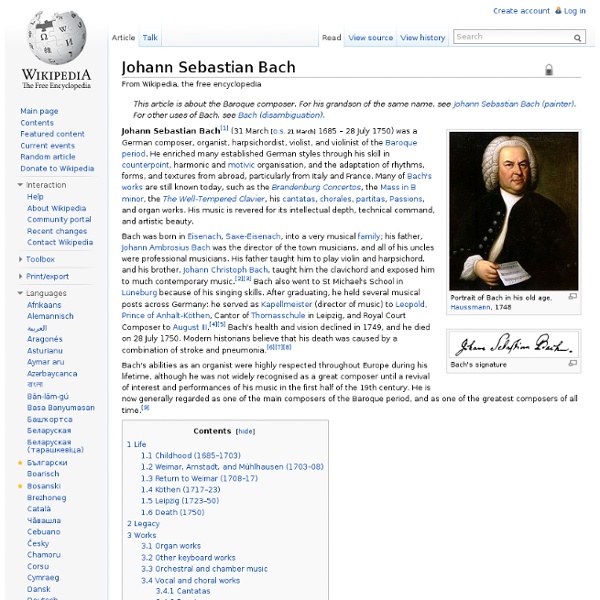
Baroque What is baroque music? First things first though! How on earth do you say this funny word ‘baroque’? ‘Baroque’ is said like ‘Ba-rock’. Think of a sheep sitting on a rock. Then you will know how to say it! So now we know how to say it, what is it? The greatest baroque composer was Johann Sebastian Bach (1685–1750). Other famous baroque composers include It is important to remember that baroque music is a style of music. Well, like classical music in general, it is not easy to describe (see the Classical Music page). If you listen to a lot of baroque music you will begin to recognise the style, even if you can’t describe it. Lots of ‘twiddly bits’ (as my mum calls them!). I think that will do. 4th and 5th movements of Bach’s Orchestral Suite No. 3 Picture credits: An example of baroque art. Video credits: Bach – Bwv1068 Orchestral Suite – 04-05 – Bourrée-Gigue.
How To Make Your Own Wicks For Candles Candle making is a popular crafting activity. They make fun and unique gifts, are customizable and give of lovely scents when lit. Many crafters create their own candles but wicks are often purchased at a hobby store. For a completely handmade candle, use just a few steps and simple materials. Things You'll Need Cotton Kite Strings Or TwineClothespins And LineTable SaltScissorsOld NewspapersPaper And Binder Clips show more Dissolve two tablespoons of table salt and four tablespoons of borax in 1-1/2 cups of warm water. Soak a 1-foot length of regular cotton kite string or twine in the solution for 15 minutes. Hang the string with a clothespin for five days to be sure it is completely dry. Use a paper clip to dip the string in melted wax three or four times, coating it completely. Store wicks rolled up in a newspaper. Add only one chemical for color variation.
About the Baroque Period - Music of the Baroque Derived from the Portuguese barroco, or “oddly shaped pearl,” the term “baroque” has been widely used since the nineteenth century to describe the period in Western European art music from about 1600 to 1750. Comparing some of music history’s greatest masterpieces to a misshapen pearl might seem strange to us today, but to the nineteenth century critics who applied the term, the music of Bach and Handel’s era sounded overly ornamented and exaggerated. Having long since shed its derogatory connotations, “baroque” is now simply a convenient catch-all for one of the richest and most diverse periods in music history. Select a box below to hear a representative sample of music from that time period.