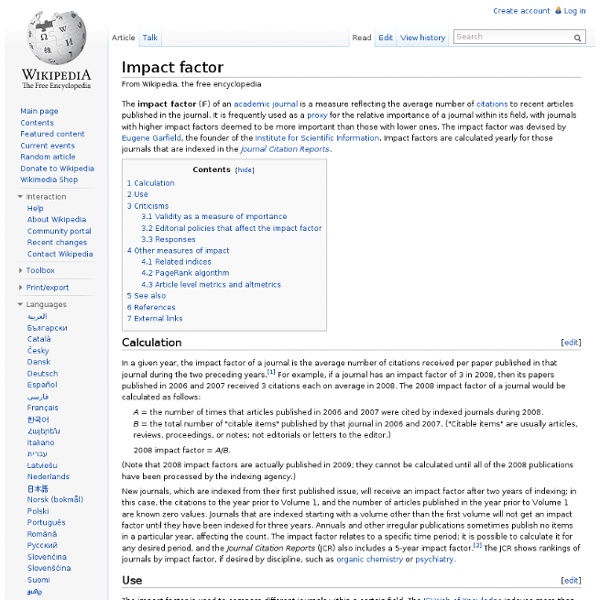
Impact factor

Calculation[edit] In any given year, the impact factor of a journal is the average number of citations received per paper published in that journal during the two preceding years.[1] For example, if a journal has an impact factor of 3 in 2008, then its papers published in 2006 and 2007 received 3 citations each on average in 2008. The 2008 impact factor of a journal would be calculated as follows: A = the number of times that articles published in that journal in 2006 and 2007, were cited by articles in indexed journals during 2008. B = the total number of "citable items" published by that journal in 2006 and 2007. 2008 impact factor = A/B. (Note that 2008 impact factors are actually published in 2009; they cannot be calculated until all of the 2008 publications have been processed by the indexing agency.) Use[edit] The impact factor is used to compare different journals within a certain field. Criticisms[edit] Numerous criticisms have been made of the use of an impact factor. Responses[edit]
ACM Digital Library
Springer Realtime
Most wanted
Google Scholar
Change of character
Crowdsourcing
Crowdsortium
Related:
Related:
Journal Impact Factor: a measure of the academic status of a journal based on the number of citations received by articles published in that journal.
Found in: 2012 - (Oliver) Succeeding With Your Literature Review by raviii Apr 10
You will also need to consider the 'impact factor' of the journal. Journal Impact Factors (JIF) are measured, usually over a year, as the ratio of the number of times papers in that journal are cited (referenced by other authors) divided by the total number of papers published in that journal.
Thus journals with the highest impact factors are generally thought of as being the most prestigious. by raviii Jun 8
