

What Would Real Democracy Look Like? | New Compass Rather than aiming for yet another change of politicians and parties in power, why not aim for a change of the political system itself? As representative democracy sinks into crisis, we need to go back to democracy in its original meaning as rule of the people. It is time to imagine what real democracy would look like and to create institutions and mechanisms that could be the building blocks of genuinely democratic societies. Today, democracy is equated with representative government based on free elections of political elites that rule on the citizens’ behalf. But this system is now in a deep crisis. A real democracy, however, is a direct and participatory democracy, in which all citizens have the possibility and the right to participate in the decisions that affect our lives and our communities. Participatory Budgeting The popular assembly where citizens meet face to face to discuss, vote and make collective decisions is the original form of democracy. Communal Councils
20 Very Interesting Photos From The '30s I love old photos because this is the only way I can really see our history. I like to check out the details such as clothing, decorations or food products because is not only interesting to see their habits but also how these evolved during decades or centuries. The images below were taken in the ’30s in various circumstances from an ice-skating scene and all the way to a legendary image with Stalin fooling around. I hope that you like them as much as I do. Young skater with safety cushion Dutch boy with a pillow strapped on his backside in order to soften the falling on ice while skating. Cabaret Dancers Cabaret dancers wearing fake mustaches. Einstein with Einstein Puppet The photo was taken by Harry Burnett at Cal Tech in Pasadena where Albert Einstein was teaching. Public Call A photograph of the making of a programme by the BBC about driving errors, taken by Saidman in 1939 for the Daily Herald. Stalin pulling a face at his bodyguard Stalin is captured in this photograph by Lt. Baby Cage
The 'Endless City' Project The 'Endless City' project would see a giant 300m skyscraper built in London with its own complete ecosystemBuilding would consist of intertwining ramps leading through business, shopping, entertainment and residential areasIncludes plans for 'huge' parks and technology aimed at reducing environmental impact and increasing sustainability By Julian Robinson for MailOnline Published: 10:09 GMT, 27 August 2014 | Updated: 13:16 GMT, 27 August 2014 These are the ambitious plans which suggest skyscrapers of the future may one day house an entire city. This 'Endless City' project would see a giant skyscraper as tall as The Shard in London, built with its own complete ecosystem featuring offices, shops and 'huge' parks. London is the proposed city for the mixed-use tower, which would include interlinking ramps connecting different sections of the structure to create a 'vertical city' housing thousands. Scroll down for video...
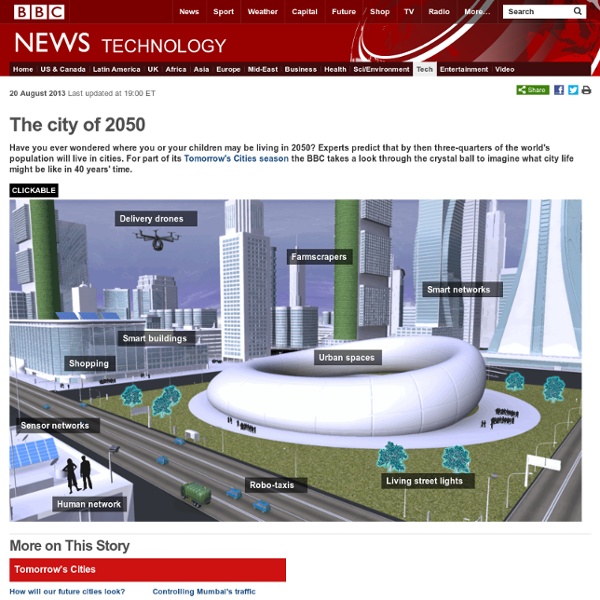
Tomorrow's cities: Do you want to live in a smart city? How do you fancy living in a city with which you can interact? A city that acts more like a living organism, a city that can respond to your needs. Around the world such cities are already being built, from Masdar in Abu Dhabi to Songdo in South Korea. Now the chaotic city near you may be in line for a makeover. In the future everything in a city, from the electricity grid, to the sewer pipes to roads, buildings and cars will be connected to the network. But how do we get to this smarter future. And is it a future we even want? Technology firms such as IBM, Siemens, Microsoft, Intel and Cisco are busy selling their software to solve a range of city problems, from water leaks to air pollution to traffic congestion. In Singapore, Stockholm and California, IBM is gathering traffic data and running it via algorithms to predict where a traffic jam will occur an hour before it has happened. IBM argues that it does get citizens involved in its smart city projects. It worries Mr Townsend.
Tras el decrecimiento, el transicionismo Ser ecologista, ya no basta | INFOKRISIS, el blog de Ernest Milà Infokrisis.- Hace solo un año Europa vivía la novedad del “decrecimiento”. En todos los ambientes intelectuales y no solamente en el ecologismo, se debatía sobre el “decrecimiento”. En agosto la moda llegó a España y los dos portavoces del progresismo a este lado de los Pirineos (El viejo Topo y Le Monde Diplomatique) dedicaron amplios artículos a esta corriente del ecologismo radical. Cuando el debate todavía en fase de introducción en España, ha sido rebasado por el llamado “movimiento de transición”. Pero ¿qué diablos es el decrecimiento? En los años 70, el ecologismo empezaba a estar sólidamente asentado en el mundo anglosajón y en el área germánica; entonces aparecieron las primeras tesis del decrecimiento que sostenían la inviabilidad de un crecimiento continuo de la producción económica y de la población. Existen distintas apreciaciones sobre si el “pico de Hubert” se ha alcanzado ya o se alcanzará en el 2040. Los tres principios del decrecimiento ¿Tiene futuro el ecologismo? 1. 2.
Urban Omnibus | 50 Ideas for the New City The Omnibus is all about ideas. From the beginning, Urban Omnibus has been a showcase of good ideas for the future of cities, conceived in the public interest and tried and tested in the five boroughs of New York. So, we have decided to surface some of the ideas that have appeared on Urban Omnibus over the past two years and broadcast them around the city. In April 2011, we released a series of Idea Posters, pasted on fences, scaffolds and storefronts from Jamaica, Queens, to the Upper West Side of Manhattan, and many places in between. Below you will find 50 ideas for New York already explored on Urban Omnibus and a space for you to share your own.
The Future is Green: 12 Visionary Architecture Concepts With looks straight out of a sci-fi movie, these 12 tall towers and super-complexes hint at the architecture of a greener future where solar-powered skyscrapers hold urban theme parks and self-sufficient mini-cities running on algae soar among the clouds. While some of these will forever remain curious concepts, others are actually slated for construction – and you’ll never guess which is which based on the incredible illustrations. Tianjin Eco City (images via: inhabitat) This one definitely looks like science fiction, but surprisingly, the Tianjin Eco City is slated for construction in the next few years with a projected completion date of 2020. 350,000 residents will occupy this showcase for new green technologies, which will serve as a model for other new cities in China. Vertical Theme Park of the Future (images via: evolo.us) What if all of the attractions currently featured in the sprawling footprint of Disney World were compacted into sky-high towers? Weave Housing It’s an airship!
WRAP/BIFFA Mixed Plastics Recycling Facility Putin advierte a Occidente que no tome medidas unilaterales sobre Siria Durante la entrevista el presidente ruso reiteró que todavía no hay "datos exactos" sobre el supuesto ataque químico en Siria. "Creemos que como mínimo hay que esperar los resultados de las investigaciones realizadas por la comisión de inspectores de la ONU", afirmó. Asimismo, insistió en que considera "absurdo" que las fuerzas de Al Assad, que actualmente están atacando y logrando victorias, empezaran a emplear armas químicas sabiendo que esto podría conllevar nuevas sanciones e incluso una acción militar contra ellas. Y si se determina que fueron los rebeldes quienes emplean armas de destrucción masiva, ¿qué va a hacer con ellos EE.UU.? "Nos convencerá una investigación profunda y la presencia de datos que sean evidentes y que demuestren claramente quién empleó [armas químicas] y qué sustancias se usaron", dijo Putin. "Después de esto estaríamos dispuestos a actuar de la manera más firme y seria", agregó. Posible ataque de EE.UU. contra Siria y posturas de otros países
Revenu social, gratuité et monnaie locale : comment passer d'une économie globalisée à une économie locale et solidaire Revenu universel, salaire citoyen, allocation d’existence … il existe de nombreux termes permettant de décrire la socialisation des salaires et des revenus. Le débat pour un revenu pour tous sans condition est souvent associé à plusieurs problématiques : si nous n’avons plus besoin de travailler pour vivre alors qui fera les tâches indispensables à notre société ? Un tel revenu ne remet pas en cause notre société de consommation, ne va-elle pas encourager à aller vers encore plus de production ? On voit à travers ces questions qu’on ne peut pas aborder le revenu social (nous utiliserons ce terme dans la suite du texte), sans aborder la problématique de la monnaie, de l’accès aux biens et services (gratuité ou accès pour tous) et de la relocalisation de l'économie. Il ne faut pas oublier également que si notre économie engendre autant de violence aujourd’hui, c’est qu’elle agrège via l’argent et la dette d'énormes puissances et pouvoirs qui subsistent dans notre société. 1. 1.1. 1.2.