background preloader

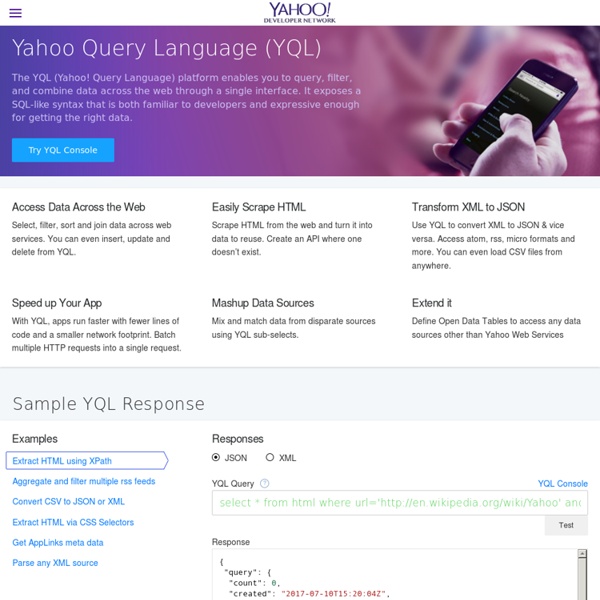
Query Language

Query Language

50 Great Examples of Data Visualization Wrapping your brain around data online can be challenging, especially when dealing with huge volumes of information. And trying to find related content can also be difficult, depending on what data you’re looking for. But data visualizations can make all of that much easier, allowing you to see the concepts that you’re learning about in a more interesting, and often more useful manner. Below are 50 of the best data visualizations and tools for creating your own visualizations out there, covering everything from Digg activity to network connectivity to what’s currently happening on Twitter. Music, Movies and Other Media Narratives 2.0 visualizes music. Liveplasma is a music and movie visualization app that aims to help you discover other musicians or movies you might enjoy. Tuneglue is another music visualization service. MusicMap is similar to TuneGlue in its interface, but seems slightly more intuitive. Digg, Twitter, Delicious, and Flickr Internet Visualizations

Introduction à Yahoo Pipes Bonjour et bienvenue sur Veille et Recherche, le blog qui vous aide à trouver. Si cet article vous plait, n'hésitez pas à vous abonner au flux RSS pour recevoir automatiquement tous les articles du blog. Par ailleurs, Veille et Recherche a également une page Facebook, pour nous y retrouver, rendez vous ici Cet article est le numéro 1 (parmi 4) de la série Yahoo Pipes Devant ce flux incessant d’informations en tous genres (et de qualité souvent très variable), il y a encore peu d’outils (qui plus est gratuits) pour faire le tri et ne suivre que les nouvelles ou les articles réellement pertinents. Yahoo Pipes est un service finalement encore assez peu connu, lancé en 2007, avec pour objectif de trier, filtrer et agréger la plupart des informations disponibles sur internet. Rôle et utilisation de Yahoo Pipes Pour imager le rôle de Yahoo Pipes, voici un petit visuel, plus parlant qu’un long discours : Transformation, tri et filtre des actualités par Yahoo Pipes Création d Un premier exercice

Find Latitude and Longitude Data Incubator Pipe.Yahoo un tutorial pour créer de la veille techno personnali J’ai écrit récemment un article sur “Astuce précieuse pour devenir un crack de n’importe quel sujet “ Cet asctuce est certes précieuse, mais si on veut changer de mot pour sa veille technique, il faut se retaper un à un les mots dans chaque lien RSS. Pour ceux qui n’ont pas lu l’astuce, je conseille d’aller y faire un tour. Dans cet article il s’agissait de faire une veille techno sur le microblogging et j’avais listé une série de lien RSS à taper dans un agrégateur de flux x ou y delicious: (français) : anglais : : L’idée était bonne mais un peu brute dans le sens où il faut se retaper les lignes pour changer de nom (ok c’est pas la mort). Je propose dans ce tutorial d’automatiser le process avec yahoopipe. Des questions?

A Brief Introduction to REST You may or may not be aware that there is debate going on about the “right” way to implement heterogeneous application-to-application communication: While the current mainstream clearly focuses on web services based on SOAP, WSDL and the WS-* specification universe, a small, but very vocal minority claims there’s a better way: REST, short for REpresentational State Transfer. In this article, I will try to provide a pragmatic introduction to REST and RESTful HTTP application integration without digressing into this debate. I will go into more detail while explaining those aspects that, in my experience, cause the most discussion when someone is exposed to this approach for the first time. Key REST principles Most introductions to REST start with the formal definition and background. Give every “thing” an ID I’m using the term “thing” here instead of the formally correct “resource” because this is such a simple principle that it shouldn’t be hidden behind terminology. Link things together

SweoIG/TaskForces/CommunityProjects/LinkingOpenData - ESW Wiki News 2014-12-03: The 8th edition of the Linked Data on the Web workshop will take place at WWW2015 in Florence, Italy. The paper submission deadline for the workshop is 15 March, 2015. 2014-09-10: An updated version of the LOD Cloud diagram has been published. Project Description The Open Data Movement aims at making data freely available to everyone. The goal of the W3C SWEO Linking Open Data community project is to extend the Web with a data commons by publishing various open data sets as RDF on the Web and by setting RDF links between data items from different data sources. RDF links enable you to navigate from a data item within one data source to related data items within other sources using a Semantic Web browser. The figures below show the data sets that have been published and interlinked by the project so far. Clickable version of this diagram. Project Pages The project collects relevant material on several wiki pages. Meetings & Gatherings LOD Community Gatherings See Also Demos 1.

Yahoo Pipes: Colonne vertébrale d’une plateforme de veille multilingue, performante et gratuite Voici l’article que j’ai publié dans l’ebook « Regards croisés sur la veille ». N’hésitez pas à commenter, critiquer et à me donner vos usages qui permettraient de compléter la méthode que je vous présente. N’oubliez pas que si Yahoo Pipes est la colonne vertébrale, le flux RSS est le système nerveux, l’idée est donc de couvrir l’ensemble du cycle de la veille avec ce format. Les outils ne l’intégrant ou ne pouvant le générer sont automatiquement écartés dans une optique de plateforme unique : La veille est un processus qui implique l’utilisation de renseignements accessibles au public afin d’apprendre diverses choses sur son environnement (ses concurrents, ses partenaires, ses fournisseurs, son cadre législatif, les innovations technologiques, les évolutions sociétales,…) Afin qu’ils soient utiles, ces renseignement doivent être transformés en informations qui éclaireront sur les menaces ou les opportunités. Processus habituellement présenté sous forme cyclique : Présentation de Yahoo!

Fusion Tables - Gather, visualize, and share data tables online Bust your data out of its silo! Get more from data with Fusion Tables. Fusion Tables is an experimental data visualization web application to gather, visualize, and share data tables. Visualize bigger table data online Filter and summarize across hundreds of thousands of rows. Two tables are better than one! Merge two or three tables to generate a single visualization that includes both sets of data. Make a map in minutes Host data online - and stay in control Viewers located anywhere can produce charts or maps from it. Visualize bigger table data online Import your own data Upload data tables from spreadsheets or CSV files, even KML. Visualize it instantly See the data on a map or as a chart immediately. Publish your visualization on other web properties Now that you've got that nice map or chart of your data, you can embed it in a web page or blog post. See how journalists and nonprofits around the world use Fusion Tables Two tables are better than one! Make a map in minutes Share that map!

Related:
