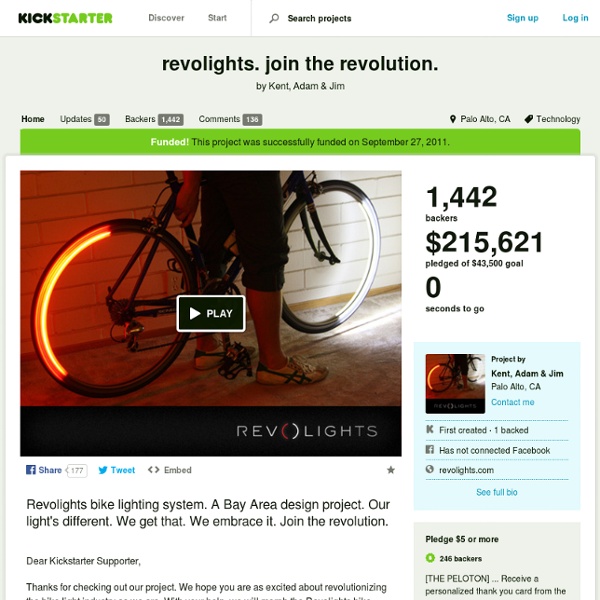
Revolights. join the revolution. by Kent, Adam & Jim
Remote-controlled fiber-optic Ceiling Light with Arduino
Mauro Alfieri, who wants to partecipate to our iniziative “TiDiGino Contest”, sent us his new application with Arduino to demonstrate his skills in this field: a Remote-controlled fiber-optic Ceiling Light. Mauro decribes himself:Today my work is focused on open-source systems, supporting networking (CCNA) and scripting language programming, in small and mid-sized companies that use Linux/Aix.Since I was 10 years old, I started mounting small electronic kits headed from my father and then – during my teens – by alone; recently I discovered Arduino that is for me the perfect combination in programming skills ( Bash, Csh, PHP, Perl, HTML, JavaScript, …) and electronics.So I began to study and to use Arduino to control LED lighting: finally, I built my first project: this Remote-controlled fiber-optic Ceiling Light. The Project The idea was to built a ceiling lamp that lights with a little surprise: a starry sky in my living room, even in the dark nights. Sketch: Download
Tutorial: Arduino and Push-wheel switches - Birds on the Wire
Welcome back fellow arduidans! In this article we go back to the past via the use of push-wheel/thumb-wheel switches with out Arduino systems. Here are some examples sourced from somewhere on eBay: For the uninitiated, each switch is one vertical segment and they can be connected together to form various sizes. You can use the buttons to select from digits zero through to nine. There are alternatives available that have a wheel you can move with your thumb instead of the increase/decrease buttons. The switch’s value is made available via binary-coded decimal. We have common on the left, then contacts for 1, 2, 4 and 8. By now you should realise that it would be easy to read the value of a switch – and you’re right, it is. From a hardware perspective, we need to take into account one more thing – the push-wheel switch behaves electrically like four normally-open push buttons. Example 40.1 The function readSwitch() is the key. So there you have it.
Detail pin out of several device
Focus stacking assistant for EOS cameras
Focus Stacking Assistant [EDIT] Here is a build log of mini-variant of this device.[/EDIT] One of my favorite shooting techniques is focus stacking. Many pictures on Circuits@Home site are made using this technique. I use Helicon Focus for post processing and even though this program has camera control built-in, it obviously requires a computer close to the object of shooting. Finished circuit can be seen on the title picture. The controller can also be set to “free run” mode. A single LED shows states of the controller. Even while connected to the camera, Focus Stacking Assistant allows camera buttons to function as usual. The control software is hosted on gitHub. The code has been extensively tested with Canon 5D Mark II and XSi cameras, it should work with any Canon DSLR with LiveView function. Oleg. No related posts.
DIY Stroboscope using a Three Phase DC Motor - Hacked Gadgets - DIY Tech Blog
We have seen some Stroboscopes in operation before, for this DIY Stroboscope that uses a Three Phase DC Motor which eLabs put together I think the actual stroboscope is the simpler part of the build. Since the project is using a three phase motor actually getting the motor to run is in my mind a huge part of the project. I love the reuse of computer related stuff in this build which is great since most of us normally have that stuff available for free! The code and schematics are available at the links below. Part 1 of the Project Build Part 2 of the Project Build Part 3 of the Project Build “With three driver inputs it is possible to create only two levels at the ends of the windings: LOW and HIGH.
Proximity USB Interface Reader For 125Khz EM4100 ID Cards
Place bid Review and confirm your bid Bid confirmation d h m s day hour hours FREE shipping See item description (Approximately ##1##) (Enter ##1## or more) (Enter more than ##1##) Your max bid: Increase max bid Confirm bid Cancel Change bid Close , you've been outbid. , you're the highest bidder on this item. , you're the first bidder. , you're currently the high bidder, but you're close to getting outbid. , this auction is almost over and you're currently the high bidder. , you're the high bidder, but the reserve price hasn't been met. Please enter your bid again. Please enter a valid number as the bid price. Enter an amount that is equal or greater than the minimum bid required. Maximum bids can't be lowered once they're submitted. Your bid is greater than or equal to the Buy It Now price.
Related:
Related:

