
A Town in New York Creates Its Own Department Store THE residents of Saranac Lake, a picturesque town in the Adirondacks, are a hardy lot — they have to be to withstand winter temperatures that can drop to 30 below zero. But since the local Ames department store went out of business in 2002 — a victim of its corporate parent’s bankruptcy — residents have had to drive to Plattsburgh, 50 miles away, to buy basics like underwear or bed linens. And that was simply too much. So when came knocking, some here welcomed it. Others felt that the company’s plan to build a 120,000-square-foot supercenter would overwhelm their village, with its year-round population of 5,000, and put local merchants out of business. It’s a situation familiar to many communities these days. It took nearly five years — the added to the challenge — but the organizers reached their $500,000 goal last spring. “Ooh, that’s nice,” said Pat Brown, as she held up a slim black skirt (price: $29.99). “It’s been a long process for all of us.
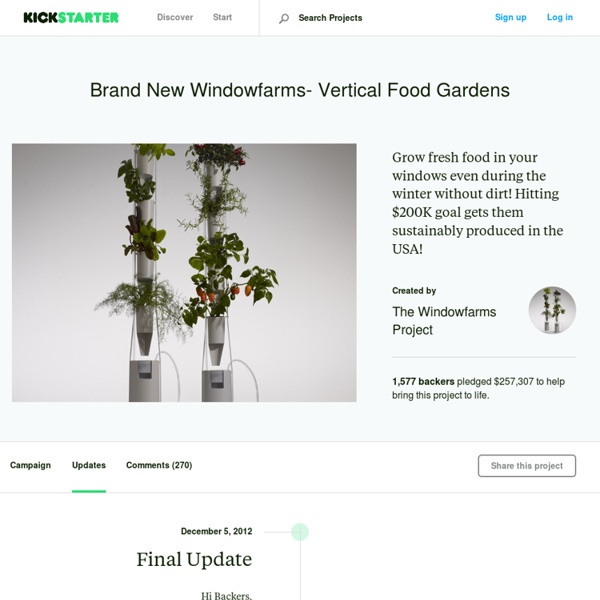
Windowfarms Now Available For Clumsy People With Short Attention Spans windowfarms/Promo image In 2009 Warren introduced us to Windowfarms, writing that they "take the vertical farming notion and make it both real, and more human scale." They are "a vertical, hydroponic garden for growing food in your windows." It became a phenomenon, an open source community of 25,080 windowfarmers around the world. Downloadable plans were provided so that handy types could build their own hydroponic farms out of PET bottles and aquarium pumps. It is a wonderful idea: Windowfarms take advantage of the natural light and climate of homes to grow fresh vegetables hydroponically, bathing the plants’ roots in nutrients from the sea, rather than in a traditional soil filled container. Windowfarms/Promo image But not all of us are handy with tools, have the time to put it together or want a bunch of DIY duct-tape covered water bottles hanging in our windows. We are excited to offer this simplified and lower cost option. Be sure to check out the Windowfarms community, too.
An Ingenious Way to Financially Bootstrap a Resilient Community Here's Marcin, a farmer scientist (not many left). In this video (click the link above if you can't see it embedded below), Marcin used Kicksarter to ask for $40,000 in support of his global village construction set project. Fortunately, he was successful and raised over $63,000. If you haven't heard of it before, the construction set project is a do-it-yourself lab/facility based on Marcin's farm in Mayesville Missouri. This project shows that it is possible to get meaningful funding for projects that matter. Is this a Backdoor Way to Financially Bootstrap a Resilient Community? I've featured Marcin's work on Global Guerrillas many times before, as a great example of open source innovation in hardware. With the addition of a fabrication facility and living units, this project is starting to sound like something even more ambitious. I'm not saying that Marcin's approach to building a resilient community is the only way, the best way, or the one I would choose.
Growing Medium by Professor Hydro There are probably hundreds of different kinds of growing medium, anything that a plant can grow in is considered a growing medium. There are manmade as well as organic (natural) mediums. Even plain old AIR can be an effective growing environment for roots. I have been asked many times what growing medium is the best. I have listed the most popular types of growing mediums below, click on the name to view details about the general use, advantages and disadvantages, and particular characteristics of the specified growing medium. Oasis cubes These lightweight pre-formed cubes are designed for propagation. The cubes are meant to be a starter medium and come in three sizes up to 2" x 2". Coconut Fiber Coconut fiber is rapidly becoming one of the most popular growing mediums in the world. Coconut fiber is also high in root stimulating hormones and offers some protection against root diseases including fungus infestation. Perlite Good old perlite! Vermiculite Soilless Mix(s)
Planet confirmed that could have water Kepler-22b is the first confirmed planet in the “habitable zone,” the area around a star where a planet could exist with liquid water on its surface, that has been discovered by NASA’s Kepler mission. The planet’s radius is about 2.4 times that of the Earth. It is located about 600 light years away. Its orbital period is shorter than that of the Earth: a "year" on Kepler-22b is 290 days instead of 365. There were two other planets confirmed this year by other projects in the habitable zone, but their stars are much cooler than our Sun, and their orbits are more like that of Venus or Mars, scientists say. Kepler-22b is 15% closer to its star than we are to the Sun. "If the greenhouse warming were similar on this planet and had a surface, its surface temperature would be something like 72 Fahrenheit, a very pleasant temperature here on Earth." Share your thoughts about searching for life on other planets The warmer a planet, the more evaporation of water there would be, Borucki said.
Frugal Hydroponics Watch flying robots build a 6-meter tower A quadrotor just before a precision landing on a brick (credit: Markus Waibel/ETH Zurich) ETH Zurich roboticists and architects used a fleet of quadcopters to build a 6 meter (20 feet) twisting tower out of 1500 foam bricks, IEEE Spectrum Automaton reports. The ceiling of the room where the assembly is taking place was equipped with a motion-capture system. First, the robots grab foam bricks from a special brick dispenser on the ground.
Study: Stem cells may aid vision in blind people The first use of embryonic stem cells in humans eased a degenerative form of blindness in two volunteers and showed no signs of any adverse effects, according to a study published by The Lancet on Monday. Publication in the peer-reviewed journal marks an important step for embryonic stem cells, which were hailed as a miracle cure after they were discovered in 1998 but then ran into technical and political hurdles. The results of the cautious first-stage test, designed to evaluate whether the treatment is safe, had been previously announced by Massachusetts biotech firm Advanced Cell Technology (ACT) Inc. The positive outcome in the United States opened the way to the first trials in Europe, which began on Monday. Embryonic stem cells are extraordinarily versatile cells, found in early-stage embryos, that can differentiate into any tissue of the body. Scientists have been hoping to turn them into replacement for tissue lost through disease or lost in accidents or war.