

Why Apple Pay Is a Huge Milestone in Payments Breakthrough A service that makes it practical to use your smartphone as a wallet in everyday situations. Why It Matters Credit card fraud damages the economy by raising the costs of goods and services. Key Players Apple Visa MasterCard Google When Apple Pay was announced in September, Osama Bedier was unimpressed. Yet when Apple Pay launched just a few weeks later, Bedier was a convert. Momentum for mobile payment technologies was building even before Apple Pay debuted last fall. None of the individual technologies is novel, but Apple turned them into a service that is demonstrably easier than any other. But even if Apple didn’t invent mobile payments, it has significantly enhanced them. That doesn’t mean most of us will be ditching our wallets and waving phones in every store in 2015—far from it. Still, Apple has done a lot of things right, suggesting that Apple Pay will turn out to be a milestone. As a result, Apple is now cementing standards for the payment industry. —Robert D.
Fantastic Programmable Goo Solves Difficult Math Problems You've got 20 U.S. cities to visit in one big trip. What's the shortest route you can take? No, this is not a problem from Ticket to Ride. It's the traveling salesman problem, a classic math puzzle that, as MIT Technology Review's arXiv blog explains, actually becomes computationally impossible to do by brute force, once the number of cities is high enough. There are just too many possible routes to calculate. Mathematicians have figured out some optimization equations to solve the problem, but none are perfect. The arXiv blog highlighted another way. The researchers wrote in their paper that they were inspired by slime mold, a single-celled organism that other researchers have shown is able to solve mazes and other math problems in its search for food. The researchers ran simulations of the goo on a computer, using numbers of cities that are computable by brute force, so they could compare their goo's solutions to perfect solutions. [MIT Technology Review]
Science Rap B.A.T.T.L.E.S. Bring Hip-Hop Into The Classroom : Code Switch This story comes to us from our friends at the science desk. They produced the 7-minute video documentary you see above. "Modern-day rappers — all they talk about is money, and all these unnecessary and irrelevant topics," says Victoria Richardson, a freshman at Bronx Compass High School. Richardson's rhymes tackle a much less-popular subject: DNA. Richardson and her teammates were finalists at the Science Genius B.A.T.T.L.E.S. "Science Genius is about harvesting the power of urban youth culture," says Christopher Emdin, a professor of education at Columbia University's Teacher's College who created the program. hide captionJayda Neor and Kephra Shaw Meredith, seventh-graders from KIPP Bridge middle school in Oakland, Calif., perform a rap song about the discovery of DNA's structure in front of a green screen. Tom McFadden The students researched and wrote rhymes about everything from gravity to evolution.
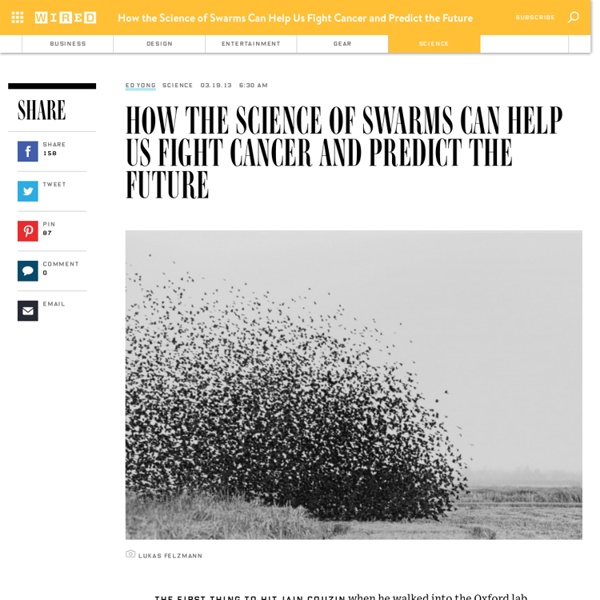
You May Have Been Born to Flock | Science More than 70,000 people will flood into the Superdome in New Orleans this weekend, while thousands more swarm through the city’s French Quarter. From a certain perspective, might those Super Bowl fans resemble, say, a herd of wildebeest or school of fish? Or maybe a murmuration of starlings? After all, collective behaviors are found across the animal kingdom — and regardless of our penchant for Shakespeare and beer helmets, humans are animals, too. “Where does this pull come from?” In “Spontaneous flocking in human groups,” a paper published in the January issue of Behavioral Sciences, Boos and colleagues describe an attempt to isolate underlying flocking mechanisms hinted at by the large-scale behaviors sometimes seen in crowds. Her team designed an experiment in which test subjects were allowed to move within a virtual space, but with the identities of other people completely hidden. 'Maybe we could trace our flocking back to fish. Some benefits of flocking might be straightforward.
Networks of Genome Data Will Transform Medicine Breakthrough Technical standards that let DNA databases communicate. Why It Matters Your medical treatment could benefit from the experiences of millions of others. Key Players Global Alliance for Genomics and Health Google Personal Genome Project Noah is a six-year-old suffering from a disorder without a name. A match could make a difference. In January, programmers in Toronto began testing a system for trading genetic information with other hospitals. One of the people behind this project is David Haussler, a bioinformatics expert based at the University of California, Santa Cruz. Haussler is a founder and one of the technical leaders of the Global Alliance for Genomics and Health, a nonprofit organization formed in 2013 that compares itself to the W3C, the standards organization devoted to making sure the Web functions correctly. The unfolding calamity in genomics is that a great deal of life-saving information, though already collected, is inaccessible. —Antonio Regalado
spacex-dragon-capsule-leaves-international-space-station-8549972 Splashdown in the Pacific Ocean west of Mexico's Baja California is slated for 12:34 p.m. EDT (1634 GMT). Using the station's 58-foot long (18-meter) robotic arm, astronauts aboard the station plucked Dragon from its berthing port and released it into orbit at 6:56 a.m. EDT (1056 GMT) as the ships sailed 252 miles (406 km) above the planet south of Australia. Flight controllers with privately owned Space Exploration Technologies, or SpaceX as the company is known, then stepped in and remotely commanded Dragon to fire its steering thrusters to leave the station's orbit. "It looks beautiful from here," station flight engineer Thomas Marshburn radioed to Mission Control in Houston as the capsule flew away. "Sad to see the Dragon go. The Dragon cargo ship reached the station on March 3 with more than 2,300 pounds (1,043 kg) of science equipment, spare parts, food and supplies. The US space agency hired both firms to fill the gap left by the retirement of its space shuttle fleet in 2011.
What Is Science? From Feynman to Sagan to Asimov to Curie, an Omnibus of Definitions by Maria Popova “The most beautiful experience we can have is the mysterious — the fundamental emotion which stands at the cradle of true art and true science.” “We live in a society absolutely dependent on science and technology,” Carl Sagan famously quipped in 1994, “and yet have cleverly arranged things so that almost no one understands science and technology. That’s a clear prescription for disaster.” Little seems to have changed in the nearly two decades since, and although the government is now actively encouraging “citizen science,” for many “citizens” the understanding of — let alone any agreement about — what science is and does remains meager. So, what exactly is science, what does it aspire to do, and why should we the people care? Stuart Firestein writes in the excellent Ignorance: How It Drives Science: Real science is a revision in progress, always. Science does not purvey absolute truth, science is a mechanism. Carl Sagan echoed the same sentiment when he remarked: Later:
How Music Hijacks Our Perception of Time - Issue 9: Time One evening, some 40 years ago, I got lost in time. I was at a performance of Schubert’s String Quintet in C major. During the second movement I had the unnerving feeling that time was literally grinding to a halt. The sensation was powerful, visceral, overwhelming. It has been my goal ever since to compose music that usurps the perceived flow of time and commandeers the sense of how time passes. The human brain, we have learned, adjusts and recalibrates temporal perception. We conceive of time as a continuum, but we perceive it in discretized units—or, rather, as discretized units. In recent years, numerous studies have shown how music hijacks our relationship with everyday time. Also in Music The Necessity of Musical Hallucinations By Jonathan Berger During the last months of my mother’s life, as she ventured further from lucidity, she was visited by music. While music usurps our sensation of time, technology can play a role in altering music’s power to hijack our perception. Footnotes