

Gerard ’t Hooft, Theoretical Physics as a Challenge by Gerard 't Hooft Note: This web site will soon be removed from its present address. An updated and renewed version is available at: This is a web site for young students - and anyone else - who are (like me) thrilled by the challenges posed by real science, and who are - like me - determined to use their brains to discover new things about the physical world that we are living in. In short, it is for all those who decided to study theoretical physics, in their own time. It so often happens that I receive mail - well-intended but totally useless - by amateur physicists who believe to have solved the world. It should be possible, these days, to collect all knowledge you need from the internet. I can tell you of my own experiences. Theoretical Physics is like a sky scraper. Note that this site NOT meant to be very pedagogical. Languages:English is a prerequisite. Return to List Now, first things first : Algebraic equations.
Solar System Scope Astronomy Interactives This site provides ranking tasks for teaching introductory astronomy. Pencil-and-paper versions as well as computer-based versions are available grouped by topic. New materials will be added as the computer-based versions are completed. It is anticipated that the pencil-and-paper versions will be photocopied for students and either used in the classroom or assigned as homework. The computer-based versions are intended as formative assessment tools to be used by students outside of class and have considerable utility in distance education courses. Paper Based Ranking Tasks Online Ranking & Sorting Tasks Kepler's Laws The materials above are collectively the work of David Hudgins (Rockhurst University), Kevin Lee (University of Nebraska), and Edward Prather (University of Arizona).
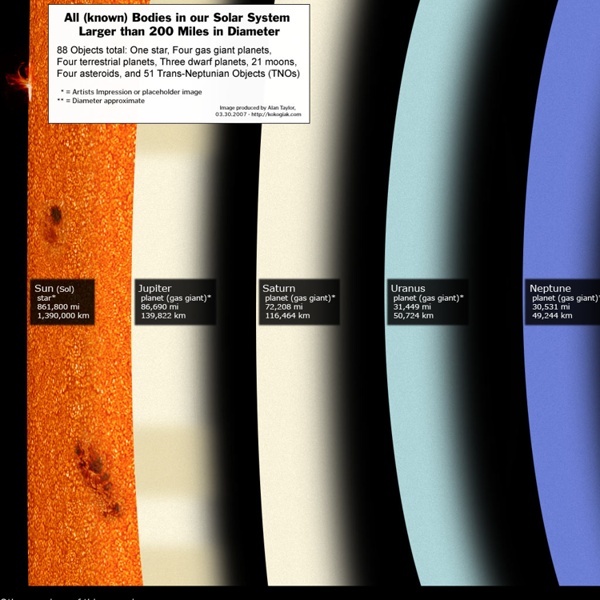
Stars & Planets Scale Comparison A Humbling Perspective"Things are not what they seem, nor are they otherwise." This scale comparison shows "the true place" of Earth and our Sun among the various giants of the universe. It is simultaneously sobering and mind-boggling experience.First series of images opens with the Death Star compared to Mimas, one of Saturn's moons. Earth is small enough to be swallowed by an average sunspot:(picture credt) Second series of images (from this site) shows the similar progression, now in 3-D: "The Universe is a big place populated by stars and thoroughly confused humans." -- Avi Abrams "We simply do not understand our place in the universe and have not the courage to admit it" -- Barry Lopez (American writer, b.1945) "The universe is like a safe to which there is a combination. "If the whole universe has no meaning, we should never have found out that it has no meaning: just as, if there were no light in the universe and therefore no creatures with eyes, we should never know it was dark.
Physics of Collective Consciousness by Attila Grandpierre Attila Grandpierre, Ph.D. Konkoly Observatory of the Hungarian Academy of Sciences H-1525 Budapest P. O. From: ABSTRACT: It is pointed out that the organisation of an organism necessarily involves fields which are the only means to make an approximately simultaneous tuning of the different subsystems of the organism-as-a-whole. 1. It is generally accepted that consciousness evolved parallel to the biological and social complexity of the living systems. 2. It is widely believed, that the way evolution manifest is from parts to the whole, from the inorganic matter through the unicellular organism towards the multicellular ones until the appearance of consciousness. This chain of thought places collective phenomena into the centre of evolution and the generation of consciousness. 3. Experiments show that collective biological fields may dominate the individual field (Popp, 1994). 4. fac,human body = v/l = 103 Hz, (1)
8 shocking things we learned from Stephen Hawking's book From the idea that our universe is one among many, to the revelation that mathematician Pythagoras didn't actually invent the Pythagorean theorem, here are eight shocking things we learned from reading physicist Stephen Hawking's new book, "The Grand Design," written with fellow physicist Leonard Mlodinow of Caltech. The book, covering major questions about the nature and origin of the universe, was released Sept. 7 by its publisher, Bantam. 1. The past is possibility According to Hawking and Mlodinow, one consequence of the theory of quantum mechanics is that events in the past that were not directly observed did not happen in a definite way. For example, if all we know is that a particle traveled from point A to point B, then it is not true that the particle took a definite path and we just don't know what it is. Yeah, we're still trying to wrap our brains around this. 2. This fun fact: A 1-watt night-light emits a billion billion photons each second. 3. 4. 5. 6. 7. 8.
'Schrödinger's hat' could spy on quantum particles An international team of physicists has proposed a new device that could detect the presence of waves or particles while barely disturbing them. Called a "Schrödinger's hat", the device has not yet been built in the lab but the team believes that it could someday be used as a new type of sensor for quantum-information systems. In the microscopic world of quantum mechanics, direct observation of the property of a particle – the position of an electron, for example – causes the collapse of the particle's wavefunction. The result is that the particle that you set out to measure has been changed in a significant way. In the early 1990s, physicists Avshalom Elitzur and Lev Vaidman at Tel Aviv University in Israel pointed out that it is not always necessary to observe particles directly to learn something of their nature. The researchers imagined a pile of bombs, each of which is designed to be triggered by the absorption of a single photon. Interaction-free measurements Unleashing a quasmon
Science Friday: How Einstein proved E=mc² March 30, 2012, 10:27 AM — If you've ever wondered how Einstein arrived at his famous calculation, YouTuber "minutephysics" has you covered. In about two minutes, here's how he did it: Now if we could just find cats that emit light energy. Oh, wait, we already have: LivePhysics Early Black Holes Grew Big Eating Cold, Fast Food-Mellon College of Science Friday, December 9, 2011 The large scale cosmological mass distribution in the simulation volume of the MassiveBlack. The projected gas density over the whole volume ('unwrapped' into 2D) is shown in the large scale (background) image. The two images on top show two zoom-in of increasing factor of 10, of the regions where the most massive black hole - the first quasars - is formed. The black hole is at the center of the image and is being fed by cold gas streams. PITTSBURGH -- Researchers at Carnegie Mellon University’s Bruce and Astrid McWilliams Center for Cosmology have discovered what caused the rapid growth of early supermassive black holes – a steady diet of cold, fast food. In the early days of the universe, a mere 700 to 800 million years after the Big Bang, most things were small. “The Sloan Digital Sky Survey found supermassive black holes at less than 1 billion years. “This simulation is truly gigantic. “We didn’t put anything crazy in. For more information, visit: