Historical Perspectives
Written by: Julia Hardy Zen has become a pop culture phenomenon in the West, especially in the United States. In recent years, there have been a number of notable scholarly publications that have severely criticized these pop culture forms of Zen as inauthentic. They have also been critical of some of the people who introduced Zen to the West, both for their romanticized and inaccurate portrayals of Zen, and for their associations with the rise of Japanese nationalism prior to World War II. Robert Sharf, a frequent critic of westernized Zen, says that, unlike other forms of Buddhism that were introduced to the West through historical and textual studies and field reports, Zen was introduced by Japanese intellectuals and priests whose view of Zen was shaped by the "New Buddhism" that developed after the Meiji Restoration in the late-19th century. Zen became a framework for establishing a Japanese national identity.
The Civil War as Photographed by Mathew Brady
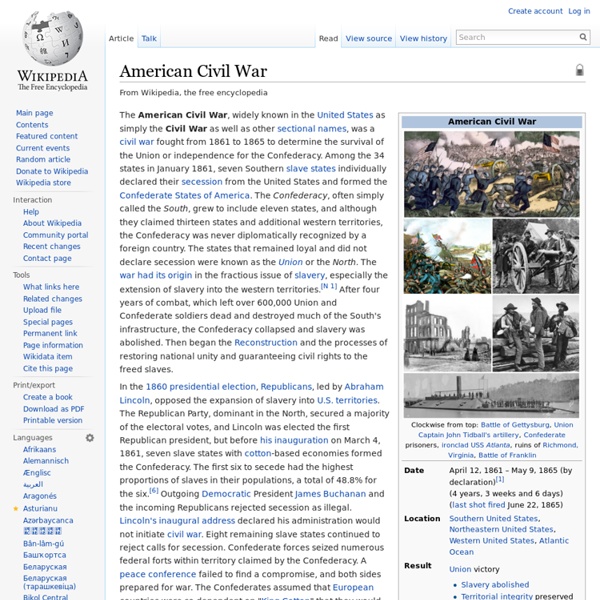
Background Many historians call the Civil War the central event in U.S. history. The formation of the Constitution corrected the autonomy of individual states that the Articles of Confederation did not harness. Still, the young country struggled for 75 years to find a graceful balance between the power of the federal government and the several states. The rights of states and the issue of slavery propelled the country into civil war. Today, America defines itself from that point forward, as it still seeks a more perfect union and equality for all its citizens.
Methodism
The Methodist movement is a group of historically-related denominations of Protestant Christianity which derive their inspiration from the life and teachings of John Wesley. George Whitefield and John's brother Charles Wesley were also significant leaders in the movement. It originated as a revival within the 18th-century Church of England and became a separate Church following Wesley's death. Because of vigorous missionary activity, the movement spread throughout the British Empire, the United States, and beyond, today claiming approximately 80 million adherents worldwide.[1]
James Ostrowski - Lincoln's Secession Arguments
by James Ostrowski* Paper delivered at the first-ever academic conference on secession--"Secession, State, and Economy", sponsored by the Mises Institute, Auburn, Alabama, held at the College of Charleston, Charleston, South Carolina, April 7-9, 1995. *Member of the bar of New York (1984); Brooklyn Law School (J.D. 1983); State University of New York at Buffalo (B.A. Philosophy, 1980). The author wishes to acknowledge the assistance of Trina Lowmaster (State University of New York at Buffalo, B.A.
Heaven's Gates, Hell's Flames
Heaven's Gates, Hell's Flames is a touring evangelistic drama that has been performed worldwide. The tagline on the official website asks, "Where will you be when reality strikes?". It is based on an evangelical presentation of the Gospel, and presents the Biblical message that one must believe in Jesus Christ in order to be saved and go to Heaven, or otherwise face eternal punishment in Hell.
Secession"
Secession, the withdrawal of part of a country or state from the central government's control. The withdrawal may be carried out peacefully or violently. Political conflicts that lead to secession are usually based on economic, cultural, or religious differences. In United States history the question of secession arose several times before the Civil War, but the term generally refers to the withdrawal of the Southern states from the Union in 1860–61.
Modern Physics and Ancient Faith
Modern Physics and Ancient Faith (2003) is a book by Stephen M. Barr, a physicist from the University of Delaware[1] and frequent contributor to First Things. This book is "an extended attack" on what Barr calls scientific materialism. National Review says of the book: "[A] lucid and engaging survey of modern physics and its relation to religious belief. . . . Barr has produced a stunning tour de force . . . [a] scientific and philosophical breakthrough
Donald Heald Original Antique Books Prints and Maps
CARPENTER, Francis Bicknell (artist, 1830-1900). - Frederick W. HALPIN (1805-1880, engraver). Abraham Lincoln N.p.: copyright line dated 1866]. Steel engraved portrait, by Halpin after Carpenter, on India paper on original thick paper mount.
Higgs Boson
The Higgs boson (or Higgs particle) is a particle that gives mass to other particles. Peter Higgs was the first person to think of it, and the particle was found in March 2013. It is part of the Standard Model in physics, which means it is found everywhere.
Lincolniana in 1996
Another year in the field of Lincoln scholarship has passed. Yet, judging from the following bibliography, the scholarship goes on unabated. Not only is Lincoln scholarship maintaining a steady output in the traditional area of print material but it is also expanding into the ever-widening influence of alternative sources. The works of multimedia products now available in CD-ROM format are expanding at a rate greater than any area in Lincoln scholarship except for the Internet. The number of Internet sites now devoted or partially dealing with Abraham Lincoln is amazing.
Gaudiya Vaishnavism
Gaudiya Vaishnavism (also known as Chaitanya Vaishnavism[1] and Hare Krishna) is a Vaishnava religious movement founded by Chaitanya Mahaprabhu (1486–1534) in India in the 16th century. "Gaudiya" refers to the Gauḍa region (present day Bengal/Bangladesh) with Vaishnavism meaning "the worship of Vishnu". Its philosophical basis is primarily that of the Bhagavad Gita and Bhagavata Purana, as well as other Puranic scriptures and Upanishads such as the Isha Upanishad, Gopala Tapani Upanishad, and Kali Santarana Upanishad.