

Human species 'may split in two' Humanity may split into two sub-species in 100,000 years' time as predicted by HG Wells, an expert has said. Evolutionary theorist Oliver Curry of the London School of Economics expects a genetic upper class and a dim-witted underclass to emerge. The human race would peak in the year 3000, he said - before a decline due to dependence on technology. People would become choosier about their sexual partners, causing humanity to divide into sub-species, he added. The descendants of the genetic upper class would be tall, slim, healthy, attractive, intelligent, and creative and a far cry from the "underclass" humans who would have evolved into dim-witted, ugly, squat goblin-like creatures. Race 'ironed out' But in the nearer future, humans will evolve in 1,000 years into giants between 6ft and 7ft tall, he predicts, while life-spans will have extended to 120 years, Dr Curry claims. However, Dr Curry warns, in 10,000 years time humans may have paid a genetic price for relying on technology.
A 130,000-Year-Old Mastodon Threatens to Upend Human History In 1993, construction workers building a new freeway in San Diego made a fantastic discovery. A backhoe operator scraped up a fossil, and scientists soon unearthed a full collection of bones, teeth, and tusks from a mastodon. It was a valuable find: hordes of fossils, impeccably preserved. The last of the mastodons—a slightly smaller cousin of the woolly mammoth—died out some 11,000 years ago. But the dig site turned out to be even more revelatory—and now, with a paper in the journal Nature—controversial. See, this site wasn’t just catnip for the paleontologists, the diggers who study all fossils. The researchers expect a bit of controversy from a discovery that pushes back the arrival of humans in North America by a factor of ten. This discovery—and the inevitable pushback it will face—center on the power and peril of dating technology. There are many ways to date fossils—and a lot of them didn’t work for the mastodon skeleton. So far, so good. Go Back to Top.
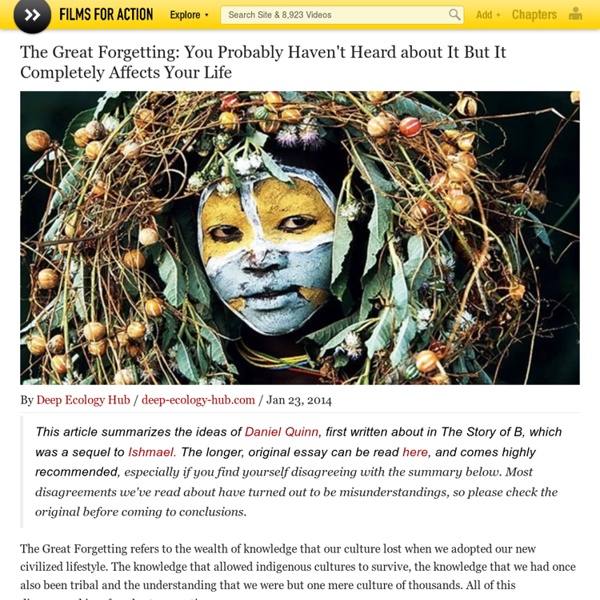
Have You Heard of The Great Forgetting? It Happened 10,000 Years Ago & Completely Affects Your Life By Daniel Quinn / ishmael.com (Excerpted from the book, The Story of B) With every audience and every individual, I have to begin by making them see that the cultural self-awareness we inherit from our parents and pass on to our children is squarely and solidly built on a Great Forgetting that occurred in our culture worldwide during the formative millennia of our civilization. What happened during those formative millennia of our civilization? What happened was that Neolithic farming communes turned into villages, villages turned into towns, and towns were gathered into kingdoms. We can hardly be surprised that the forgetting took place. By the time anyone was ready to write the human story, the foundation events of our culture were ancient, ancient developments - but this didn’t make them unimaginable. In the absence of any other theory, it seemed reasonable (even inescapable) to suppose that the human race must have begun with a single human couple, an original man and woman. Q. A. Q.
Daniel Quinn: The Great Forgetting (Excerpted from the book, The Story of B) With every audience and every individual, I have to begin by making them see that the cultural self-awareness we inherit from our parents and pass on to our children is squarely and solidly built on a Great Forgetting that occurred in our culture worldwide during the formative millennia of our civilization. What happened during those formative millennia of our civilization? What happened was that Neolithic farming communes turned into villages, villages turned into towns, and towns were gathered into kingdoms. Concomitant with these events were the development of division of labor along craft lines, the establishment of regional and interregional trade systems, and the emergence of commerce as a separate profession. We can hardly be surprised that the forgetting took place. By the time anyone was ready to write the human story, the foundation events of our culture were ancient, ancient developments - but this didn’t make them unimaginable. Q.
Bronze Age Women Explorers Were Key To Exchanging Cultural Ideas As Men Stayed At Home It’s all too easy to imagine that the Stone Age was a time of wandering warrior men with their women staying at home to tend to the hearth and family, and that independent, well-traveled, and important women are a relatively new phenomenon in human history. However, a new study suggests quite the opposite. The new research, published in the journal PNAS, suggests that it was women who traveled vast distances in Western Europe around the turn of the Stone Age and the start of the Bronze Age. The researchers from Ludwig-Maximilians-Universität in Munich used ancient DNA and isotope analyses of 84 skeletons found in present-day Lechtal in the south of Augsburg, Germany. "Based on analysis of strontium isotope ratios in molars, which allows us to draw conclusions about the origin of people, we were able to ascertain that the majority of women did not originate from the region," archaeologist Corina Knipper explained.
Daniel Quinn Da Wikipedia, l'enciclopedia libera. Daniel Quinn (Omaha, 1935) è uno scrittore statunitense, conosciuto per il suo libro Ishmael che gli garantì la vittoria del Turner Tomorrow Fellowship Award nel 1991, un concorso istituito da Ted Turner per romanzi che proponessero soluzioni originali a problemi globali come la crisi ambientale e la fame nel mondo. Comunemente definito filosofo ambientalista, egli tuttavia rifiuta questa definizione, dato che ritiene implichi una falsa dicotomia (prettamente politica) tra ambiente non-umano e ambiente umano, che in realtà sono la stessa cosa, e tra gente a favore dell'ambiente e contro le persone e gente a favore delle persone e contro l'ambiente. Distinzione secondo lui assurda,[1] perché se si è a favore dell'ambiente si è a favore anche delle persone, dato che esse dipendono dall'ambiente per esistere. Viceversa, se si è contro l'ambiente si è contro anche le persone. Sono anche disponibili delle estensive FAQ in italiano.[4]
23 maps and charts on language by Dylan Matthews on April 15, 2015 "The limits of my language," the philosopher Ludwig Wittgenstein once posited, "mean the limits of my world." Explaining everything within the limits of the world is probably too ambitious a goal for a list like this. But here are 23 maps and charts that can hopefully illuminate small aspects of how we manage to communicate with one another. The basics Indo-European language rootsMinna Sundberg, a Finnish-Swedish comic artist, created this beautiful tree to illustrate both the relationships between European and central Asian languages generally, as well as a smaller but still striking point: Finnish has less in common with, say, Swedish than Persian or Hindi do. Language divides Bilingualism Who in Europe speaks EnglishMany countries have more than one commonly used language, with many residents learning two or more. English American English
5.7-Million-Year-Old Hominin Footprints Challenge Human Evolutionary Timeline If the discoveries over the past few decades have told us anything, it’s that the evolution of humans is anything but simple. Now, a new discovery on the Mediterranean island of Crete might be about to put yet another cat among those pigeons, as researchers claim that hominin footprints found on the island date back some 5.7 million years. The fossils have been found in Trachilos, western Crete, and appear to show many hominin-like characteristics at a time when it has long been believed hominins were evolving in relative isolation in East Africa. Published in the journal Proceedings of the Geologists’ Association, the researchers argue that despite lacking any other fossil bones, the footprints indicate that bipedal apes, with hominin features were clearly present in Europe some 5.7 million years ago. As more and more finds are made, the history of us gets more and more complicated.