

Northern Tradition Shamanism: Yggdrasil: The World Tree In order to understand the geography of the Nine Worlds, it is crucial to start with Yggdrasil, the World Tree. Conceptions of the World Tree have been found in tribal societies from Siberia to Polynesia; they differ in some aspects, but generally come with some kind of upper world in the top branches of the tree, some kind of ancestral world of the Dead at the roots, and various other worlds in the middle. It has been theorized that they are different trees on the same model, or that they are the same tree existing in many different dimensions, with different worlds in each, which seems more right to me somehow. We refer to the dimension of the Tree explored by the ancient Norse/Germanic/Saxon peoples as Yggdrasil. Ygg is a byname of Odin, and Yggdrasil means "Odin's steed", a kenning. Yggdrasil exists in a void of nothingness called Ginnungagap. Here's where things get strange. Denizens: Yggdrasil is generally pictured as an ash tree, but this may be human interpretation.
The Nine Worlds of Norse Mythology The designation "Nine Worlds" is a well-known staple of Old Norse mythology, but what are the nine worlds exactly? Can anyone name all nine? Where are they located? These are natural questions. In the Poetic Edda, we first learn of the tree Yggdrassil and the Nine Worlds. Mjötvíð, the Measuring Tree, is commonly understood to be the world-tree, Yggdrassil, so-named in Völuspá 20. To complicate matters, not only are there nine worlds, according to the Eddas, but also twelve heavens. Nine Worlds— the concept is easy enough to grasp. Although several illustrations of Yggdrassil have been published, these 4 works contain the primary representative efforts to create a list of the nine worlds. All 4 of these lists share the following worlds in common: Only the first four are found in the poems of the Elder Edda. Of these Muspelheim (and its variants) are unique to Snorri's Edda, and does not appear in the poems of the Elder Edda. Other passages in the Poetic Edda also support this separation.
Yggdrasil, Norse world tree - Key symbols - LOTUS Gods, elves, giants and humans The universe was born from emptiness 1, the deep abyss (Ginnungagap), with the appearance of the primeval polarity of two complementary principles: fire/ice, warm/cold, light/darkness. Their interaction generated nine worlds equally divided into three spheres: celestial, intermediary and terrestrial. These worlds were supported by the branches of the Norse World Tree named Yggdrasil. The first creatures were born from the interaction of both principles: the giant Ymir, the primeval Androgyne father of the giants' line, and the cow Audhumla, wet nurse of the giants and ancestor of living beings and Aesir gods. As primeval Androgyne, Ymir unifies both complementary principles within himself. As a reflection of Unity, Ymir also reveals himself as the possessor, the custodian of the primeval Knowledge attached to the origin of the universe and beings. The Aesir gods killed Ymir with the assistance of giants and dismembered him to create the universe.
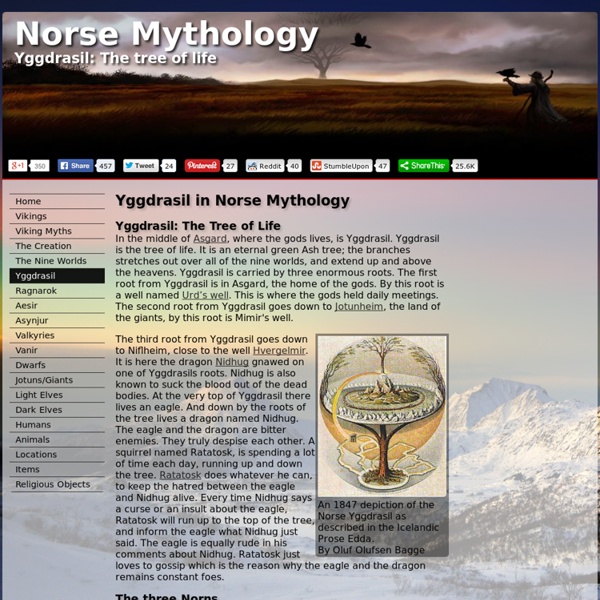
World tree From Northern Antiquities, an English translation of the Prose Edda from 1847. Painted by Oluf Olufsen Bagge. World tree. Norse mythology[edit] In Norse mythology, Yggdrasil is the world tree. Siberian culture[edit] The world tree is also represented in the mythologies and folklore of Northern Asia and Siberia. The symbol of the world tree is also common in Tengriism, an ancient religion of Mongols and Turkic peoples. The world tree is visible in the designs of the Crown of Silla, Silla being one of the Three Kingdoms of Korea. Mesoamerican culture and Indigenous cultures of the Americas[edit] Among pre-Columbian Mesoamerican cultures, the concept of "world trees" is a prevalent motif in Mesoamerican mythical cosmologies and iconography. A common theme in most indigenous cultures of the Americas is a concept of directionality (the horizontal and vertical planes), with the vertical dimension often being represented by a world tree. Other cultures[edit] Popular culture[edit] See also[edit]
THE CENTRAL SPIRITUAL SUN, THE ANTAHKARANA AND ALCHEMICAL VITRIOL Super Computers gain speed through the number of processors connected. Each Chakra is a processor. As we connect the chakras higher and higher along the antahkarana by removing the energy blockages between them so we gain more intelligence the higher they go, and the more chakras we connect together. As more processors are connected, so a human being gains more wisdom. The communication bus connecting the chakras together is the Antahkarana - a connecting tower of energy between heaven and earth. Brahma is God. Sexual Energy and Selfish Desire is Mastered through the Soul Connection and ONLY through the Soul Connection because the energy of God is higher and stronger. Established in the connection with God is Enlightenment. As my Master Roshi Hogen says "The spring at the top of the Mountain." - the Energy coming from the Crown Chakra. In Energy Enhancement this is the Energy in the Center of the Universe. Illness is caused by a lack of energy. Energy is a glow. Energy is beauty. GooRoo
THE NINE WORLDS OF THE NORSE COSMOLOGY The purpose of this particular page is to give those who lack a good degree of familiarity with the cosmological stomping grounds of the Norse deities, and the other races of beings they regularly interact with in the myths, a crash course on the subject. I will endeavor to make this page as succinct and to the point as possible, giving only the basic information that one may require to fully understand and appreciate the complete otherworldly milieu in which the Norse deities operate within. It should first be noted that much of the original myths as written down before and during the Age of Vikings in Europe was lost, and what survived was in certain cases rewritten by Christian monks of Scandinavian heritage who sought to preserve this literary tradition of their culture after the fall of Northern Paganism, albeit adding Christian-inspired conceits to the material. 1. Asgard--the realm inhabited by the great majority of the Norse deities, and ruled by Odin and Frigga. 2. 3. 4. 5. 6.
Norse cosmology The cosmology of Norse mythology has "nine homeworlds", unified by the world tree Yggdrasill. Mapping the nine worlds escapes precision because the Poetic Edda often alludes vaguely. The Norse creation myth tells how everything came into existence in the gap between fire and ice, and how the gods shaped the homeworld of humans. Yggdrasill[edit] A cosmic ash tree, Yggdrasill, lies at the center of the Norse cosmos. The root in the Æsir homeworld taps the sacred wellspring of fate, the Well of Urðr. Animals continually feed on the tree, threatening it, but its vitality persists evergreen as it heals and nourishes the vibrant aggression of life. Creation[edit] In the beginning, there were two regions: Muspellsheimr in the south, full of fire, light and heat; and Niflheimr in the north, full of arctic waters, mists, and cold. Búri's son Borr had three sons, the gods Odin, Vili and Vé. Norse Gods[edit] The realm of the Norse gods, the Æsir, is called Ásgarðr or the "Court of the Ás". Völuspá 2
Níðhöggr Níðhöggr gnaws the roots of Yggdrasill in this illustration from a 17th-century Icelandic manuscript. In Norse mythology, Níðhöggr (Malice Striker, often anglicized Nidhogg[1]) is a dragon who gnaws at a root of the world tree, Yggdrasil. In historical Viking society, níð was a term for a social stigma implying the loss of honor and the status of a villain. Thus, its name might refer to its role as a horrific monster or in its action of chewing the corpses of the inhabitants of Náströnd: those guilty of murder, adultery, and oath-breaking, which Norse society considered among the worst possible crimes. Etymology[edit] In the standardized Old Norse orthography, the name is spelled Níðhǫggr or Niðhǫggr, but the letter 'ǫ' is frequently replaced with the Modern Icelandic 'ö' for reasons of familiarity or technical expediency. Prose Edda[edit] According to the Gylfaginning part of Snorri Sturluson's Prose Edda, Níðhöggr is a being which gnaws one of the three roots of Yggdrasill. See also[edit]
Nidhogg - Draconika Nidhogg is a creature from Norse mythology who chews on the tree Yggdrasill. n Norse mythology, there is an immense ash tree called Yggdrasill. Its branches extend up into the heavens and it is supported beneath the earth by three roots. Nidhogg is a monstrous serpent that relentlessly gnaws on the deepest root of Yggdrasill. Nidhogg lies upon Nastrond, the corpse shore. A loathing is felt between Nidhogg and a nameless eagle that lived at the very top of Yggdrasill. When Mimir stops guarding his well, Yggdrasill’s roots will begin to rot. Nidhogg will fly up from below Yggdrasill and head to Asgard.
Nidhogg's Shrine: Who is Nidhogg? What we know from myth, history, and inspiration Yggdrasil, the great World Tree, has its roots in the lowest worlds - Niflheim and Helheim. Its most obvious third protruding root is found, huge and dark, at the great well Hvergelmir in Niflheim. Hvergelmir means "Boiling Cauldron", and all the rivers of the Nine Worlds flow from its churning depths. Next to it lies the third root of the Tree, drawing nourishment form the Well, so huge that it runs off the boundary of Niflheim and into Helheim; the Wall of Helheim incorporates it like it would a small mountain. When not coiled around the lowest root of the World Tree, Nidhogg crosses the wall into Helheim and visits Dead Man's Shore. This is a lesson that modern Westerners have a hard time with. When you meet her at Dead Man's Shore, Nidhogg is sometimes followed by her brood of serpent-children, whose names include Goin, Moin, Grabak, Grafvollud, Ofnir, and Svafnir. Artwork by Katie Hofgard.