

Paradise Lost Epic poem by John Milton Composition[edit] In his introduction to the Penguin published edition of Paradise Lost, the Milton scholar John Leonard notes: "John Milton was nearly sixty when he published Paradise Lost in 1667. Leonard also notes that Milton "did not at first plan to write a biblical epic". Publication[edit] In the 1667 version of Paradise Lost, the poem was divided into ten books. Synopsis[edit] The poem follows the epic tradition of starting in medias res (lit. At several points in the poem, an Angelic War over Heaven is recounted from different perspectives. The story of Adam and Eve's temptation and fall is a fundamentally different, new kind of epic:[further explanation needed] a domestic one. Meanwhile, Satan returns triumphantly to Hell, amid the praise of his fellow fallen angels. Adam and Eve are cast out of Eden, and Michael says that Adam may find "a paradise within thee, happier far". Characters[edit] Satan[edit] Adam[edit] Adam is the first human created by God. C.
Internet U.S. Army soldiers "surfing the Internet" at Forward Operating Base Yusifiyah, Iraq The Internet is a global system of interconnected computer networks that use the standard Internet protocol suite (TCP/IP) to link several billion devices worldwide. The origins of the Internet date back to research commissioned by the United States government in the 1960s to build robust, fault-tolerant communication via computer networks.[2] This work, combined with efforts in the United Kingdom and France, led to the primary precursor network, the ARPANET, in the United States. Most traditional communications media, including telephony and television, are being reshaped or redefined by the Internet, giving birth to new services such as voice over Internet Protocol (VoIP) and Internet Protocol television (IPTV). Terminology The Internet, referring to the specific global system of interconnected IP networks, is a proper noun and written with an initial capital letter. History T3 NSFNET Backbone, c. 1992.
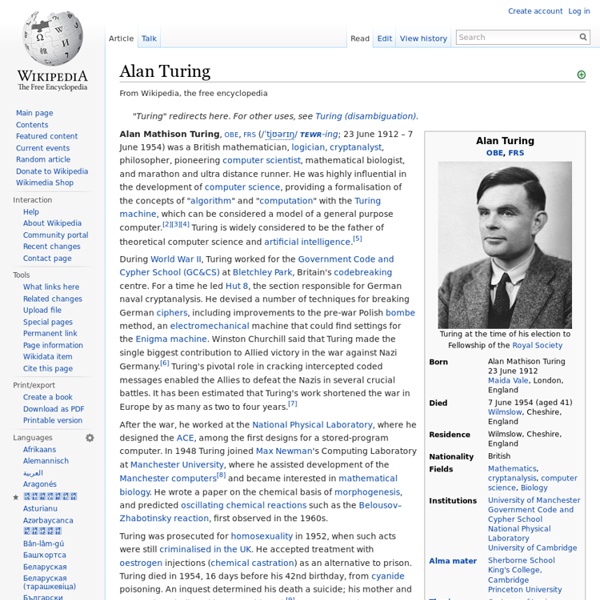
Enigma machine Military Enigma machine An Enigma machine was any of a family of related electro-mechanical rotor cipher machines used in the twentieth century for enciphering and deciphering secret messages. Enigma was invented by the German engineer Arthur Scherbius at the end of World War I.[1] Early models were used commercially from the early 1920s, and adopted by military and government services of several countries—most notably by Nazi Germany before and during World War II.[2] Several different Enigma models were produced, but the German military models are the most commonly discussed. Though Enigma had some cryptographic weaknesses, in practice it was German procedural flaws, operator mistakes, laziness, failure to systematically introduce changes in encipherment procedures, and Allied capture of key tables and hardware that, during the war, enabled Allied cryptologists to succeed. Design[edit] Enigma in use, 1943 Electrical pathway[edit] Rotors[edit] Enigma rotor assembly. Stepping[edit]
Kardashev scale The Kardashev scale is a method of measuring a civilization's level of technological advancement, based on the amount of energy a civilization is able to utilize. The scale has three designated categories called Type I, II, and III. A Type I civilization uses all available resources on its home planet, Type II harnesses all the energy of its star, and Type III of its galaxy. The scale is only hypothetical, but it puts energy consumption in a cosmic perspective. It was first proposed in 1964 by the Russian astronomer Nikolai Kardashev (Kardashyov). Various extensions of the scale have been proposed since, from a wider range of power levels (types 0, IV and V) to the use of metrics other than pure power. Definition[edit] Type I "Technological level close to the level presently attained on earth, with energy consumption at ≈4×10¹⁹ erg/sec (4 × 10¹² watts) Type II Type III "A civilization in possession of energy on the scale of its own galaxy, with energy consumption at ≈4×1044 erg/sec
Vint Cerf Vinton Gray "Vint" Cerf[1] (/ˈsɜrf/; born June 23, 1943) is an American computer scientist, who is recognized as one of[5] "the fathers of the Internet",[6] sharing this title with American computer scientist Bob Kahn.[7][8] His contributions have been acknowledged and lauded, repeatedly, with honorary degrees and awards that include the National Medal of Technology,[1] the Turing Award,[9] the Presidential Medal of Freedom,[10] and membership in the National Academy of Engineering. In the early days, Cerf was a program manager for the United States Department of Defense Advanced Research Projects Agency (DARPA) funding various groups to develop TCP/IP technology. When the Internet began to transition to a commercial opportunity during the late 1980s,[citation needed] Cerf moved to MCI where he was instrumental in the development of the first commercial email system (MCI Mail) connected to the Internet. Cerf was instrumental in the funding and formation of ICANN from the start.
Mission 2: "Flight To Freedom" | Mission US | THIRTEEN <object classid="clsid:D27CDB6E-AE6D-11cf-96B8-444553540000" width="800" height="600" id="mission_2"><param name="movie" value="//cdn.mission-us.org/flash/streaming_mission02/mission02.swf" /><param name="quality" value="high" /><param name="bgcolor" value="#000000" /><param name="allowScriptAccess" value="sameDomain" /><param name="allowFullScreen" value="true" /><param name="wmode" value="transparent" /><param name="flashvars" value="base_path=//cdn.mission-us.org/flash/streaming_mission02/" /><!--[if !IE]>--><object type="application/x-shockwave-flash" data="//cdn.mission-us.org/flash/streaming_mission02/mission02.swf" width="800" height="600"><param name="quality" value="high" /><param name="bgcolor" value="#000000" /><param name="allowScriptAccess" value="sameDomain" /><param name="allowFullScreen" value="true" /><!--<![endif]--><! Chromebook and Chrome users: If you see a blank screen above, your browser may be blocking Flash content. Still having difficulty streaming Mission 2?
Seven ways to control the Galaxy with self-replicating probes So, you want to take over the Galaxy. A good career move. Ultimately, you're hoping to communicate with extraterrestrials, colonize entire sets of star clusters, and eventually lord it over the entire Milky Way. You've got the motive, but what about the means? Well, forget about generation ships, suspended animation or ringworlds – the best way for you to explore, colonize and ultimately rule the Milky Way will be through the use of self-replicating robotic spacecraft – what are sometimes referred to as von Neumann probes. Von Neumann's idea Back in late 1940’s the brilliant mathematician John Von Neumann wondered if it might be possible to design a non-biological system that could replicate itself. The strength of Von Neumann's idea lies in the brute efficiency of exponential growth. In order to work, however, a von Neumann spacecraft would have to be put together using advanced nanotechnology and artificial intelligence -- technologies that we have yet to develop. 1. 1. 2. 3. 4. 5. 6.
Tim Berners-Lee Sir Timothy John "Tim" Berners-Lee, OM, KBE, FRS, FREng, FRSA, DFBCS (born 8 June 1955),[1] also known as TimBL, is an English computer scientist, best known as the inventor of the World Wide Web. He made a proposal for an information management system in March 1989,[2] and he implemented the first successful communication between a Hypertext Transfer Protocol (HTTP) client and server via the Internet sometime around mid-November of that same year.[3][4][5][6][7] Berners-Lee is the director of the World Wide Web Consortium (W3C), which oversees the Web's continued development. He is also the founder of the World Wide Web Foundation, and is a senior researcher and holder of the Founders Chair at the MIT Computer Science and Artificial Intelligence Laboratory (CSAIL).[8] He is a director of the Web Science Research Initiative (WSRI),[9] and a member of the advisory board of the MIT Center for Collective Intelligence.[10][11] Early life Career Current work Awards and honours Personal life
Making brains: Reverse engineering the human brain to achieve AI The ongoing debate between PZ Myers and Ray Kurzweil about reverse engineering the human brain is fairly representative of the same debate that's been going in futurist circles for quite some time now. And as the Myers/Kurzweil conversation attests, there is little consensus on the best way for us to achieve human-equivalent AI. That said, I have noticed an increasing interest in the whole brain emulation (WBE) approach. While I believe that reverse engineering the human brain is the right approach, I admit that it's not going to be easy. But we have to start somewhere, and we have to start with a plan. Rules-based AI versus whole brain emulation Now, some computer theorists maintain that the rules-based approach to AI will get us there first. This approach aside, like Kurzweil, Bostrom, Sandberg and a growing number of other thinkers, I am drawn to the WBE camp. Emulation, simulation and cognitive functionalism Moreover, emulation is not simulation. The roadmap to whole brain emulation
How to build a Dyson sphere in five (relatively) easy steps Let's build a Dyson sphere! And why wouldn't we want to? By enveloping the sun with a massive array of solar panels, humanity would graduate to a Type 2 Kardashev civilization capable of utilizing nearly 100% of the sun's energy output. Implausible you say? Think again: We are closer to being able to build a Dyson Sphere than we think. Now, before I tell you how we could do such a thing, it's worth doing a quick review of what is meant by a "Dyson sphere". Dyson Spheres, Swarms, and Bubbles The Dyson sphere, also referred to as a Dyson shell, is the brainchild of the physicist and astronomer Freeman Dyson. Needless to say, the amount of energy that could be extracted in this way is mind-boggling. I should note at this point that a Dyson sphere may not be what you think it is. Dyson's original proposal simply assumed there would be enough solar collectors around the sun to absorb the starlight, not that they would form a continuous shell. Megascale construction Why Mercury first?
Vitruvius Marcus Vitruvius Pollio (born c. 80–70 BC, died after c. 15 BC), commonly known as Vitruvius, was a Roman author, architect, and civil engineer during the 1st century BC, known for his multi-volume work entitled De Architectura. By his own description[1] Vitruvius served as an artilleryman, the third class of arms in the military offices. He probably served as a senior officer of artillery in charge of doctores ballistarum (artillery experts) and libratores who actually operated the machines.[2] Life and career[edit] Vitruvian Man by Leonardo da Vinci, an illustration of the human body inscribed in the circle and the square derived from a passage about geometry and human proportions in Vitruvius' writings Little is known about Vitruvius' life. That [name is] very common in Formiae and regions adjacent, as well Dr. The locations where he served can be reconstructed from, for example, descriptions of the building methods of various "foreign tribes". Greek house plan after Vitruvius
Fullerene The discovery of fullerenes greatly expanded the number of known carbon allotropes, which until recently were limited to graphite, diamond, and amorphous carbon such as soot and charcoal. Buckyballs and buckytubes have been the subject of intense research, both for their unique chemistry and for their technological applications, especially in materials science, electronics, and nanotechnology. History[edit] The icosahedral fullerene C540, another member of the family of fullerenes. Independently from Henson, in 1973 a group of scientists from the USSR, directed by Prof. Minute quantities of the fullerenes, in the form of C60, C70, C76, C82 and C84 molecules, are produced in nature, hidden in soot and formed by lightning discharges in the atmosphere.[15] In 1992, fullerenes were found in a family of minerals known as Shungites in Karelia, Russia.[3] In 2010, fullerenes (C60) have been discovered in a cloud of cosmic dust surrounding a distant star 6500 light years away. Naming[edit]