background preloader

Jesus

Jesus
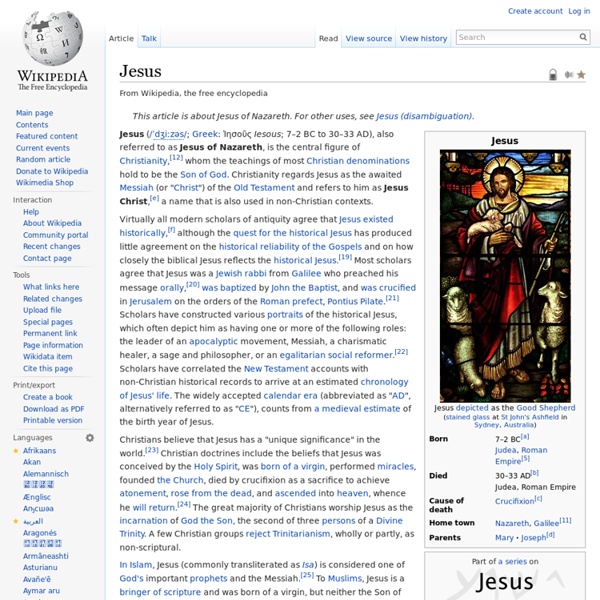
Jesus (/ˈdʒiːzəs/; Greek: Ἰησοῦς Iesous; 7–2 BC to 30–33 AD), also referred to as Jesus of Nazareth, is the central figure of Christianity,[12] whom the teachings of most Christian denominations hold to be the Son of God. Christianity regards Jesus as the awaited Messiah (or "Christ") of the Old Testament and refers to him as Jesus Christ,[e] a name that is also used in non-Christian contexts. Etymology of names Since early Christianity, Christians have commonly referred to Jesus as "Jesus Christ". The word Christ is derived from the Greek Χριστός (Christos),[28][37] which is a translation of the Hebrew מָשִׁיחַ (Meshiakh), meaning the "anointed" and usually transliterated into English as "Messiah".[38] Christians designate Jesus as Christ because they believe he is the awaited Messiah prophesied in the Hebrew Bible (Old Testament). Chronology A number of approaches have been used to estimate the year of the crucifixion of Jesus. Life and teachings in the New Testament

About Buddha Cathedral of Worship / E.L. Warren Ministries Spirituality The term "spirituality" lacks a definitive definition, although social scientists have defined spirituality as the search for "the sacred," where "the sacred" is broadly defined as that which is set apart from the ordinary and worthy of veneration. Definition[edit] There is no single, widely-agreed definition of spirituality. According to Waaijman, the traditional meaning of spirituality is a process of re-formation which "aims to recover the original shape of man, the image of God. Waaijman points out that "spirituality" is only one term of a range of words which denote the praxis of spirituality. Spirituality can be sought not only through traditional organized religions, but also through movements such as liberalism, feminist theology, and green politics. Etymology[edit] The term spirit means "animating or vital principle in man and animals". Development of the meaning of spirituality[edit] Classical, medieval and early modern periods[edit] In the 11th century this meaning changed.

Confucius Confucius (551–479 BC)[1] was a Chinese teacher, editor, politician, and philosopher of the Spring and Autumn period of Chinese history. Confucius is traditionally credited with having authored or edited many of the Chinese classic texts including all of the Five Classics, but modern scholars are cautious of attributing specific assertions to Confucius himself. Aphorisms concerning his teachings were compiled in the Analects, but only many years after his death. Confucius's principles had a basis in common Chinese tradition and belief. Names Within the Analects, he is often referred to simply as "the Master" (子 Zǐ). Background Biography Early life Lu can be seen in China's northeast Confucius was born into the class of shi (士), between the aristocracy and the common people. Political career Exile Return home According to the Zuo Zhuan, Confucius returned home when he was 68. Philosophy In the Analects, Confucius presents himself as a "transmitter who invented nothing". Ethics 廄焚。 己所不欲,勿施於人。

Bible Study Tools Online – Verses, Commentaries, Concordances, Verses, Parallel Versions Zoroastrianism Iranian religion founded by Zoroaster With possible roots dating back to the 2nd millennium BCE, Zoroastrianism enters recorded history around the middle of the 6th century BCE.[10] It served as the state religion of the ancient Iranian empires for more than a millennium (approximately from 600 BCE to 650 CE), but declined from the 7th century CE onwards as a direct result of the Arab-Muslim conquest of Persia (633–654 CE), which led to the large-scale persecution of the Zoroastrian people. Recent estimates place the current number of Zoroastrians in the world at around 110,000–120,000[12] at most, with the majority of this figure living in India, Iran, and North America; their number has been thought to be declining.[13][14] Terminology The name Zoroaster (Ζωροάστηρ) is a Greek rendering of the Avestan name Zarathustra. Overview Theology Practices Ossuary with reliefs of Zoroastrian priests attending a fire, Mullakurgan (near Samarkand), Uzbekistan, 7-8th century CE.[52] History Conversion

Martin Luther King - Biography Martin Luther King, Jr., (January 15, 1929-April 4, 1968) was born Michael Luther King, Jr., but later had his name changed to Martin. His grandfather began the family’s long tenure as pastors of the Ebenezer Baptist Church in Atlanta, serving from 1914 to 1931; his father has served from then until the present, and from 1960 until his death Martin Luther acted as co-pastor. Martin Luther attended segregated public schools in Georgia, graduating from high school at the age of fifteen; he received the B. A. degree in 1948 from Morehouse College, a distinguished Negro institution of Atlanta from which both his father and grandfather had graduated. After three years of theological study at Crozer Theological Seminary in Pennsylvania where he was elected president of a predominantly white senior class, he was awarded the B.D. in 1951. In 1954, Martin Luther King became pastor of the Dexter Avenue Baptist Church in Montgomery, Alabama. Selected bibliography

Free Home Bible Study You will be able to take this Free Bible Study Course with no cost or obligation, in the privacy of your own home and at a pace that you choose. We will need your name and email address to identify you as a student for our records, but all other personal information is purely optional. This will automatically include the Bible study offered on the website authored by Ron Boatwright. Each Lesson contains a set of questions which you answer by clicking on the appropriate list of potential answers. Once you have made your selection, you will be informed on the correctness of your answer plus the scripture in which the answer was taught. If you would prefer a Free Home Bible Study by mail, we will be glad to oblige. Please note, we will never use your information to solicit funds from you.

Flood myth "The Deluge", frontispiece to Gustave Doré's illustrated edition of the Bible. Based on the story of Noah's Ark, this shows humans and a tiger doomed by the flood futilely attempting to save their children and cubs. A flood myth or deluge myth is a symbolic narrative in which a great flood is sent by a deity, or deities, to destroy civilization in an act of divine retribution. Parallels are often drawn between the flood waters of these myths and the primeval waters found in certain creation myths, as the flood waters are described as a measure for the cleansing of humanity, in preparation for rebirth. Mythologies[edit] The Mesopotamian flood stories concern the epics of Ziusudra, Gilgamesh, and Atrahasis. In the Genesis flood narrative, Yahweh decides to flood the earth because of the depth of the sinful state of mankind. Claims of historicity[edit] Nanabozho in Ojibwe flood story from an illustration by R.C. See also[edit] References[edit] Jump up ^ Leeming, David (2004).

Gandhi - Wikipedia, Mohandas Karamchand Gandhi pronunciation (pronounced: [ˈmoːɦənd̪aːs ˈkərəmtʃənd̪ ˈɡaːnd̪ʱi] ; 2 October 1869 [ 1 ] – 30 January 1948), commonly known as Mahatma Gandhi , was the preeminent leader of Indian nationalism in British-ruled India . Employing non-violent civil disobedience , Gandhi led India to independence and inspired movements for non-violence, civil rights and freedom across the world. [ 2 ] [ 3 ] The son of a senior government official, Gandhi was born and raised in a Hindu community in coastal Gujarat , and trained in law in London. Gandhi led Indians in protesting the national salt tax with the 400 km (250 mi) Dandi Salt March in 1930, and later in demanding the British to immediately Quit India in 1942, during World War II . In his last year, unhappy at the partition of India , Gandhi worked to stop the carnage between Muslims, Hindus and Sikhs that raged in the border area between India and Pakistan. Early life and background English barrister Gandhi and the Africans

Related: