

Near-field electromagnetic ranging Near-field electromagnetic ranging (NFER) refers to any radio technology employing the near-field properties of radio waves as a Real Time Location System (RTLS). Overview[edit] Near-field electromagnetic ranging is an emerging RTLS technology that employs transmitter tags and one or more receiving units. Operating within a half-wavelength of a receiver, transmitter tags must use relatively low frequencies (less than 30 MHz) to achieve significant ranging. Depending on the choice of frequency, NFER has the potential for range resolution of 30 cm (1 ft) and ranges up to 300 m (1,000 ft).[1] Technical Discussion[edit] Advantages[edit] NFER technology is a different approach for locating systems. For instance, a radio wave at 1 MHz has a period of 1 µs, and the EH phase difference changes about 45 degrees between 30 m (100 ft) to 60 m (200 ft). Using relatively low frequencies also conveys additional advantages. Disadvantages[edit] Operation at low frequencies faces challenges as well.
Digital worlds can help autistic children to develop social skills The benefits of virtual worlds can be used to help autistic children develop social skills beyond their anticipatedlevels, suggest early findings from new research funded by the Economic and Social Research Council (ESRC). 21 October 2011 The benefits of virtual worlds can be used to help autistic children develop social skills beyond their anticipated levels, suggest early findings from new research funded by the Economic and Social Research Council (ESRC). Researchers on the Echoes Project have developed an interactive environment which uses multi-touch screen technology where virtual characters on the screener act to children’s actions in real time. During sessions in the virtual environment, primary school children experiment with different social scenarios, allowing the researchers to compare their reactions with those they display in real-world situations. "Discussions of the data with teachers suggest a fascinating possibility," said project leader Dr Kaska Porayska-Pomsta.
Central bank The primary function of a central bank is to manage the nation's money supply (monetary policy), through active duties such as managing interest rates, setting the reserve requirement, and acting as a lender of last resort to the banking sector during times of bank insolvency or financial crisis. Central banks usually also have supervisory powers, intended to prevent bank runs and to reduce the risk that commercial banks and other financial institutions engage in reckless or fraudulent behavior. Central banks in most developed nations are institutionally designed to be independent from political interference.[4][5] Still, limited control by the executive and legislative bodies usually exists.[6][7] The chief executive of a central bank is normally known as the Governor, President or Chairman. History[edit] Prior to the 17th century most money was commodity money, typically gold or silver. Bank of England[edit] The sealing of the Bank of England Charter (1694). Spread around the world[edit]
Real-time locating system Real-time locating systems (RTLS) are used to automatically identify and track the location of objects or people in real time, usually within a building or other contained area. Wireless RTLS tags are attached to objects or worn by people, and in most RTLS, fixed reference points receive wireless signals from tags to determine their location.[1] Examples of real-time locating systems include tracking automobiles through an assembly line, locating pallets of merchandise in a warehouse, or finding medical equipment in a hospital. The physical layer of RTLS technology is usually some form of radio frequency (RF) communication, but some systems use optical (usually infrared) or acoustic (usually ultrasound) technology instead of or in addition to RF. Tags and fixed reference points can be transmitters, receivers, or both, resulting in numerous possible technology combinations. RTLS are a form of local positioning system, and do not usually refer to GPS, mobile phone tracking. Origin[edit]
Cloud computing Cloud computing metaphor: For a user, the network elements representing the provider-rendered services are invisible, as if obscured by a cloud. Cloud computing is a computing term or metaphor that evolved in the late 1990s, based on utility and consumption of computer resources. Cloud computing involves application systems which are executed within the cloud and operated through internet enabled devices. Purely cloud computing does not rely on the use of cloud storage as it will be removed upon users download action. Clouds can be classified as public, private and hybrid.[1][2] Overview[edit] Cloud computing[3] relies on sharing of resources to achieve coherence and economies of scale, similar to a utility (like the electricity grid) over a network.[2] At the foundation of cloud computing is the broader concept of converged infrastructure and shared services. Cloud computing, or in simpler shorthand just "the cloud", also focuses on maximizing the effectiveness of the shared resources.
Indoor Autonomous Positioning SCP technology makes it possible to provide reliable, consistent, and accurate indoor positioning without the support of network infrastructure and services. By exploiting freely available signals including GPS, cellular, digital television, and wireless LAN (e.g. WiFi), SCP based Doppler Aided Inertial Navigation (DAIN) determines location through a sensor fusion approach. Combining inertial, magnetic, and gravity data with the SCP RF observables, DAIN provides continuous position, velocity, and direction information. A fundamental breakthrough in indoor positioning, SCP DAIN is ideal for emerging location enabled applications hosted on smart phone devices. DAIN is an ideal enabler for both consumer and commercial applications.
New Prodcut Development Stratgy by Madhusmita Choudhury, Balaram Saura Choudhury, M. & Saura, B. (2015), "New Product development Strategy", Comdex Times, Vol-21(1), PP-6-9 Abstract New product development means the changes of customer tastes, technology and competition of a product; must of companies are developed a strategy for new products and services. A firm can gain new products in two ways. One is buying a whole company’s patent or license to produce other company’s product. Companies are needed to grow with their income over time by developing new products and increasing into new market. Choudhury, Madhusmita and Saura, Balaram, New Prodcut Development Stratgy (January 14, 2015).
Indoor Navigation with SVG SVG, positioning technologies, mobility, guiding system Christian SchmittResearcherFraunhofer FIT Schloss Birlinghoven Sankt-Augustin Germany christian.schmitt@fit.fraunhofer.de Oliver KaufmannFraunhofer FITSchloss Birlinghoven Sankt-Augustin Germany oliver.kaufmann@fit.fraunhofer.de This paper describes a mobile guide providing office building visitors with indoor navigation aid. 1. 1. FIT has a long history in developing mobile guides for museums, fairs, symposiums. Our mobile guide was developed with the aim to be used for demo purposes by visitors to our institute, for demonstrating our expertise in mobile computing, positioning technologies and human-computer interface. Present information about our research department (employees, projects)Let the user experience indoor navigation on our floor Presenting information can be easily achieved by integrating functionalities from the Pocket Internet Explorer in the application and having the content available as HTML pages. 2. 3. 4.
-------------------------------------------------------------------------------------------------------------------------------------------------------------------
2025-08-03 20:09
by raviii Aug 3
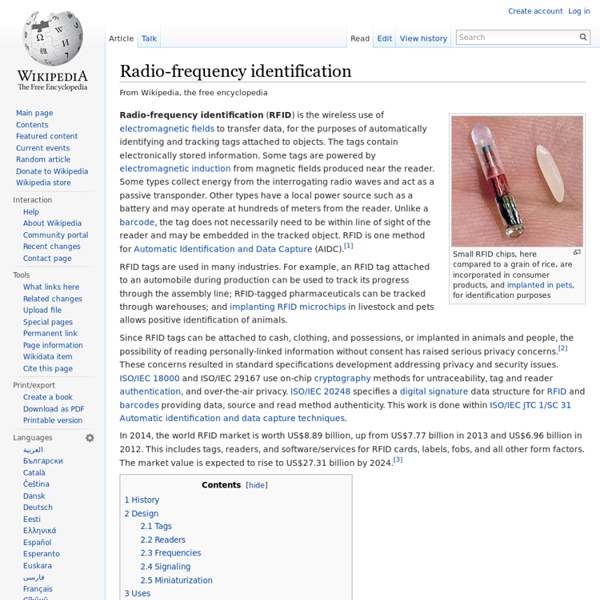
RFID (radio frequency identification): A technology that uses small, inexpensive chips attached to products (or even animals) that then transmit a unique identification number over a short distance to a special radio transmitter/receiver.
Found in: Hurwitz, J., Nugent, A., Halper, F. & Kaufman, M. (2013) Big Data For Dummies. Hoboken, New Jersey, United States of America: For Dummies. ISBN: 9781118504222. by raviii Jan 1