

http://www.odu.edu/educ/roverbau/Bloom/blooms_taxonomy.htm
Major Categories in the Taxonomy of Educational Objectives Knowledge remembering of previously learned material; of terminology; specific facts; ways and means of dealing with specifics (conventions, trends and sequences, classifications and categories, criteria, methodology); universals and abstractions in a field (principles and generalizations, theories and structures): Knowledge is (here) defined as the remembering (recalling) of appropriate, previously learned information. defines; describes; enumerates; identifies; labels; lists; matches; names; reads; records; reproduces; selects; states; views; writes;. Comprehension: Grasping (understanding) the meaning of informational materials. classifies; cites; converts; describes; discusses; estimates; explains; generalizes; gives examples; illustrates; makes sense out of; paraphrases; restates (in own words); summarizes; traces; understands. Application: The use of previously learned information in new and concrete situations to solve problems that have single or best answers.
Bloom's Taxonomy Mary Forehand The University of Georgia Introduction One of the basic questions facing educators has always been "Where do we begin in seeking to improve human thinking?" (Houghton, 2004). Fortunately we do not have to begin from scratch in searching for answers to this complicated question.
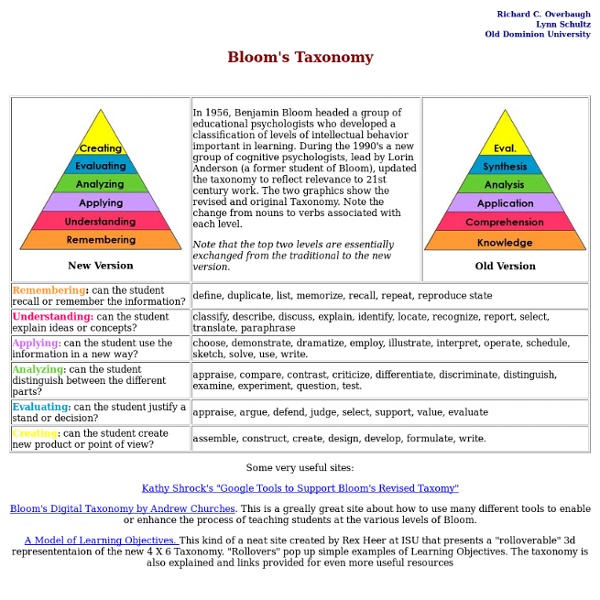
Virginia's Community Colleges: Computer Science (CSC) CSC 90 - Coordinated Internship Supervises on-the-job training in selected business, industrial or service firms coordinated by the college. Credit/practice ratio not to exceed 1:5 hours. May be repeated for credit. Definitions of Bloom's Taxonomy Activities at Various Cognitive Levels of Learning (LoL) Bloom’s taxonomy of learning objectives is used to define how well a skill or competency is learned or mastered. A fuller description of Bloom’s taxonomy is given in the following pages but a brief summary of the activities associated with each level is given below. At Knowledge Level of Learning a student can define terms At Comprehension Level of Learning a student can work assigned problems and can example what they did At Application Level of Learning a student recognizes what methods to used and then used the methods to solve problems At Analysis Level of Learning a student can explain why the solution process works At Synthesis Level of Learning a student can combine the part of a process in new and useful ways At Evaluation Level of Learning a student can create a variety of ways to solve the problem and then, based on established criteria, select the solution method best suited for the problem. What do I do at this level?
Kathy Schrock's Guide to Everything - Bloomin' Apps This page gathers all of the Bloomin' Apps projects in one place.Each image has clickable hotspots and includes suggestions for iPad, Android, Google and online tools and applications to support each of the levels of Bloom's Revised Taxonomy.I have created a page to allow you to share your favorite online tool, iOS, or Android app with others. Cogs of the Cognitive Processes I began to think about the triangular shape of Bloom's Taxonomy and realized I thought of it a bit differently.Since the cognitive processes are meant to be used when necessary, and any learner goes in and out of the each level as they acquire new content and turn it into knowledge, I created a different type of image that showcased my thoughts about Bloom's more meaningfully.Here is my visual which showcases the interlocking nature of the cognitive processes or, simply, the "Cogs of the Cognitive Processes". IPAD APPS TO SUPPORT BLOOM'S REVISED TAXONOMYassembled by Kathy Schrock
William & Mary - Computer Science Computer science is concerned with the systematic study of algorithms for describing and transforming information. The fundamental question is: what can be (efficiently) automated? Innovative computing solutions have provided the basis for advances in other fields. Along with creative, wide-ranging, and profitable careers, computer science offers practitioners the chance to make real contributions that benefit society at large. The Department of Computer Science offers an undergraduate major leading to a B.S. degree and a graduate program leading to the M.S. and Ph.D. degrees.
Bloom's Taxonomy of Learning Domains Note: This site is moving to KnowledgeJump.com. Please reset your bookmark. Bloom's Taxonomy was created in 1956 under the leadership of educational psychologist Dr Benjamin Bloom in order to promote higher forms of thinking in education, such as analyzing and evaluating concepts, processes, procedures, and principles, rather than just remembering facts (rote learning). Bloom’s Taxonomy Poster for Elementary Teachers [Updated Nov 9, 2009 - Thanks for the feedback everyone! A special thanks to Mr. Portman & Ms. Quirk for their additional comments. Department of Modeling, Simulation and Visualization Engineering The MSVE Department offers an undergraduate four-year degree program leading to the Bachelor of Science in Modeling and Simulation Engineering (BS-M&SE). The department also offers programs of graduate study leading to the degrees Master of Engineering, Master of Science, Doctor of Engineering, and Doctor of Philosophy with a major in Modeling and Simulation. The department's academic programs are coupled with a strong department research program conducted jointly with researchers from the Virginia Modeling, Analysis and Simulation Center (VMASC).