

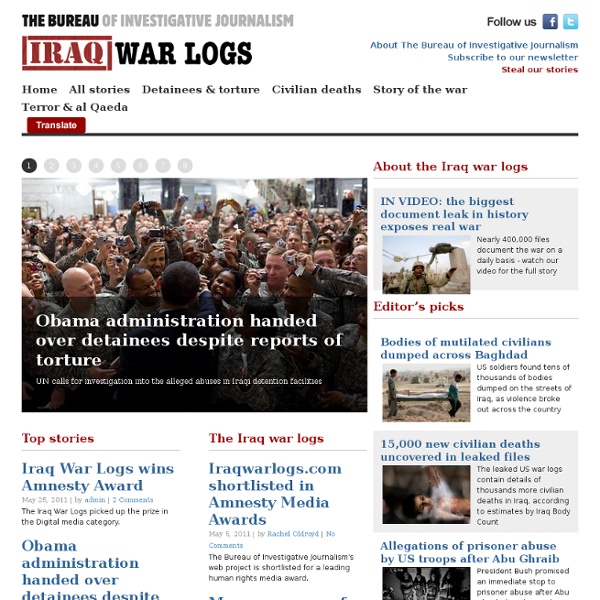
Irak : l'horreur ordinaire révélée par Wikileaks Le Monde, conjointement avec le New York Times, le Guardian, le Bureau of investigative journalism et le Spiegel, a pu consulter en avant-première 400 000 rapports de l'armée américaine en Irak, rendus publics ce vendredi par le site Wikileaks, spécialisé dans la publication de documents confidentiels. Il s'agit des rapports d'incidents, rédigés par les officiers sur le terrain, qui constituent le fichier SIGACTS ("significant activity") des forces américaines de janvier 2004 à décembre 2009. Une masse de documents qui décrivent, jour à près jour, les attentats, les échanges de tirs, les fouilles de caches d'armes, les arrestations, et les violences contre les civils. Confidentiels, les "rapports d'incidents" ne sont pas classés secret défense. L'intérêt de cette masse de documents est ailleurs : les 400 000 rapports jettent un regard nouveau sur le lourd tribut que les populations civiles ont payé à la guerre. Pour en savoir plus :
IIP leader gunned down in Mosul : Aswat Al Iraq Parallels is a worldwide leader in virtualization and automation software that optimizes computing for consumers, businesses, and Cloud services providers across all major hardware, operating systems, and virtualization platforms. For the Cloud, Parallels automation and virtualization software enables cloud services providers to rapidly and profitably deliver the widest range of cloud services that small businesses want and need. Our software includes key building blocks of cloud service delivery - self service control panels, billing, cloud service provisioning and virtualization. We enable the delivery of all types of services that small businesses need - shared web hosting and web applications, messaging and collaboration services, virtualized infrastructure services and thousands of other applications. Our Automation products allow businesses to optimize their systems to maximize profit. This website was created using our Parallels Panel product.
WikiLeaks editor defends release of classified Iraq docs The publishing of nearly 400,000 classified military documents aims to reveal hidden truths about the Iraq war, the founder of WikiLeaks said Saturday. "The attack on the truth by war begins long before war starts and continues long after a war ends," WikiLeaks editor-in-chief Julian Assange told reporters in London, England. "In our release of these 400,000 documents about the Iraq war, the intimate detail of that war from the U.S. perspective, we hope to correct some of that attack on the truth that occurred before the war, during the war and which has continued on since the war officially concluded." The whistleblower website published the military documents from the Iraq war on Friday, calling it the largest classified military leak in history. Pentagon officials had warned that it had similar concerns of exposure of Iraqi names. Hrafnsson said the website used new methodology, an electronic redaction method combined with tests done by groups of people.
Counting the Casualties of War Thousands of previously unrecognized civilian casualties of the war in Iraq were documented in a collection of classified U.S. military records that were published online October 22 by the Wikileaks organization. The unauthorized release of the records was presented with Wikileaks’ usual understatement and precision. The newly disclosed records are said to be “the first real glimpse into the secret history of the [Iraq] war,” as if there had been no declassification, no previous unauthorized disclosures of classified information, and no prior reporting on the subject in the last seven years. But setting aside the hyperbole, it seems clear that the documents significantly enrich the public record on the Iraq war, as reported over the weekend by the New York Times, the Guardian, Le Monde, Der Spiegel, Al Jazeera, and others. But the counting of casualties is an imprecise business, permitting a surprisingly broad range of credible estimates. A companion report from the CRS considers “U.S.
WikiLeaks releases secret Iraq file - Secret Iraq Files In the biggest leak of military secrets in history, WikiLeaks, the whistleblower website, has released 400,000 secret US files detailing every aspect of the war in Iraq, copies of which have been obtained by Al Jazeera. The sheer magnitude of data contained in the secret files reveals a graphic narrative of the war that goes far beyond any information about the conflict ever released into the public domain. Using thousands of classified US military reports, Al Jazeera is now able to tell the inside story of a war which left thousands dead and a country fractured along sectarian lines. Working with the Bureau of Investigative Journalism in London for the past 10 weeks, Al Jazeera has analysed tens of thousands of documents, finding facts the US has kept hidden from public scrutiny. What has been uncovered often contradicts the official narrative of the conflict. The new material throws light on the day-to-day horrors of the war.
WikiLeaks, la pire "agence de renseignement du peuple" | Rue89 Julian Assange à Londres, le 23 octobre 2010 (Luke MacGregor/Reuters). Vendredi 22 octobre, WikiLeaks révélait 400 000 documents sur la guerre en Irak - « Iraq War Logs » - soit la « plus grande fuite de l’histoire », a titré la presse. Ainsi les scoops seront désormais jugés au poids. C’est du journalisme à la pesée. Et quels scoops... Des tortures dans les prisons, des compagnies militaire privées qui se comportent comme au Far West, des innocents et des civils tués par erreur chaque jour aux checkpoints... WikiLeaks pour « les élus » vs. Ce sont pourtant ces scoops que révèlent Der Spiegel, Le Monde, The Guardian, The New York Times et Al Jazeera, les « élus » choisis pour la révélation. Incompréhensible ? Sur WikiLeaks, le ‘peuple’ aura droit à ceci. Capture d’écran des ‘Iraq War Logs’ (WikiLeaks). Une insulte pour les journalistes, du vol pour les internautes WikiLeaks brouille le jeu mondial des médias, certes, mais pour en faire quoi ? Lorsqu’on parcourt les “Iraq War Logs”...
Iraq war logs: live reaction and WikiLeaks address | World news 9.53am: A massive cache of secret US military files passed to the Guardian via the whistleblowing website WikiLeaks has revealed the devastating scale of the human rights abuses committed in the wake of the invasion of Iraq. WikiLeaks has passed almost 400,000 secret US army field reports to the Guardian and a range of other media outlets. The files are believed to have come from the same dissident US army intelligence analyst who earlier this year is alleged to have leaked 90,000 logs chronicling civilian killings and human rights abuses in the Afghan war. Read the Guardian's special report on the Iraq war logs here. The main revelations are: • US authorities failed to investigate hundreds of reports of abuse, torture, rape and even murder by Iraqi police and soldiers whose conduct appears to go unpunished. • A US helicopter gunship involved in a notorious Baghdad incident had previously killed Iraqi insurgents after they tried to surrender. "This disclosure is about the truth.
WikiLeaks: We Want to Fix "Attack on the Truth" Julian Assange, founder of WikiLeaks, speaks at a news conference in London, Oct. 23, 2010. CBS Updated at 6:45 a.m. Eastern Military documents laid bare in the biggest leak of secret information in U.S. history suggest that far more Iraqis died than previously acknowledged during the years of sectarian bloodletting and criminal violence unleashed by the 2003 U.S. "We hope to correct some of that attack on the truth that occurred before the war, during the war, and which has continued on since the war officially concluded," said Julian Assange, the founder of WikiLeaks, at a news conference Saturday morning in London. WikiLeaks Documents Detail Rape, Abuse, MurderPentagon: Iraqi Collaborators Now in Danger? John Sloboda, of the group Iraqi Bodycount, which worked with WikiLeaks to redact and release the war logs, praised the U.S. military for keeping such detailed accounts of Iraqis killed during the war - whether it was at the hands of American or Iraqi forces, or the insurgency.
Why hasn’t the US government crushed Wikileaks? So, Wikileaks has done it again. The largest military data leak in history has revealed grisly truths about the Iraq war that the US and Iraqi governments would surely prefer had never been widely known. It was clear that some serious evidence against the US was coming when almost a week ago The Pentagon urged news organisations not to publish the data. As news organisations around the world that had been analysing the war records for weeks released their reports a few hours ago, the US government condemned Wikileaks, saying they “Threatened national security”. That all seems a little “soft” though, doesn’t it? As I see it, there are a number of good reasons and the Internet is behind them all: Wikileaks organises itself online. Still, the benefit of this type of organisation is you get access to “people power” via a volunteer network around the world, while making it extremely difficult for unwanted people to infiltrate the network of descision makers.
“Hi, this is Julian Assange” » Article » OWNI, Digital Journalism While WikiLeaks relied on the greatest news outlets in the world, Julian Assange entrusted OWNI with the conception, the design and the development of the crowdsourcing application. Here is the story. Our questions. His answers. On Friday, October 8, an email appeared in our inbox, citing an “urgent request” for the team that developed the Afghanistan warlogs application. It was Sunshine Press. After such excitement, we of course accepted to go to the meeting Assange had proposed, in London, three days later. “We have the same dataset as the one you worked on. “What is the risk that this file encounters the same criticism as the first ones, especially with regards to the names of the informants?” In the end, we were told that many journalists were investigating the current corpus and that we wouldn’t have to dig out stories by ourselves. 1. We started work as soon as we signed the NDAs, while still in the London studio.
WikiLeaks: VS hield marteling stil WikiLeaks Warlogs Diary Dig Honderden gevallen van marteling, verkrachting en moord door Iraakse veiligheidsdiensten zijn met hulp van Amerika in de doofpot gestopt. Dat staat in de bijna 400.000 nieuwe documenten van het Amerikaanse leger die klokkenluiderswebsite WikiLeaks op internet heeft geplaatst. De stukken gaan over de oorlog in Irak tussen 2004 en 2010. Het gaat om het grootste lek ooit van geheime militaire documenten. WikiLeaks-woordvoerder Assange zegt in een toelichting dat de verslagen genoeg bewijs leveren om oorlogsmisdaden aan te tonen. In de documenten wordt verder melding gemaakt van het willekeurig doden van Iraakse burgers bij Amerikaanse controleposten kort na de inval in Irak in 2003. Zo zouden er volgens de documenten 109.000 Irakezen zijn omgekomen onder wie bijna 70.000 burgers. WikiLeaks bestrijdt dat, omdat alle namen, plaatsen en tijden zijn doorgehaald.