

Michael Polanyi and tacit knowledge Contents: introduction · tacit knowledge · conclusion · bibliography · how to cite this article Michael Polanyi (1891-1976) made a profound contribution both to the philosophy of science and social science. Born in Budapest into a upper class Jewish family, he studied at the University there (gaining doctoral degrees both in medicine and physical science) and at Karlsruhe. His initial work was as a physical chemist – undertaking significant work at the University of Berlin (and other universities) on crystal structure and reaction kinetics. With the rise to power in Germany of Hitler, Michael Polanyi emigrated to Britain and became Professor of Physical Chemistry at the University of Manchester (1933-1948). In a significant shift, following his growing contribution to the literature of social science and philosophy, Michael Polanyi then became Professor of Social Sciences at Manchester (1948-58). Tacit knowledge Conclusion Further reading and bibliography Mullins, P. Bibliography Links
Jean Lave and Etienne Wenger - Community of Practice As new practitioners discuss their problems with their fellows, or learn from their colleagues how to integrate the practice with the rest of their business workflow; in such a way, the CoP becomes a repository and dissemination mechanism combined for best practice - Etienne Wenger Communities of Practice: Learning, Meaning, and Identity (1998). Jean Lave and Etienne Wenger pioneer the concept of a Community of Practice (CoP) in their book, Situated Learning: Legitimate Peripheral Participation. (1991) They theorized that knowledge can be developed through social and spontaneous communities that are driven by common interests and passions, whereas innovation lies in the interaction between different communities. A community of practice defines itself along three dimensions: What it is about: A joint enterprise as understood and continually renegotiated by its members. These community of practices normally go through five stages: Lave and Wenger Further Reading Next Step
Carl Rogers Carl Ransom Rogers (January 8, 1902 – February 4, 1987) was an influential American psychologist and among the founders of the humanistic approach (or client-centered approach) to psychology. Rogers is widely considered to be one of the founding fathers of psychotherapy research and was honored for his pioneering research with the Award for Distinguished Scientific Contributions by the American Psychological Association (APA) in 1956. The person-centered approach, his own unique approach to understanding personality and human relationships, found wide application in various domains such as psychotherapy and counseling (client-centered therapy), education (student-centered learning), organizations, and other group settings. Biography[edit] Rogers was born on January 8, 1902, in Oak Park, Illinois, a suburb of Chicago. Rogers was intelligent and could read well before kindergarten. Together with his daughter, Natalie Rogers, and psychologists Maria Bowen, Maureen O'Hara,and John K.
Donald Schon (Schön): learning, reflection and change Contents: introduction · donald schon · public and private learning and the learning society · double-loop learning · the reflective practitioner – reflection-in- and –on-action · conclusion · further reading and references · links · how to cite this article Note: I have used Donald Schon rather than Donald Schön (which is the correct spelling) as English language web search engines (and those using them!) often have difficulties with umlauts). Donald Alan Schon (1930-1997) trained as a philosopher, but it was his concern with the development of reflective practice and learning systems within organizations and communities for which he is remembered. Significantly, he was also an accomplished pianist and clarinettist – playing in both jazz and chamber groups. This interest in improvisation and structure was mirrored in his academic writing, most notably in his exploration of professional’s ability to ‘think on their feet’. Donald Schon Double-loop learning and theories in use Conclusion
Aprendizaje Social. Teorias de Albert Bandura. « Psicología Social - La Coctelera 1. Atención. Si vas a aprender algo, necesitas estar prestando atención. De la misma manera, por ejemplo, estás adormilado, drogado, enfermo, nervioso o incluso “hiper”, aprenderás menos bien. Igualmente ocurre si estás distraído por un estímulo competitivo. Alguna de las cosas que influye sobre la atención tiene que ver con las propiedades del modelo. 2. 3. 4. Refuerzo pasado, como el conductismo tradicional o clásico. Refuerzos prometidos, (incentivos) que podamos imaginar. Factores que influyen en el aprendizaje observacional . *Estado del desarrollo *Prestigio y competencia del modelo *Consecuencias vicarias *Expectativas de los resultados *Establecimiento de metas *Auto-eficiencia El aprendizaje observacional en la enseñanza (cinco posibles resultados) . *Enseñar nuevas conductas y actitudes. *Promover la conducta actual (previamente aprendida). *Modificar inhibiciones (Fortalecer / Debilitar). *Dirigir la atención. *Despertar emociones Los niños ven.... los niños hacen Técnicas del modelaje.
Challenging the Presentation Paradigm with the 1/1/5 Rule A measure of how bad presentations in academia can be is the sheer number of tips and strategies we’ve suggested on ProfHacker, in a recurring series called Challenging the Presentation Paradigm. One of these techniques I’ve used in my classes for several years is the Pecha Kucha format. With 20 slides at 20 seconds per slide, a Pecha Kucha is, as Jason writes, necessarily “SHORT, INFORMAL, and CREATIVE.” However, as I’ve found out the hard way, a Pecha Kucha format does not necessarily mean students will avoid text-heavy slides, one of the major causes of DBP (Death By PowerPoint). In addition to the time constraint of the Pecha Kucha, your presentation must also follow the 1/1/5 rule. The 1/1/5 rule is just a small tweak, but it has made all the difference. Have you tried similar techniques in your classrooms? (Death by PowerPoint image courtesy of Flickr user alice_c / Creative Commons Licensed) Return to Top
Introduction to reflection, Brookfield's lenses, multimedia and further resources The perspective which underpins this lens is based on the premise that our own experiences as learners can influence our behaviour as teachers. This may have a positive or negative impact but the important point is that an ability to use our autobiographical lens will enable us to identify these personal drivers and therefore review our practices. In the following video Jenny Mackness presents her experience of blogging for reflective practice as an activity to facilitate the autobiographical lens. In the video we learn how Jenny has used the medium of blogging to examine her own personal pedagogies as an outcome of being an active participant within massive open online courses (MOOCs) Transcript of autobiograhical lens video "Blogging is a wonderful tool for reflective learning. "Stephen Brookfield has written that autobiographical self-reflection is fraught with dangers. "For me perhaps the best thing about blogging is that it is my own personal space.
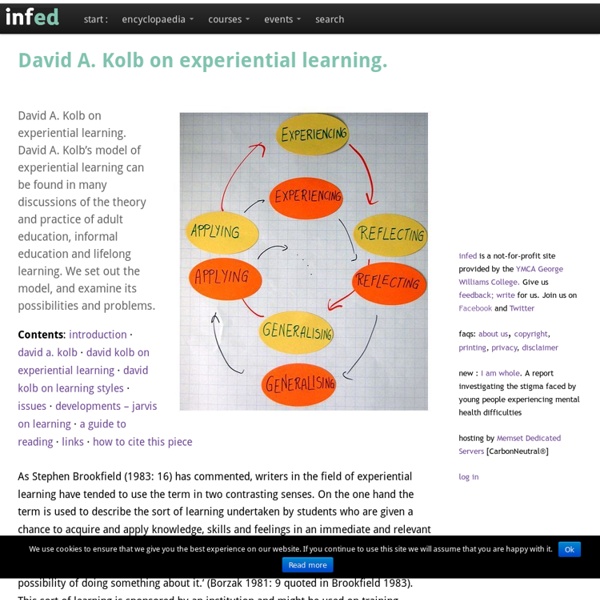
Kelly - David Kolb, The Theory of Experiential Learning and ESL The Internet TESL Journal Curtis Kellyctskelly [at] [at] gray.plala.or.jpHeian Jogakuin College (Osaka, Japan) It will soon be twenty years old, but the Theory of Experiential Learning has had little presence in ESL. "Experiential" learning is not just "fieldwork" or "praxis" (the connecting of learning to real life situations) although it is the basis for these approaches, it is a theory that defines the cognitive processes of learning. In particular, it asserts the importance of critical reflection in learning. Background: 20th Century Theories of Learning In my opinion, the greatest single event in this century that has shaped our view of teaching did not occur in the field of education at all, but rather, in psychology. In the first half of this century, a reductionist view of human behavior - behaviorialism - dominated the field. As a result, the sixties and seventies saw the reductionist view displaced by far more complex non-reductionist views. Experiential Learning Theory
Examples of Reflective Writing Types of reflective writing assignments A journal requires you to write weekly entries throughout a semester. May require you to base your reflection on course content. A learning diary is similar to a journal, but may require group participation. The diary then becomes a place for you to communicate in writing with other group members. A logbook is often used in disciplines based on experimental work, such as science. A reflective note is often used in law. An essay diary can take the form of an annotated bibliography (where you examine sources of evidence you might include in your essay) and a critique (where you reflect on your own writing and research processes). a peer review usually involves students showing their work to their peers for feedback. A self-assessment task requires you to comment on your own work. Some examples of reflective writing Social Science fieldwork report (methods section) Engineering Design Report Learning Journal (weekly reflection) References
Make It Stick — Peter C. Brown, Henry L. Roediger III, Mark A. McDaniel To most of us, learning something “the hard way” implies wasted time and effort. Good teaching, we believe, should be creatively tailored to the different learning styles of students and should use strategies that make learning easier. Make It Stick turns fashionable ideas like these on their head. Drawing on recent discoveries in cognitive psychology and other disciplines, the authors offer concrete techniques for becoming more productive learners. Memory plays a central role in our ability to carry out complex cognitive tasks, such as applying knowledge to problems never before encountered and drawing inferences from facts already known. New insights into how memory is encoded, consolidated, and later retrieved have led to a better understanding of how we learn. Many common study habits and practice routines turn out to be counterproductive.
What Are Some Strategies For Reflection Activities? Find more faculty resources Reflection strategies for classroom activities (Compiled by Professor Diane Sloan, Miami Dade College, and based on the work of Julie Hatcher and Robert Bringle's "Reflection Activities for the College Classroom": Indiana University-Purdue University Indianapolis ) It is clear that the power in learning is in the action of doing the activity. Reflection provides the same power through the action of articulating thoughts. Reflection is the necessary bridge in the learning process that takes place when a student is involved in a service-learning experience. There are the traditional strategies such as writing in journals, reporting orally in front of the class, or writing an essay describing the experience. 1. ( A note about reflection journals: a common tendency is for journal entries to become a mere log of events rather than a reflective activity in which students consider the service experience in the context of learning objectives. 1. 2. 3. 4. 5. 6. 7. 8.
Reflective thinking and writing: Schön's model How to think reflectively Schön's model Schön (1991) presented the concept of 'reflection in action' and 'reflection on action': Schön's theory is that there are two types of reflection, one during and one after an activity or event. Example of using Schön's model Reflection in action You are in a lecture and keep being distracted by thinking about what to have for lunch! Reflection on action You notice that sometimes after a lecture you can’t remember what was covered.You find out about the lecture topic in advance and write down some questions you want answered.You make notes during the lecture to help you focus.You arrange to go for a coffee after the lecture and talk with your peers about what was presented, to help you understand and form your own opinions.You file your lecture notes and any handouts. You can put these models into practice through your reflective writing.
Reflective thinking and writing: Kolb's Learning Cycle How to think reflectively Kolb's Learning Cycle Kolb's Learning Cycle (1984) has four elements of a loop which you can start at any point, though normally you start with an experience: Figure 1: Kolb's Learning Cycle The four elements of Kolb's Learning Cycle Experience -doing itObservations and reflections- reviewing and reflecting on the experienceDevelopment of ideas- learning from the experienceTesting ideas in practice- planning, trying out what you have learned Example of using Kolb's Learning Cycle ExperienceYou give a 5 minute presentation in class and received low marks for presentation style.Observations and reflectionsYou over ran the 5 minutes and kept forgetting what you wanted to say.Development of ideasYou spoke to your lecturer and the Learning Skills tutor to get some advice on presentation techniques.
Link proposed by: Luis Rodriguez by kobda Oct 31