
background preloader

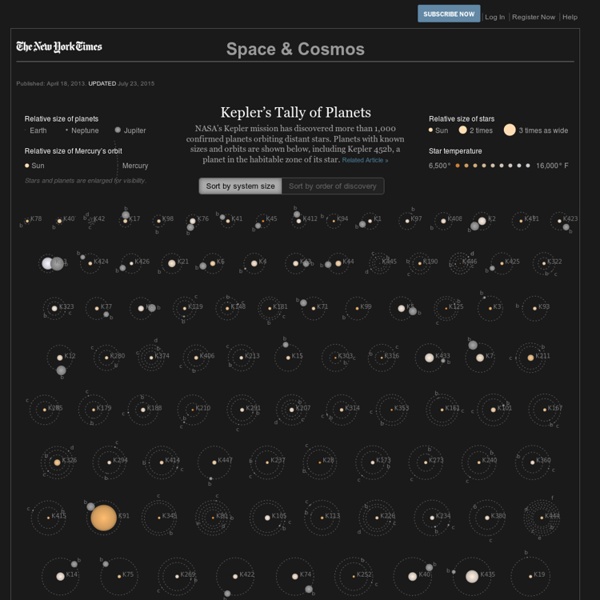
Kepler’s Tally of Planets - Interactive Feature

Kepler’s Tally of Planets - Interactive Feature

Albert Einstein Told Marie Curie To Ignore The Haters In November 1911, Marie Skłodowska-Curie was weeks away from being awarded the Nobel Prize in Chemistry. She received her first Nobel in 1903 for Physics, and the new award meant that she was the first person ever to receive two Prizes. She remains the only person to be recognized in two different sciences. Though her extraordinary work as a scientist should have been all anyone cared about, it seemed that many were preoccupied with her personal life. Pierre Curie died in 1906, leaving Marie as a widow. Curie, Langevin, and about 20 other scientists were invited to an elite, invitation-only conference in Brussels in the fall of 1911. Albert Einstein—who had just recently been introduced to Curie at the Brussels conference—was disgusted by the media’s actions, prompting him to write this letter to his new friend: Translation: Haters gonna hate. (Sidenote: “Perrin” refers to Jean Perrin, a family friend of the Curies and Langevins, who defended Curie in the aftermath)

Kepler spots two super Earths, one squarely in the habitable zone Liquid water is one of the essential ingredients of life on Earth and it has properties conducive to life in general, so researchers have defined the concept of a habitable zone with water as its focus. For astronomers, the habitable zone is the area far enough from a host star that a planet would be cool enough to support liquid water, but not so far that the water would be frozen. Although there are many caveats to this definition—everything from the presence of greenhouse gasses to clouds will shift a planet's average surface temperature—the concept helps drive the search for a planet capable of supporting life. The caveats, however, have led to a number of arguments over whether a given exoplanet is likely able to host liquid water, with some candidates shifting in and out of the habitable zone more than once. Still, it's pretty clear that given the large number of reported candidate exoplanets, the odds suggest we've already spotted one.

Metallica a joué le tout premier concert de l'Histoire en Antarctique Ils l’avaient promis, voilà qu’ils l’ont fait. Metallica s’est bel et bien produit en Antarctique dimanche 8 décembre pour ce qui est aujourd’hui le tout premier concert jamais donné sur le continent le plus au sud (et le plus hostile) de la planète Terre. Et les Four Horsemen ont même réussi à jouer devant un public réuni pour l’occasion : organisé en partenariat avec Coca-Cola Zero, l’évènement a permis aux titans du thrash metal d’inviter des fans latino-américains gagnants d’un concours organisé pour l’occasion. Le concert s’est déroulé sur la base argentine de Carlini, sous un dôme de verre protégeant le groupe et les metalheads du froid (-12 selon la Chaîne Météo qui précise que c’est la zone la plus douce de l’Antarctique). Une première pour Metallica : en plus de jouer sur le continent entourant le pôle Sud, la bande de James Hetfield a donné son concert par le biais d’écouteurs à son public présent sur place.

ESO News Astronomers have used ESO’s Very Large Telescope, along with radio telescopes around the world, to find and study a bizarre stellar pair consisting of the most massive neutron star confirmed so far, orbited by a white dwarf star. This strange new binary allows tests of Einstein’s theory of gravity — general relativity — in ways that were not possible up to now. So far the new observations exactly agree with the predictions from general relativity and are inconsistent with some alternative theories. The results will appear in the journal Science on 26 April 2013. The release, images and videos are available on: Translations are available in: Czech, Danish, Dutch, Finnish, French, German, Icelandic, Italian, Norwegian, Polish, Portuguese/Brazil, Portuguese/Portugal, Russian, Spanish, Swedish, Turkish, Ukrainian Space Scoop - the children's version of this release is available at:

PanelPicker This past year, students from around the world came together to collaborate on world issues affecting their communities, taking the concept of global learning and turning it into a reality. In GlobalCOlab (GCL), Students teaching students from around the world, has connected students and educators from different cultures and religions from around the world to cross-cut disciplines, curricula, and traditional subjects to empower participants through student-led and student-created topics. These topics are based around global issues affecting each student’s community. GCL educators will discuss the need for an educational paradigm shift towards a global classroom in a one hour panel format. Additional Supporting Materials Questions Answered Speakers Organizer Brian Jones GlobalCOlab Show me another

Orbital Sciences : l'espace public devient de plus en plus privé Pour mettre un satellite en orbite ou envoyer une capsule ravitailler la Station spatiale internationale, il n'y a plus besoin que des gouvernements forts demandent un effort national. Il suffit simplement de décrocher son téléphone et de demander à des sociétés privées si elles ont un vol libre dans les 10 prochaines années. Aujourd'hui, Orbital Sciences Corp vient de réussir son premier vol d'essai en envoyant sa fusée Antares embarquant 3,8 tonnes de charge en orbite autour de la Terre. Orbital Sciences est une des 2 sociétés (l’autre s’appelle SpaceX) à avoir décroché un contrat avec la NASA pour ravitailler la Station spatiale internationale tant que les États-Unis n’ont pas de navette ou de capsule exploitable. Le vol d’essai de la fusée Antares était initialement prévu, il y a plus d’un an. Le lancement était prévu mercredi, mais comme la malchance a décidé de s’acharner sur Orbital Sciences, le vol d’essai a encore été retardé 2 fois. Photo : NASA/Bill Ingalls

Facebook: Burger King préfère perdre des fans mais gagner des fidèles Five years of stereo imaging for NASA's TWINS Jun 21, Astronomy & Space/Space Exploration Since 2008, NASA's two TWINS spacecraft have been providing a sterescopic view of the ring current -- a hula hoop of charged particles that encircles Earth. Credit: J. Goldstein/Southwest Research Institute (Phys.org) —Surrounding Earth is a dynamic region called the magnetosphere. On June 15, 2008, a new set of instruments began stereoscopic imaging of this mysterious region. In five years of operation, the TWINS maps have provided three-dimensional images and global characterization of this region. "With two satellites, with two sets of simultaneous images we can see things that are entirely new," said Mei-Ching Fok, the project scientist for TWINS at NASA's Goddard Space Flight Center in Greenbelt, Md. Each spacecraft is in a highly elliptical orbit called a Molniya orbit, during which the spacecraft spend most of their time around 20,000 miles above Earth, where they get a great view of the magnetosphere.

Related: