

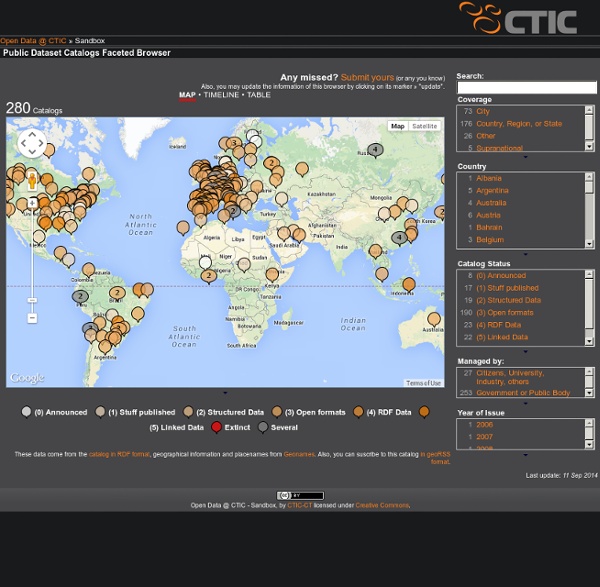
http://datos.fundacionctic.org/sandbox/catalog/faceted/
Datacenter Portail Volobsis VOLOBSIS is a portal to access data collected in the French volcanological and seismological observatories managed by the Institut de Physique du Globe (IPGP). Currently, in its first version, VOLOBSIS gives access to continuous GPS data and catalogs of seismic events with waveforms.Link to the Volobsis portal Realtime seismic data (seedlink) Tou can access to the realtime seismic data using the seedlink protocol (**). Perceptual Edge - Library Contents Books Articles Whitepapers Other Brief Publications Books Information Dashboard Design: Displaying data for at-a-glance monitoring, Second Edition, Stephen Few, $40.00 (U.S.), Analytics Press, 2013
Government data UK: what's really been achieved? "I think this project is doomed" - not perhaps what you expect on the front page of a website launched to huge fanfare a year ago today by Sir Tim Berners-Lee, the British inventor of the world wide web. One year after the Labour government launched the data.gov.uk portal, intended to provide a front door to a library of government data that developers in the outside world could use to analyse trends and create commercial services, there is disquiet that the initial enthusiasm has worn off and that civil servants are quietly blocking widespread release of useful information. Peter Austin, a web developer using the site, commented : "I became a member of this community nearly a year ago.
How DBpedia Treats Wikipedia as a Database - ReadWriteCloud DBpedia is a community driven effort that treats Wikipedia like a database, enabling people to do more sophisticated queries, distribute the open encyclopedia's data to the Web and add back to Wikipedia for the purposes of enriching it. In a blog post this week, the community showed again what makes the service a unique effort with the launch of the latest version of the technology. You can get into the weeds pretty quick with DBpedia when seeking to better understand how it functions. We see it useful to think of it in terms of context. On Wikipedia, you can do keyword searches for the Rhine River in Germany. But you can't ask it questions that have more context such as the rivers that flow into the Rhine that are longer than 50 kilometers.
Products: Servers: SGI Altix UV Altix is a brand name that holds a huge amount of cachet in the world of technical and high-performance computing. SGI launched the Altix name in 2002, and the products under this brand have continually proven their worth among the most powerful computers in the world, as evidenced both by the number of appearances in the TOP500 and results of SPEC benchmarking. Overview As SGI evolves its product lines, the newest and most powerful of our large-scale servers are no longer branded "Altix". Use this table to learn how to find your formerly-branded Altix products.
Visualising Ad Hoc Tweeted Link Communities, via BackType So you’ve tweeted a link as part of your social media/event amplification strategy, and it’s job done, right? Or is there maybe some way you can learn something about who else found that interesting? Notwitshtanding the appearance of yet another patent of the bleedin’ obvious, here’s one way I’ve been experimenting with for tracking informal, ad hoc communities around a link. OpenData Marseille, 6 juillet 2011 Sous le haut patronage du Premier Ministre Monsieur François FILLON Under the patronage of Ms Neelie Kroes, Vice-President of the European Commission Putting Linked Data to work: A developer’s perspective « The LUCERO Project This is a guest post by Liam Green-Hughes, a developer at The Open University, relating his experience with Linked Data to date, and his initial use of Linked Data from Over the last few months I have been on a bit of a journey in the world of Linked Data. It has had highs and lows, frustrations and triumphs, but in the end it was worth it. When you first enter the world of the “Linked Data movement” the terminology can be baffling it is a world of “triples”, “RDF”, “SPARQL” and lots of other terms that will come as news to many developers. Yet when you see past all that it turns out it is a genuinely useful concept to developers like me.
Google Cleans Up Messy Data with Refine If you live for data, slave over spreadsheets and constantly find yourself sifting through endless rows and columns of facts and figures, Google's got a lovely new product just for you — and it's free and open-source, too. Google Refine is a project born of Freebase Gridworks, a data-cleaning tool Google acquired when it bought Metaweb during the summer. Google has since renamed Gridworks and relaunched it as Refine.
C Semantic Web Activity The Semantic Web is a web of data. There is lots of data we all use every day, and it is not part of the web. I can see my bank statements on the web, and my photographs, and I can see my appointments in a calendar. the 5 stars of open linked data While perusing the minutes of today’s w3c egov telecon I noticed mention of Tim Berners-Lee’s Bag of Chips talk at the gov2.0 expo last week in Washington, DC. I actually enjoyed the talk not so much for the bag-of-chips example (which is good), but for the examination of Linked Data as part of a continuum of web publishing activities associated with gold stars, like the ones you got in school. Here they are: