Amid bankruptcy, Detroit has a bigger problem: Column
Last week, the city of Detroit filed for Chapter 9 bankruptcy, leaving many of its residents wondering what this will mean for their families, their neighborhoods and their economic security. Whether it turns out to be a real opportunity to turn things around — or a trajectory to an uncertain, grim future — remains to be seen. The problem is that even before bankruptcy was declared, Detroit's children were in deep trouble. And while Detroit may be the only major city in America filing for bankruptcy, it is far from the only place where children are living in dire conditions. According to the Annie E. A recent study out from First Focus shows that federal spending on programs serving the country's children has decreased three years in a row, falling by $35 billion. Many other countries have long understood the devastating consequences of poverty and are making the necessary investments to achieve a prosperous future. Read or Share this story:
The Reasons Behind Detroit’s Decline by Pete Saunders
My hometown of Detroit has been studied obsessively for years by writers and researchers of all types to gain insight into the Motor City’s decline. Indeed, it seems to have become a favorite pastime for urbanists of all stripes. How could such an economic powerhouse, a uniquely American city, so utterly collapse? Most analysis tends to focus on the economic, social and political reasons for the downfall. One of my favorite treatises on Detroit is The Origins of the Urban Crisis by Thomas Sugrue, who argues that housing and racial discrimination practices put in place after World War II played a primary role in the decline of Motown. Everyone seems to know the shorthand narrative for Detroit’s fall. But here’s the thing. So why has Detroit suffered unlike any other major city? Detroit’s decline has been going on far longer than most people realize, because of the city’s lack of attention to creating a pleasant built environment. Emphasis added. 1. 2. 3. 4. 5. 6. 7. 8. 9.
The impact on Detroit Public Schools after bankruptcy
In the wake of the bankruptcy filing for the city of Detroit, there is a population that has not been talked about much....the Detroit Public School children. Everyone in Detroit is impacted by the financial downfall of the once great American city. As we fight for funds for our schools in our own Midwestern state we need to learn from our neighbors, advocate for protecting and expanding the education budget in Springfield, and make smart choices with the limited resources that we do have. Check out this article from NBC. Shrinking population, heavy debt make turnaround tough for Detroit schools By Daniel Arkin, Staff Writer, NBC News Michigan’s governor on July 15 appointed a seasoned financial guru to run Detroit’s ailing public school district, a move that many observers hailed as a saving grace for the city's classrooms in decline. Three days later, Detroit filed for bankruptcy. And that’s been the case for years. “The district was in dire straits long before the bankruptcy,” Moje said.
Anatomy of Detroit’s Decline - Interactive Feature
Mayor Coleman A. Young of Detroit at an event in 1980. Richard Sheinwald/Associated Press The financial crisis facing Detroit was decades in the making, caused in part by a trail of missteps, suspected corruption and inaction. Here is a sampling of some city leaders who trimmed too little, too late and, rather than tackling problems head on, hoped that deep-rooted structural problems would turn out to be cyclical downturns. Charles E. Edward Jeffries, who served as mayor from 1940 to 1948, developed the Detroit Plan, which involved razing 100 blighted acres and preparing the land for redevelopment. Albert Cobo was considered a candidate of the wealthy and of the white during his tenure from 1950 to 1957. Coleman A. Kwame M. Dave Bing, a former professional basketball star, took office in 2009 pledging to solve Detroit’s fiscal problems, which by then were already overwhelming. Related
National Review Online
It took only six decades of “progressive” policies to bring a great city to its knees. By the time Detroit declared bankruptcy, Americans were so inured to the throbbing dirge of Motown’s Greatest Hits — 40 percent of its streetlamps don’t work; 210 of its 317 public parks have been permanently closed; it takes an hour for police to respond to a 9-1-1 call; only a third of its ambulances are driveable; one-third of the city has been abandoned; the local realtor offers houses on sale for a buck and still finds no takers; etc., etc. — Americans were so inured that the formal confirmation of a great city’s downfall was greeted with little more than a fatalistic shrug. But it shouldn’t be. To achieve this level of devastation, you usually have to be invaded by a foreign power. In the War of 1812, when Detroit was taken by a remarkably small number of British troops without a shot being fired, Michigan’s Governor Hull was said to have been panicked into surrender after drinking heavily.
Six grueling demographic indicators of Detroit’s decline (and some pictures)
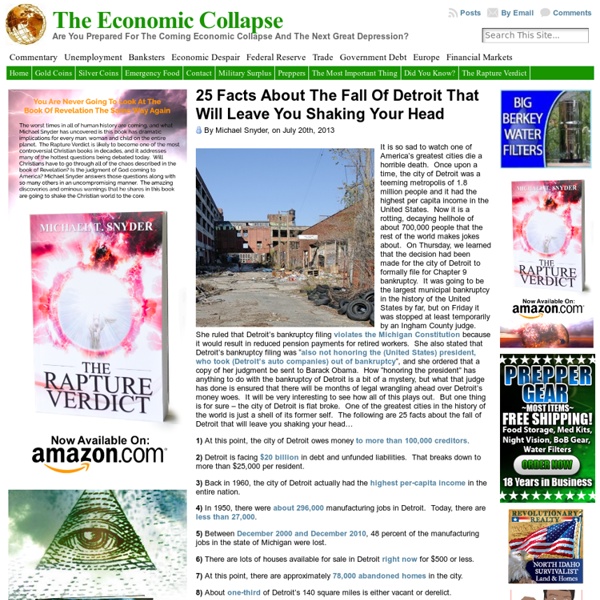
You don’t have to be an expert on the collapse of Detroit, which I’m not, to know it’s really bad. In fact, does modern world history include any other city once this big (1.87 million at its peak) losing two-thirds of its population? And you don’t have to be an expert in social policy, which I’m not, to know that the United States wouldn’t let this happen if it cared. Detroit’s condition has bobbed into the national news now and then. Here are six more demographic indicators of the condition of Detroit, from data collected by the Census Bureau*, and then a few pictures. 1. This is it, in a nutshell: A drop in population of 64% since 1950, during which time the city’s population shifted from 16% Black to more than 80% Black. Of course, Detroit isn’t the only city to fall on hard times. 2, 3. I put these indicators together because they are so closely intertwined: 4, 5. Chronic economic hardship and uncertainty both limit options for long-term partners and stress existing marriages. 6.