

Bloomin' Apps This page gathers all of the Bloomin' Apps projects in one place.Each image has clickable hotspots and includes suggestions for iPad, Android, Google and online tools and applications to support each of the levels of Bloom's Revised Taxonomy.I have created a page to allow you to share your favorite online tool, iOS, or Android app with others. Cogs of the Cognitive Processes I began to think about the triangular shape of Bloom's Taxonomy and realized I thought of it a bit differently.Since the cognitive processes are meant to be used when necessary, and any learner goes in and out of the each level as they acquire new content and turn it into knowledge, I created a different type of image that showcased my thoughts about Bloom's more meaningfully.Here is my visual which showcases the interlocking nature of the cognitive processes or, simply, the "Cogs of the Cognitive Processes". IPAD APPS TO SUPPORT BLOOM'S REVISED TAXONOMYassembled by Kathy Schrock Bloom's and SAMR: My thoughts
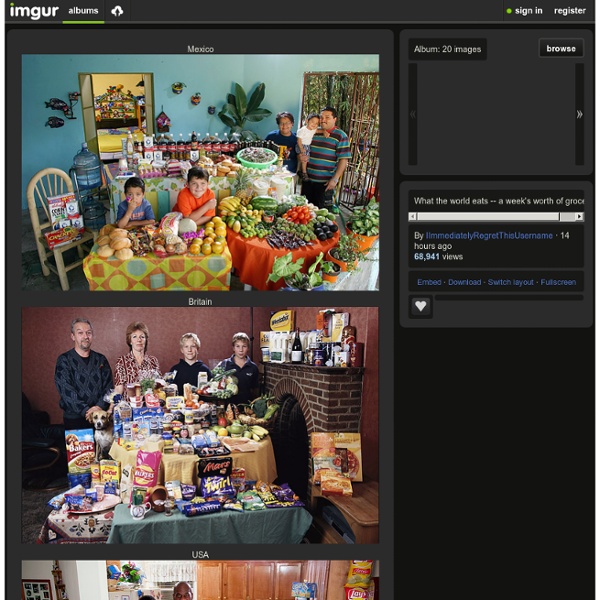
Que mangez-vous en une semaine ? En une semaine, que mange une famille au Tchad ? En Australie ? En Allemagne ? Pour le savoir, rendez-vous sur une page du site réalisé par la Cité des sciences de Paris à l'occasion de son exposition "Bon appétit", qui vous permettra d'associer six pays aux photos représentant une famile devant ce qu'elle mange en une semaine. L'exercice n'est pas difficile, mais néanmoins instructif, comme en témoignent les commentaires laissés sous ce quiz. Grâce à une loupe, on observera le détail des aliments consommés. Nous n'en dirons pas plus. Les photos faisant l'objet du quiz ont été réalisées par Peter Menzel, un photographe allemand de renommée internationale, dont le dernier ouvrage est précisément consacré à la nourriture dans le monde. Niveau : Primaire
NASA or MOMA? Play the Game! - Megan Garber Here are some pictures. Were they taken in space, or painted here on Earth? One of the most enduring and inspiring side effects of space exploration is the pictures -- pictures of Earth taken from new heights; pictures of Earth's neighbors, taken from new angles; pictures that resemble, and in fact are, art. They are magical. They are mysterious. And they often resemble art of a more earthly variety. Scroll down for the key. 1. 2. 3. 4. 5. 6. 7. 8. 9. 10. 11. 12. 13. 14. 15. 16. 17. 18. 19. 20. Key: 1.
27 Ways To Make Your Groceries Last As Long As Possible Questioning | Marginal Learning Gains When it comes to Marginal Learning Gains, it is a real challenge to include QUESTIONING as an area where there could be a Marginal Learning Gain. There are many who would argue that if all we did was to concentrate on questioning, the gains for learning would be massive. With that in mind, the only way to include questioning in our suite of MLGs is to start to break it down into its own component parts. Quality questioning provides a great source for each of the Three As of Motivation in the following ways… AFFILIATION – Establishes a safe environment to encourage speculation, sharing of ‘best thinking’ and articulation of ideas AGENCY - Encourages a sense of self-efficacy as questions that are well-pitched, targeted and directed will elicit thoughtful and accurate responses AUTONOMY - Different types of questions and be used to encourage decision-making and self-direction by requiring students to reflect on their own and each others’ thinking and responses 1. 2. Like this: Like Loading...
Joshua Bell Plays in a Subway Station Forwarded email describes what happened when acclaimed classical violinist Joshua Bell appeared incognito on a subway platform in Washington, D.C. one cold winter morning and played his heart out for tips. Description: Forwarded email Circulating since: Dec. 2008 Status: True (see details below) Example:Email text contributed by Bill B., Dec. 17, 2008: A Violinist in the Metro A man sat at a metro station in Washington DC and started to play the violin; it was a cold January morning. Analysis: True. "No one knew it," explained Washington Post reporter Gene Weingarten several months after the event, "but the fiddler standing against a bare wall outside the Metro in an indoor arcade at the top of the escalators was one of the finest classical musicians in the world, playing some of the most elegant music ever written on one of the most valuable violins ever made." And how did they react? Which is fair to ask. Sources and further reading:
How to Cook Moist & Tender Chicken Breasts Every Time Boneless, skinless chicken breasts (aka BSCBs) — is there anything more boring? They are all too often overcooked until dry and chewy, and I generally prefer more succulent boneless, skinless thighs. But for lunch and dinner favorites like chicken Caesar salad and chicken pasta, sliced juicy chicken breasts can't be beat. They're a great staple for quick lunches, too. Fortunately I have one method that makes unfailingly juicy and tender boneless, skinless chicken breasts. A Method That Requires Trust! This method takes trust; you can't check the chicken breasts or watch them cooking. So you can't peek, and you have to trust us. Watch the Video Error loading player: No playable sources found Simple chicken, for salads and rice bowls. (Image credit: Leela Cyd) Seasoning the Chicken This method alone makes plain, simple chicken breasts — a blank slate to be used on top of salads, rice dishes, and tacos. Tester's Notes What You Need Ingredients Equipment Instructions Recipe Notes
Six Thinking Hats® Six Hats® ... A Critical and Creative Thinking Process that improves listening, speaking, reading and writing and is fun for ALL! Penn Hills PAGE Presentation " A special thank you to Franny for introducing me to the thinking hats and opening me up to becoming a better teacher by teaching my students to think about thinking." Improve academic performance in reading and writing with SIX THINKING HATS®. think using six strategies problem solve make clear decisions design quality questions self assess collaborate more effectively The Research -- "Develop Critical and Creative Thinking Skills: Put on Six Thinking Hats®," PA Educational Leadership During the workshop the teachers will collaborate to learn the Six Hats® process and apply it to their content areas and standards. Six Thinking Hats® Cards: Key Words, Applications, Standards, and Examples How to Differentiate Instruction Using Six Hats® and 6 Product Choices- PowerPoint Getting Started: How to Teach Six Hats® to Your Students
The Norwegian prison where inmates are treated like people | Society The first clue that things are done very differently on Bastoy prison island, which lies a couple of miles off the coast in the Oslo fjord, 46 miles south-east of Norway's capital, comes shortly after I board the prison ferry. I'm taken aback slightly when the ferry operative who welcomed me aboard just minutes earlier, and with whom I'm exchanging small talk about the weather, suddenly reveals he is a serving prisoner – doing 14 years for drug smuggling. He notes my surprise, smiles, and takes off a thick glove before offering me his hand. Before he transferred to Bastoy, Petter was in a high-security prison for nearly eight years. There are big differences between the two countries, of course. Despite the seriousness of their crimes, however, I found that the loss of liberty was all the punishment they suffered. As the ferry powers through the freezing early-morning fog, Petter tells me he is appealing against his conviction. I wasn't sure what to expect on Bastoy.
What are some great recipes which change your standard daily eggs and make them go from "eh.." to "WOAH HOLD UP A SECOND HERE!!!" : Cooking Ten Takeaway Tips for Teaching Critical Thinking Suggestions from educators at KIPP King Collegiate High School on how to help develop and assess critical-thinking skills in your students. Ideally, teaching kids how to think critically becomes an integral part of your approach, no matter what subject you teach. But if you're just getting started, here are some concrete ways you can begin leveraging your students' critical-thinking skills in the classroom and beyond. 1. Questions, questions, questions. Questioning is at the heart of critical thinking, so you want to create an environment where intellectual curiosity is fostered and questions are encouraged. In the beginning stages, you may be doing most of the asking to show your students the types of questions that will lead to higher-level thinking and understanding. 2. Pose a provocative question to build an argument around and help your students break it down. 3. 4. 5. Lively discussions usually involve some degree of differing perspectives. 6. 7. 8. 9. 10.
Toy Stories | gabriele galimberti If Riverboom’s photographer Gabriele Galimberti had happened to shoot me, aged 6 and surrounded by my favorite toys, he would have seen the following: plastic medieval weaponry; assorted Lego (Space, Castle and Pirate); an inflatable Tyrannosaurus rex (punctured slowly into extinction); a Superman action figure (I lost it and hyperventilated with grief); a pair of cuddly rabbits (Sally and Billy); toy cars; a tiny guitar; a plane you launched with an elastic catapult; a replica pistol I thought my mum didn’t know about. Everyone remembers their childhood toys. The fact that I can recall how most of mine tasted better than I can remember the names of my primary school teachers says everything you need to know about the universe kids inhabit. But how they play can reveal a lot. “The richest children were more possessive. Yet even children worlds apart share similarities when it comes to the function their toys serve. Ben Machell – The Times Magazine
The Student Epicure: Shakshouka! Whoa, that's a mouthful! I first discovered this Middle Eastern breakfast staple at the inimitable Sofra Bakery and Cafe in Watertown, MA. I worship the chef Ana Sortun and this wonderful dish only adds to her allure. The recipe came by way of Libya and consists of tomatoes, onions, garlic and spices in which whole eggs are poached until just cooked. This version is inspired by the recipe I found on Saveur , though I have amended it to more closely resemble the version at Sofra by pureeing the vegetables before poaching the eggs. I love to eat this for dinner, though obviously it is delicious for any meal of the day. My mother brings me amazing multicolored eggs from The Berkshires. Shakshouka after Saveur Staples: olive oil, salt and pepperSpecial equipment: a frying pan, skillet, or small pan that can be put in the oven Return puree to the skillet and over medium heat bring the it back to a simmer.
15 Legitimate Ways Daydreaming Improves Thinking 15 Legitimate Ways Daydreaming Improves Thinking The student’s eyes drift to the classroom window and the teacher’s voice fades from consciousness. The daydream begins. It’s a familiar scene, one we have likely both experienced as students and struggled against in our students as teachers. But daydreaming is not what it might seem. Recent research in both psychology and neuroscience makes clear that daydreaming is an essential part of mental processing, reasoning and, yes, even learning. 1. The most common view of the human mind assumes that our normal way of thinking consists of concentrated focus upon immediate tasks at hand. Daydreaming is now considered to be the normal state of our minds, with focus appearing as a break from the more common mind wandering. Another study has shown that the parts of the brain stimulated during daydreaming consist of the “default network” regions of the brain that are associated with most higher level mental activity. 2. 3. 4. 5. 6. 7. 8. 9. 10. 11.