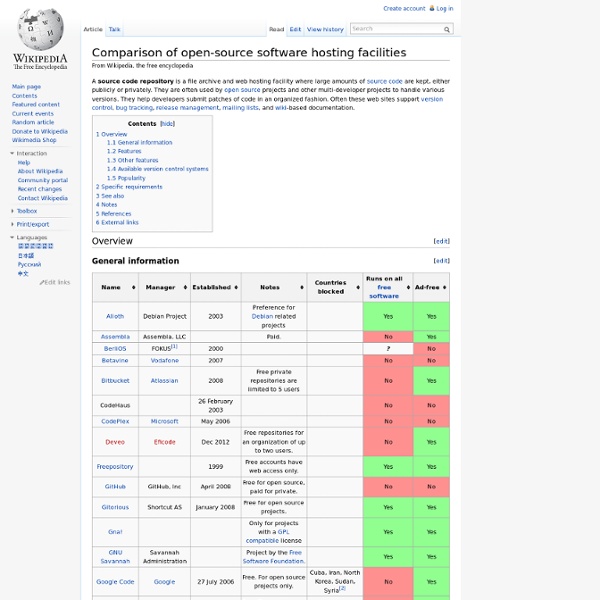
Comparison of open source software hosting facilities
Comparison of different SQL implementations
The goal of this page — which is a work in progress — is to gather information relevant for people who are porting SQL from one product to another and/or are interested in possibilities and limits of 'cross-product' SQL. The following tables compare how different DBMS products handle various SQL (and related) features. If possible, the tables also state how the implementations should do things, according to the SQL standard. I will only write about subjects that I've worked with personally, or subjects which I anticipate to find use for in the near future. Subjects on which there are no significant implementation variances are not covered. Beta-versions of software are not examined. I'm sorry about the colors. If you have corrections or suggestions, please contact me; even notifications about spelling errors are welcome. Legend, definitions, and notes The following SQL standard and implementations have been examined, if not otherwise stated: Features Views Join types and features Remarks: Note:
Introduction
What is Arduino? Arduino is a tool for making computers that can sense and control more of the physical world than your desktop computer. It's an open-source physical computing platform based on a simple microcontroller board, and a development environment for writing software for the board. Arduino can be used to develop interactive objects, taking inputs from a variety of switches or sensors, and controlling a variety of lights, motors, and other physical outputs. Arduino projects can be stand-alone, or they can communicate with software running on your computer (e.g. Flash, Processing, MaxMSP.) The Arduino programming language is an implementation of Wiring, a similar physical computing platform, which is based on the Processing multimedia programming environment. Why Arduino? There are many other microcontrollers and microcontroller platforms available for physical computing. Inexpensive - Arduino boards are relatively inexpensive compared to other microcontroller platforms.
Desktop CPU Comparison Guide Rev. 3.2
Desktop CPU Comparison Guide There are so many CPU models that it has become quite impossible to keep up with the different models or even remember their specifications! Therefore, we decided to compile this guide to provide an easy reference for those who are interested in comparing the specifications of the various desktop CPUs in the market, as well as those already obsolescent or obsolete. Currently covering 989 desktop CPUs, this comprehensive comparison will allow you to easily compare 19 different specifications for each and every CPU. We hope it will prove to be a useful reference. We will keep this guide updated regularly so do check back for the latest updates! To make it easy to compare the specifications, we split it up into three sections for your convenience. Support Tech ARP! If you like our work, you can help support out work by visiting our sponsors, participate in the Tech ARP Forums, or even donate to our fund. Questions & Comments
Appropedia
Arthur Weasley
Molly Weasley: "Your sons flew that enchanted car of yours to Surrey and back last night." Arthur Weasley: "Did you really? How did it go?" Arthur Weasley (b. 6 February,[1] 1950) was a pure-blood wizard in the employ of the Ministry of Magic, as well as a member of the second Order of the Phoenix. He was a staunch believer in the equality of all magical and Muggle people and the patriarch of the Weasley family. Arthur was born to Septimus and Cedrella Weasley (née Black) and had at least two brothers. Biography Early life and Hogwarts years Arthur was born on 6 February, 1950[1] to Septimus and Cedrella Weasley (née Black).[4] His mother was disowned for marrying a "blood traitor," as her family believed strongly in the notion of pure-blood supremacy. He attended Hogwarts School of Witchcraft and Wizardry from 1961 to 1968 and was sorted into Gryffindor House. First Wizarding War Ginny: "Including you and Dad." — Molly Weasley reflecting on her marriage in 1996[src] Between the wars
Related:
Related:

