

Google Reader to shut down July 1st Google has announced yet another spring cleaning of its various services, and this time around, the company is giving the axe to its Google Reader RSS aggregator. The service, which originally launched back in 2005, will be officially put out to pasture on July 1st, 2013. Reader has gone through a number of iterations, but it had not been significantly updated in a long time. The last time that Google updated the product, it built in integration for the Google+ social network and removed Reader's own native sharing service, causing a bit of a backlash with die hard users. Google is offering users a way to export their Reader content, including lists of users that they follow and starred and liked articles. In addition to killing off Reader, beginning next week Google is ending support for the Google Voice app for BlackBerry smartphones, instead pointing users toward the HTML5 webapp. Lack of usage and a 'focus on fewer products' are to blame
Fermeture de Google Reader – Comment survivre ? Google vient d'annoncer l'air de rien sur son blog que son célèbre lecteur de flux RSS Google Reader allait tirer sa révérence après 8 années de bons et loyaux services. Évidemment, ça hurle dans les chaumières ! Tous les amateurs de veille (oui, je n'ai pas dit de "vieille" mais ça peut marcher aussi), tous les journalistes, tous les blogueurs et j'en passe se voient déjà à la rue, s'impatientant du rendez-vous journalier à la machine à café pour faire le plein de news fraiches. Avant toute chose, il faut savoir que Google Reader c'était : Une application web et mobileUne API super cool Et tout ceci (SURPRISE !!!) La décision subite de Google de tout arrêter n'a pas été réellement justifiée. Maintenant, concrètement, je ne pense pas qu'il faille céder à la panique. Certains s'imaginent déjà que Google va passer son service en open source, mais je pense que là-dessus, on peut se toucher. Une sur le téléphone, une sur la tablette, une sur l'ordi...etc. Et bien c'est simple...
Fear Not, Digg Is Building a Google Reader Alternative Fresh off the news that Google will be shuttering Reader at the beginning of July, Digg announced Thursday that it will release its own Google Reader alternative. “We’ve heard people say that RSS is a thing of the past, and perhaps in its current incarnation it is, but as daily (hourly) users of Google Reader, we’re convinced that it’s a product worth saving. So we’re going to give it our best shot," Digg’s Andrew McLaughlin said in a blog post. While the blog post was timed around news of Reader’s demise, McLaughlin says that Digg had been planning to create an RSS reader for some time. “We’ve been planning to build a reader in the second half of 2013, one that, like Digg, makes the Internet a more approachable and digestible place. Digg hopes to have its Google Reader alternative up and running before Google ends service for Reader on July 1. Digg hopes to have its Google Reader alternative up and running before Google ends service for Reader on July 1.
Google Closes The Book On Google Reader On July 1, Seven Other Products Also Get The Chop Google just revealed plans to shut down eight of its services as part of what it’s calling an ongoing spring cleaning effort. Some of them are pretty arcane, but among TechCrunch writers, anyway, we’re pretty bummed to see that Google Reader will be shut down on July 1. “We launched Google Reader in 2005 in an effort to make it easy for people to discover and keep tabs on their favorite websites,” SVP of Technical Infrastructure Urs Hölzle writes in the blog post. As a result, we can probably expect another round of “RSS is dead” posts. Google’s declining interest in RSS was already pretty obvious given last fall’s shutdown of AdSense for feeds. RSS, as a mainstream consumer technology, is mostly dead today (though it still provides a lot of the backend plumbing for many web and mobile apps). Other products being shut down (with various nuances in terms of what will still be available to whom) include: Latest Coverage
What Does the Internet OWE us? All through my newsfeed today, friends and internet acquaintances were aghast at Google’s decision to dissolve Google Reader. “I demand justification, Google,” wrote one. “We must fight to save it,” wrote another. Not to poo-poo their righteous indignation too much (today also marked the day when Veronica Mars the Movie got Crowdfunded in less than 24 hours. Earlier this year, EveryBlock, owned by NBC closed it’s doors without any sort of notice. But, there’s an important lesson in this that I hope people see through their anger: we own our online platforms as much as we own the television shows we adore e.g. we don’t own them at all.
BlackBerry adds security offering for iOS, Android BlackBerry plans to extend its device management software to iOS and Android devices. The software, called Work Space, will allow Apple and Android users to keep both personal data and company information separately on the same device. Work Space for iOS and Android will be managed through BlackBerry Enterprise Service 10. The package creates a secure space on the iOS or Android device for elements including secure client applications for email, calendar, contacts, tasks, memos, secure browsing and document editing for each device that is provisioned via BlackBerry Enterprise Service 10. Additional applications can also be secured and added to the workspace, BlackBerry said. BlackBerry announced Balance in 2011 to allow users to separate work and personal data and applications, said David Smith, EVP of enterprise mobile computing.
GoogleReaderpocalypse. For Real This Time. Don’t be evil? If that’s the unofficial Google motto, then the company has failed to deliver today. Among the products Google just announced it plans to sunset (read: kill off), beloved feed-reading service Google Reader is now on the chopping block. “*$%#” wrote at least one TechCrunch staffer upon hearing the news. “What will feed my Reeder app,?” These reactions will be echoed among a legion of Google Reader fans, and loudly, as the news spreads. Google Reader never made it as a mainstream product, which is why Google is giving the ax. We got a taste of what life without Reader was like in February, when the service became unusable for nearly two days. I guess that’s good news for those early stage startups though. Google has been gradually destroying Google Reader for over a year now. There were even movements like the “we are the (1000+)” #occupyGoogleReader meme, from Google Reader’s original creators, no less! After all, who uses it but bloggers anyway, right? You were loved.
Digg va lancer un successeur à Google Reader Vendredi 15 mars Web 2.0 - 15 mars 2013 :: 09:53 :: Par Valentin-Pringuay Google a annoncé hier la fermeture de Google Reader. Entre déni et recherche d’alternatives, Digg a décidé de se présenter en sauveur de la situation avec un Google Reader à la sauce 2013. Digg est un service social de partage qui a été lancé en 2004 par Kevin Rose. Son système de votes (permettant de faire ressortir les articles populaires) est considéré comme l’un des principes fondateurs du Web 2.0. Digg, le successeur de Google Reader ? Et alors qu’une partie de la communauté tech bondissait à l’annonce de la fermeture de Google Reader le 1 Juillet prochain, Digg a décidé de sauter sur l’opportunité. En effet, l’équipe de Digg avait prévu de lancer un lecteur de flux RSS dans la seconde moitié de 2013. RSS version 2013 Mais bien plus loin qu’un simple clonage de Google Reader, Digg pourrait avoir une occasion unique de repenser la syndication RSS pour la faire correspondre aux attentes de 2013.
Google announces Reader’s imminent demise Google has announced that Google Reader, its RSS aggregation system, will be turned off on July 1st. Citing years of declining usage, Reader is one of several victims of the advertising giant's periodic "spring cleaning." The Reader RSS platform had a popular Web front-end, and was also used to provide behind-the-scenes support for a wide range of RSS clients. Current users of Reader will be able to export their list of feeds up until the cut-off date using Google's Takeout facility. Google's last periodic clean, its "winter clean," saw the company announce the end of support for Exchange ActiveSync (EAS) for non-paying customers. That Google was willing to change its plans over EAS might give Reader users a slight glimmer of hope that enough pressure could make the company change its mind. We'll going to follow up later tonight with some thoughts on replacements.
C'est la fin de Google Reader : 5 alternatives pour vos flux RSS C’est la fin d’une époque, Google Reader ne sera bientôt plus. Le 1 juillet 2013, le rideau retombera sur l’agrégateur RSS de Google. L’annonce vient de tomber, Google Reader c’est fini, ou presque. C’est le 1er juillet 2013 que Google mettra définitivement au garage son agrégateur de flux RSS et beaucoup (comme moi) cherchent déjà des alternatives. En voici une petite liste non exhaustive. C’est la fin d’une époque, Google Reader ne sera bientôt plus. Mais pleurer sur notre sort ne changera probablement pas grand chose à la logique du produit rentable donc autant se mettre dès maintenant à la recherche d’un outil de substitution. Voici donc une petite liste d’alternatives non exhaustive que je vous invite à compléter et à préciser dans les commentaires. Feedly Vous permet de lire vos flux RSS sur votre browser ainsi que sur vos smartphones et tablettes. Netvibes Un outil un peu plus large qui permet de catégoriser votre navigation dans des catégories. Flipboard NewsBlur FeedDemon (source)
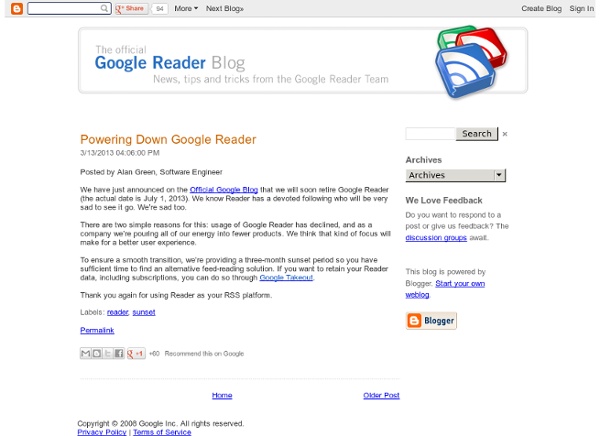
Google shreds Reader in new round of 'spring cleaning' High performance access to file storage Update Google is killing off Reader, its web-based RSS reading service, as part of its latest round of culling little-used or unprofitable products. A spring clean, if you will. The service will disappear on July 1st, 2013. Google’s reason for the termination, revealed in a blog post, follows: “There are two simple reasons for this: usage of Google Reader has declined, and as a company we’re pouring all of our energy into fewer products. Software Engineer Alan Green penned the post and added that “We know Reader has a devoted following who will be very sad to see it go. Happily, users can extract their RSS subscriptions and use them in another reader using Google Takeout. Other products and services set for the axe, as detailed here, include: The GUI Builder and five UiApp widgets in its AppScript service, “to focus efforts on Html Service” as of September 16th. Update
Après l'annonce de l'arrêt de Google Reader, Feedly récupère 500 000 utilisateurs Après l’annonce retentissante faite par Google la semaine dernière sur son arrêt de Reader, les utilisateurs de son service semblent avoir déjà entrepris la recherche d’une nouvelle terre pour leurs bons vieux flux RSS. De toute évidence, Feedly fait partie des grands gagnants. L’agrégateur, présent sur la toile depuis 2008, a ainsi révélé ce week-end sur son blog officiel avoir comptabilisé pas moins d’un demi-million d’inscriptions à son service en seulement 48 heures. Si l’on en croit leurs dires, celles-ci proviendraient dans leur intégralité d’actuels utilisateurs de Google Reader. La décision prise par Google de mettre fin à Reader aura soulevé des torrents de protestations sur la toile, la pétition créée à cet effet sur change.org regroupant à ce jour plus de 120 000 signatures. Pour finir, l’application iOS de Feedly est passée première du classement des applications gratuites sur l’Apple Store en cette fin de semaine. (Source)
Google kills Google Reader, says it will go offline on July 1, 2013 Google is doing a second round of spring cleaning — its euphemism for small projects it finds unworthy of its time and efforts — and is killing off a whole bunch of projects, the biggest of them being Google Reader. In a blog post Wednesday afternoon, Urs Hölzle, Google’s senior vice president of Technical Infrastructure, announced the pending closure: Everyone has a device, sometimes multiple devices. The other projects that are being euthanized include Google Voice for Blackberry, Calendar API, Snapseed for desktop, Search API for shopping and others. We launched Google Reader in 2005 in an effort to make it easy for people to discover and keep tabs on their favorite websites. I take issue with Urs’ comments about usage declining. It is probably my second-most used Google service — after GMail — and I have always been befuddled by Google’s lack of desire to make Google Reader into a bigger reading platform. Google announced today that they will be shutting down Google Reader.