

The Social Lab Reinventing the Toilet in India Gandhi said “Sanitation is more important than independence”. To demonstrate his commitment he made cleanliness and sanitation an integral part of the Gandhian way of living and believed in total sanitation for all. October 2, 2013, is the 144th birthday of Bapu and what better way for the Bill & Melinda Gates to celebrate this profound and inspirational leader, than to announce our new partnership with The Department of Biotechnology (DBT), Ministry of Science and Technology, Government of India in joint funding the Biotechnology Industry Research Assistance Council (BIRAC) to launch the Reinvent the Toilet Challenge – India. If you are not immersed in the issues facing global sanitation, you should be. At 1.27 billion people, India is the second most populous country in the world. And, millions of tons of fecal sludge collected from pit latrines and septic tanks are discharged untreated into the environment, creating a horrendous health hazard.
Design | WarkaWater Inspiration The Warka’s water harvesting technique and construction system are inspired by several sources. Many plants and animals have developed unique micro- and nano-scale structural features on their surfaces that enable them to collect water from the air and survive in hostile environments. By studying the Namib beetle’s shell, lotus flower leaves, spider web threads and the integrated fog collection system in cactus, we are identifying specific materials and coatings that can enhance dew condensation and water flow and storage capabilities of the mesh. The termite hives have influenced the design of Warka’s outer shell, its airflow, shape and geometry. We also looked at local cultures and vernacular architecture, incorporating traditional Ethiopian basket-weaving techniques in Warka’s design. Front View Top View How it Works The external skeleton consists of bamboo and provides structural support and holds up the mesh, collector and canopy. Characteristics Materials Elements Modularity
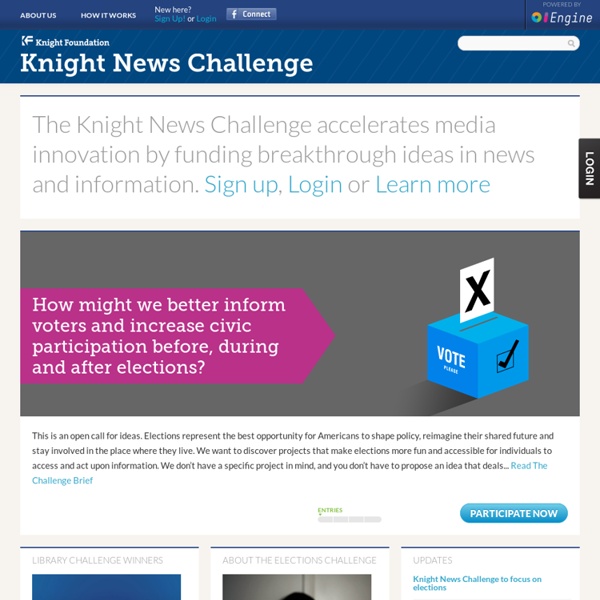
Knight challenge seeks innovative community health concepts The Knight Foundation is joining with a quartet of healthcare's heavy hitters to spur new ideas to harness healthcare data technology for community health. The Miami-based media conglomerate is launching a health innovation contest with the Robert Wood Johnson Foundation, California HealthCare Foundation, Clinton Foundation and Health Data Consortium. The contest challenges participants to answer the question, "How might we harness data and information for the health of communities?" The right answer could be worth up to $2 million. Knight officials said they'll be looking for ideas that, for example, make use of large public datasets, help inform healthcare consumers, leverage personal behavioral data or inform local health policy. mHealth tools and concepts should play a role in many of the proposals. Each of the participating organizations, who will help with outreach and review the entries, weighed in on the importance of the challenge in the press release.
Kairos T-band Smartwatch: Best of analog-digital | Indiegogo Watches express who you are. Kairos T-band allows you to wear your favorite wristwatch while enjoying all the benefits a smartwatch can bring. Smartwatches and wearable devices (smart bands) are here to stay. It began as a simple notification extension of your smart phone. It evolved into counting your steps, calories, and sleep patterns. We are now seeing more and more app support where you can control music, turn speech to text, GPS navigation, and also remote starting your vehicle. "Watches are more than just an accessory that tells time. It holds sentimental value. It’s an asset – something you hold onto and possibly pass on. T-band. T-band ND / HD / OD: There are three models of the T-band. T-Band ND (No Display): (* T-band ND shown with KAIROS MSW 115M model) Features: On board Kairos OS will be able to push notifications such as text messages, incoming calls, and also push alerts from available apps via a discreet multi-color LED indicator and/or vibrator motor. The Perks: Light.
Stars in Global Health | Grand Challenges Canada Grand Challenges Canada, which is funded by the Government of Canada, has developed the Stars in Global Health program to support Bold Ideas with Big Impact from the best and brightest talent, both in low- and middle-income countries and in Canada, to use scientific/technical, social and business innovation to address some of the most pressing global health challenges. This Request for Proposals is now closed. Round 7 Applicants will be notified in July 2014 regarding the application decision. Note to applicants from Peru / Nota para los solicitantes del Perú: Clique aquí para más información sobre ayuda adicional para innovadores basados en el Perú. Deadline: Monday, March 10, 2014, at 3:00 p.m. ET In the Round 7 Request for Proposals, Grand Challenges Canada seeks bold ideas aligned with innovative social entrepreneurial approaches that could be easily implemented in developing countries to save and improve lives. Please submit queries to stars@grandchallenges.ca.
CoeLux Transforming Health Systems: Gamechanging Business Models Winners announced! The verdict is in – the three winners of Transforming Health Systems: Gamechanging Business Models have been selected. Two winning entries, selected by the Changemakers community and a panel of expert judges, and the Idea Prize winner, represent gamechanging business models that are solving the systemic health problems of different markets around the world. They will receive cash prizes totalling US $55,000 plus support from Boehringer Ingelheim to help grow their innovations. Read about their solutions below. The competition finalists continue to be eligible to win an additional $30,000 funding envelope from Boehringer Ingelheim. Follow us on Twitter and Facebook to receive updates on the latest in social innovation and to send us your feedback. For questions about the competition, email Jessica Hannon: jhannon@ashoka.org (North America and Africa), Indrani Sharma: isharma@ashoka.org (Asia) or ThienVinh Nguyen: tvnguyen@ashoka.org (Europe). Dear Changemakers Community,
FingerReader Roy Shilkrot, Jochen Huber, Meng Ee Wong, Pattie Maes, and Suranga Chandima Nanayakkara. "FingerReader: a wearable device to explore text reading on the go". To appear in the proceedings of the International Conference on Human Factors in Computing Systems (CHI). 2015 ACM [PDF] Roy Shilkrot, Jochen Huber, Connie K. Roy Shilkrot, Jochen Huber, Connie K. katemural : Getting ready for... AeroMobil: Flying car MIT Builds An Open-Source Platform For Your Body Siberian temperatures. Eleven grueling days, navigating rough terrain. Six teams, matched for talent, competing for glory at the end. The Iditarod? This isn’t your average social app-fest. Healing The Health Industry "The tradition in health care technology is, ‘This is our device, we make our own software,’" says Dr. To unify the segmented market for health technology takes heavy lifting on the engineering side, since much of the progress made by private companies hasn’t been shared back to the community. "Working from a common platform takes an extra effort to build," Moore says, "but it ensures that the prototype will be something that has legs." Hacking Together Industry Partnerships The teams encamped on the Media Lab’s sixth floor, overlooking a Charles River initially frozen so solid you could stroll over to the Back Bay for pizza. "It would take years for all of these sectors to realize the potential that they have seen unfolding in the two weeks of this event," says Moore. My Op
Digital Designs for Physical Objects Days Remaining: 0 Could you live on Mars? Certainly not without great design and engineering. That's why we, in cooperation with NASA's Jet Propulsion Laboratory, are excited to present the Makerbot Mars Base Challenge. Learn more about Mars and what kind of home could actually sustain life there on {*style:<a href=' Imagine Mars website{*style:</a>*}.Upload your design to Thingiverse with the tag #MakerBotMars between May 30th and June 12th.
Want To Be More Creative In Your World-Changing Work? Apply For This Fellowship Many people assume that creativity is some kind of innate trait, like green eyes or a certain height, that you either have or you don’t. Only about half of Americans see themselves as creative. At Stanford University’s d.school, students learn that creativity is just another kind of skill. “What we’re basically looking for are people who are expert in their area but are dissatisfied with the ecosystem in which they operate. The fellows come from wildly different backgrounds. “These are super qualified people,” Ferrell says. The fellowship starts by instilling what the d.school calls creative confidence. Throughout the year, after learning a basic framework for creativity, the fellows go back and forth with their organizations building and testing prototypes of solutions, with the goal of having creative impact as quickly as possible. “I’m not the first person to work on this, but I’m probably one of the first people to apply design thinking to it,” Lee says.