

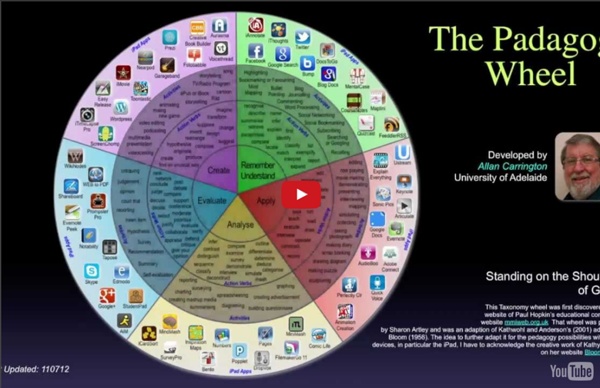
The Padagogy Wheel … it's a Bloomin' Better Way to Teach - In Support of Excellence When I received the invitation from the new Lee Kong Chian School of Medicine at the Nanyang Technological University in Singapore, I decided to completely upgrade two seminar workshops. Dr Ian Green from the School of Education here at Adelaide and I have used Padagogy101 (introduction to iPad in HE) and Padagogy201 (more advanced use for L&T) to train over 600 faculty from universities in Australia. For Singapore, Ian wasn’t going to be with me and I was solo, as well I needed a better way to leave resources in place for people to revisit. However I was completely surprised at what else happened. During my research I saw lots of great work done by others using Bloom’s Taxonomy including the Revised Taxonomy which has now become the Bloom’s Digital Taxonomy. It was a huge amount of work to meet the Singapore deadlines and involved quite a bit of lost sleep. I have added 62 iPad apps to the wheel and put them where they could serve the pedagogy.
Allan's Blog Fourni par Traduction DOWNLOAD THE LATEST VERSION: V4 published Mar 2015. This PDF Poster has links to 122 of the latest and most popular educational apps. Now these resources are available in 19 different languages. The poster also has app selection criteria according to Blooms taxonomy. V4.0 was published in March 2015 but I knew I was onto something useful when I first put the Padagogy Wheel together in July 2012. So why the need for Version 2.0? We need to have transformation at the core of what we do: If it is all about the students, where do you start with curriculum and/or teaching design – surely it is with what do you want your graduates to look like? Technology integration into the fabric of learning and teaching: is where we should be heading with all we do as teachers. Finally, can you help with V3.0? Please join in the conversation with your ideas and comments using the comments area of this blog.
The Best Resources For Helping Teachers Use Bloom’s Taxonomy In The Classroom Bloom’s & SOLO ‘are not Just Colorful Posters we Hang on the Wall’ is my two-part series at Education Week Teacher. Bloom’s Taxonomy is talked about a lot in educational circles. However, if you believe a recent survey of visits to 23,000 U.S. classrooms, the higher-order thinking skills it’s ideally designed to promote doesn’t get much use. And I can understand why. It’s easy to get caught-up in the day-to-day work involved in teaching a class or multiple classes, and it’s easy to fall into the trap of doing the “usual stuff” and not “think out of the box.” I thought it might be useful to share in a “The Best…” list the resources that help me try to use Bloom’s Taxonomy in my classroom. There may very well be resources out there that do a far better job of explaining the Taxonomy and how to use it. I personally try to use Bloom’s Taxonomy in two ways. In addition, I try to use Bloom’s to help me formulate my own lessons. Bloom’s Revised Taxonomy Memory Understanding Applying and Analyzing
Revised Bloom’s Taxonomy – CELT Jump to the Bloom's Revised Taxonomy Model Go to the Flash version of the Bloom's Revised Taxonomy Model Download the PDF Version A statement of a learning objective contains a verb (an action) and an object (usually a noun). The verb generally refers to [actions associated with] the intended cognitive process. The cognitive process dimension represents a continuum of increasing cognitive complexity—from remember to create. The knowledge dimension represents a range from concrete (factual) to abstract (metacognitive) (Table 2). Bloom’s Digital Taxonomy by Andrew Churches – a thorough orientation to the revised taxonomy; practical recommendations for a wide variety of ways mapping the taxonomy to the uses of current online technologies; and associated rubrics Bloom et al.’s Taxonomy of the Cognitive Domain (Dr. Revising Bloom’s Taxonomy. The Best Resources For Helping Teachers Use Bloom’s Taxonomy In The Classroom (Larry Ferlazzo’s Websites of the Day…) *Anderson, L.W.
Bloomin' Apps This page gathers all of the Bloomin' Apps projects in one place.Each image has clickable hotspots and includes suggestions for iPad, Android, Google and online tools and applications to support each of the levels of Bloom's Revised Taxonomy.I have created a page to allow you to share your favorite online tool, iOS, or Android app with others. Cogs of the Cognitive Processes I began to think about the triangular shape of Bloom's Taxonomy and realized I thought of it a bit differently.Since the cognitive processes are meant to be used when necessary, and any learner goes in and out of the each level as they acquire new content and turn it into knowledge, I created a different type of image that showcased my thoughts about Bloom's more meaningfully.Here is my visual which showcases the interlocking nature of the cognitive processes or, simply, the "Cogs of the Cognitive Processes". IPAD APPS TO SUPPORT BLOOM'S REVISED TAXONOMYassembled by Kathy Schrock Bloom's and SAMR: My thoughts
5 Highly Effective Teaching Practices I remember how, as a new teacher, I would attend a professional development and feel inundated with new strategies. (I wanted to get back to the classroom and try them all!) After the magic of that day wore off, I reflected on the many strategies and would often think, "Lots of great stuff, but I'm not sure it's worth the time it would take to implement it all." We teachers are always looking to innovate, so, yes, it's essential that we try new things to add to our pedagogical bag of tricks. What Research Says This leads me to educational researcher John Hattie, who wrote Visible Learning for Teachers: Maximizing Impact on Learning. Hattie has spent more than 15 years researching the influences on achievement of K-12 children. 1. When a teacher begins a new unit of study or project with students, she clarifies the purpose and learning goals, and provides explicit criteria on how students can be successful. 2. 3. 4. 5. Collaborating with Colleagues Great teachers are earnest learners.
Blooming Orange: Bloom's Taxonomy Helpful Verbs Poster Here’s another poster to help get you thinking about how you can apply Bloom’s higher-order thinking skills with your children. This poster shows the segments of an orange with each segment relating to a thinking skill and some helpful verbs to serve as prompts. While there are many more verbs that we could have added, we felt that including just seven in each segment would make them easier to remember (For more information, see Miller’s paper “The Magical Number Seven, Plus or Minus Two: Some Limits on Our Capacity for Processing Information.” We thought it would be interesting to depict the verbs in a circular form as opposed to a hierarchical list, given that these skills don’t often occur in isolation and are interconnected. For those of you who prefer it, we’ve also created a grayscale version of the poster. Let us know what you think – you know we’re always listening! Download the pdf’s here:
Foucault and His Panopticon - power, knowledge, Jeremy Bentham, surveillance, smart mobs, protests, cooperation, philosopher Michel Foucault Above all else, Michel Foucault believed in the freedom of people. He also realized that as individuals, we react to situations in different ways. His used his books as a vehicle to show the various factors that interact and collide in his analyzation of change and its effects. Along with other social theorists, Foucault believed that knowledge is always a form of power, but he took it a step further and told us that knowledge can be gained from power; producing it, not preventing it. Knowledge linked to power, not only assumes the authority of 'the truth' but has the power to make itself true. For him, power exists everywhere and comes from everywhere; it was a key concept because it acts as a type of relation between people, a complex form of strategy, with the ability to secretly shape another's behaviour. Foucault's Panopticon When only certain people or groups of people control knowledge, oppression is a possibility. Related Papers Jeremy Bentham and Rhetoric
TEAL Center Fact Sheet No. 4: Metacognitive Processes | Adult Education and Literacy | U.S. Department of Education Metacognition is one’s ability to use prior knowledge to plan a strategy for approaching a learning task, take necessary steps to problem solve, reflect on and evaluate results, and modify one’s approach as needed. It helps learners choose the right cognitive tool for the task and plays a critical role in successful learning. What Is Metacognition? Metacognition refers to awareness of one’s own knowledge—what one does and doesn’t know—and one’s ability to understand, control, and manipulate one’s cognitive processes (Meichenbaum, 1985). It includes knowing when and where to use particular strategies for learning and problem solving as well as how and why to use specific strategies. Cognitive strategies are the basic mental abilities we use to think, study, and learn (e.g., recalling information from memory, analyzing sounds and images, making associations between or comparing/contrasting different pieces of information, and making inferences or interpreting text). What’s the Research?