

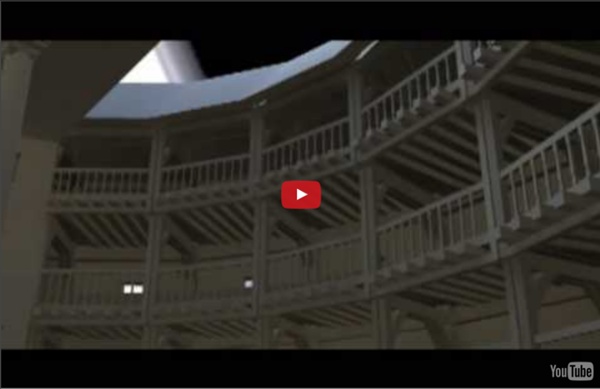
Shakespeare's Globe Globe Theatre Links | Home (picture credit: Utrecht University Library) The sketch at left is perhaps one of the most important in theatrical history. In 1596, a Dutch student by the name of Johannes de Witt attended a play in London at the Swan Theatre. While there, de Witt made a drawing of the theatre's interior. A friend, Arend van Buchell, copied this drawing—van Buchell's copy is the sketch rendered here—and in doing so contributed greatly to posterity. Shakespeare's company erected the storied Globe Theatre circa 1599 in London's Bankside district. The story of the original Globe's construction might be worthy of a Shakespearean play of its own. Unfortunately, their aristocratic neighbors complained to the Privy Council about the plans for Blackfriars. In late December of 1598, Allen left London for the countryside. The endeavor was not without controversy. Globe Links Cambridge History of English and American Literature—William Shakespeare From the Bartleby.com website.
London This EFL lesson plan is designed around a short film by Simon Smith who recaptured the shots of London taken by Claude Friese-Greene in 1927. Students talk about what they know about London, compare London in 1927 and now, do a dictation and discuss their home towns. Language level: Intermediate (B1) – Upper Intermediate (B2) Learner type: Teens and adults Time: 90 minutes Activity: watching a short film and making notes, dictation and speaking Topic: London and cities Language: Vocabulary to describe towns and comparative forms Materials: Short film Downloadable materials: london lesson instructions Overview Step 1 Pair the students and ask them to write down as many places and things that London is famous for. Step 2 Get feedback from the whole class and discuss what the students know about London. Step 3 Ask the following questions: If you’ve been to London, what did you like about it? Step 4 Ask the learners to write down five adjectives to describe London. Step 5 Step 6 Step 7 Show the film. Step 8
The Top 10 Relationship Words That Aren't Translatable Into English | Marriage 3.0 Here are my top ten words, compiled from online collections, to describe love, desire and relationships that have no real English translation, but that capture subtle realities that even we English speakers have felt once or twice. As I came across these words I’d have the occasional epiphany: “Oh yeah! That’s what I was feeling...” Mamihlapinatapei (Yagan, an indigenous language of Tierra del Fuego): The wordless yet meaningful look shared by two people who desire to initiate something, but are both reluctant to start. Oh yes, this is an exquisite word, compressing a thrilling and scary relationship moment. Yuanfen (Chinese): A relationship by fate or destiny. From what I glean, in common usage yuanfen means the "binding force" that links two people together in any relationship. But interestingly, “fate” isn’t the same thing as “destiny.” Cafuné (Brazilian Portuguese): The act of tenderly running your fingers through someone's hair. Ya’aburnee (Arabic): “You bury me.”
Romeo and Juliet Comic [Grammarman Home] [Romeo and Juliet Menu] [Next Page] Jump to page: [1] [2] [3] [4][5] [6] [7] [8] Sanjay Dastoor: A skateboard, with a boost (Teens) | TEDxESL “Next time you think about a vehicle, I hope, like us, you’re thinking about something new.” Imagine an electric vehicle that can get you to work — or anywhere in a six-mile radius — quickly, without traffic frustrations or gasoline. Now imagine you can pick it up and carry it with you. Yes, this skateboard could change the face of morning commutes. Do you think that skateboarding is a good form of transport? The electric skateboard can run for 1000 kilometres.The parts for the skateboard were bought at a toy store.The skateboard is too heavy to hold and carry around with you.It is really expensive to build.The skateboard cannot easily go up a hill. Comparatives and Superlatives Focus on the use of “than” with comparatives. Would you like to skateboard everywhere? Skateboarding is a terrible form of transport. Like this: Like Loading...
Your Brain In Love | Brains in love - Page 5 • Those who endure have a story, and they stick to it. Robert Sternberg, dean of the school of arts and science at Tufts University, has researched this and has come up with about two dozen relationship stories, some good, some bad. The "fairy tale story" has a prince and a princess; the "visionist story" is a business model, accumulating homes, goods and successful children; the "travel story" says that life is a journey; the "police story" divides the partners' roles into cop and perp, with the former constantly monitoring the latter; the "war story" means that two people expect constant fights. "What our research shows is that couples tend to be more satisfied if they have matching story profiles," Sternberg says. Pair a fairy tale believer with a war story believer and "it won't work," he says. • Anxiety or depression is relationship poison. The best predictor of divorce, Aron says, has little to do with love, even less to do with initial attraction. -- Susan Brink
Romeo and Juliet Character Map 10 More Homophones that will make you laugh The last time I posted an infographic showing 10 funny homophones, it was viewed over 11,000 times in one day alone!!!! The wonderful illustration by Kaplan clearly captured your imagination. So I thought I would share with you 10 more hilarious homophones beautifully illustrated in the infographic below. Homophones are those confusing words in the English language that sound the same but have different meanings and spelling. Kaplan International Vocabulary mussels – a small shellfish with a soft body inside a hard black or green shell, often cooked and eaten as food; knight – in the past, a European soldier who wore a suit of armour and rode a horse. current – happening or existing now; currant – a small round fruit that may be red, black, or white; bald – with little or no hair on your head bawled – to cry loudly hare – an animal similar to a rabbit Are there any new words you’ve discovered?
Shakespeare's Unconventional Conventions Slideshow Shakespeare's Unconventional Conventions When the love-struck Romeo first sees Juliet emerge on her balcony, what poetic form could mirror his pounding heart? Iambic pentameter of course. "But, soft! [zoog-muh] Are your verbs slacking off? [en-jam-muhnt, -jamb-] Queen Hermione stands trial in Shakespeare's A Winter's Tale after being falsely accused of adultery by her husband. [lahy-tuh-teez, lit-uh-, lahy-toh-teez] In the third act of Julius Caesar, Marc Antony enters the Roman forum holding Caesar's body. Shakespeare's King Lear is about to end, and with his last lines, the young Edgar looks toward his future as his whole family lies dead around him. [ahy-suh-koh-luhn] Hamlet has just begun; Claudius just married Gertrude after killing her husband his brother. [ant-an-uh-klas-is] [as-uh-nuhns] The Tempest, one of Shakespeare's last plays, is about to end.
Elizabethan Theater - Shakespeare Fun Facts Acting was not a highly paid or highly respected profession. Actors were seen as vagrant troublemakers who promoted hard living and sin. In the 16th century, actors traveled from town to town on a cart, looking for audiences to pay to watch them perform. Playhouses were not constructed in London until 1576. Because acting was not a respected profession, women were not allowed to act until after 1660. Teenage boys who hadn't gone through puberty would play the roles of women, Going to the theater was not considered to be a fancy affair. Poor people called the groundlings, or penny knaves, were famous their love of plays. Going to a play was a lively event. The most expensive seats in a theater were the in the top row of the theater, farthest from the audience. People expected to see a new play everyday in theaters. Most plays were seen at two o'clock in the afternoon.