

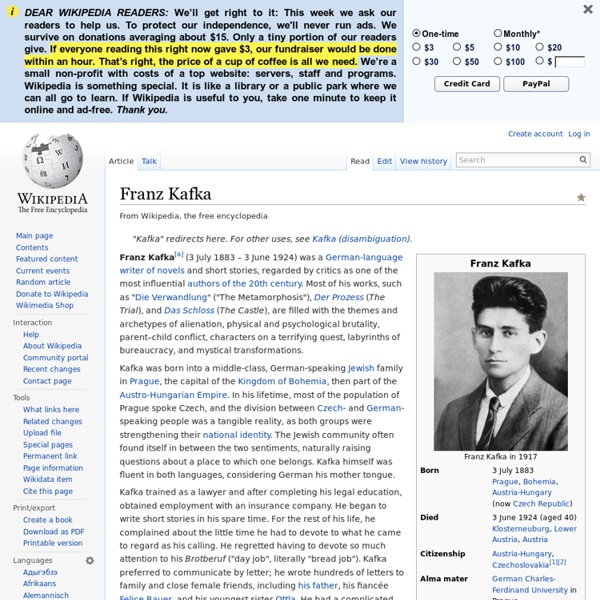
http://en.wikipedia.org/wiki/Franz_Kafka
Don DeLillo DeLillo has described his fiction as being concerned with "living in dangerous times",[3] and in a 2005 interview declared, "Writers must oppose systems. It's important to write against power, corporations, the state, and the whole system of consumption and of debilitating entertainments [...] I think writers, by nature, must oppose things, oppose whatever power tries to impose on us."[4] Early life and Influences[edit] The Metamorphosis The Metamorphosis (German: Die Verwandlung, also sometimes translated as The Transformation) is a novella by Franz Kafka, first published in 1915. It has been cited as one of the seminal works of fiction of the 20th century and is studied in colleges and universities across the Western world. The story begins with a traveling salesman, Gregor Samsa, waking to find himself transformed (metamorphosed) into a large, monstrous insect-like creature. The cause of Samsa's transformation is never revealed, and Kafka himself never gave an explanation. The rest of Kafka's novella deals with Gregor's attempts to adjust to his new condition as he deals with being burdensome to his parents and sister, who are repulsed by the horrible, verminous creature Gregor has become.
Arthur Eddington British astrophysicist (1882–1944) Sir Arthur Stanley Eddington OM FRS[2] (28 December 1882 – 22 November 1944) was an English astronomer, physicist, and mathematician. He was also a philosopher of science and a populariser of science. The Eddington limit, the natural limit to the luminosity of stars, or the radiation generated by accretion onto a compact object, is named in his honour. Around 1920, he anticipated the discovery and mechanism of nuclear fusion processes in stars, in his paper "The Internal Constitution of the Stars".[3][4] At that time, the source of stellar energy was a complete mystery; Eddington was the first to correctly speculate that the source was fusion of hydrogen into helium. Eddington wrote a number of articles that announced and explained Einstein's theory of general relativity to the English-speaking world.
Maxim Gorky Alexei Maximovich Peshkov (Russian: Алексе́й Макси́мович Пешко́в or Пе́шков;[1] 28 March 1868 – 18 June 1936), primarily known as Maxim (Maksim) Gorky (Russian: Макси́м Го́рький), was a Russian and Soviet writer, a founder of the Socialist realism literary method and a political activist.[2] Life[edit] Early years[edit] Gorky was born in Nizhny Novgorod and became an orphan at the age of eleven. Walter Benjamin German literary critic, philosopher and social critic Walter Bendix Schönflies Benjamin (; German: [ˈvaltɐ ˈbɛnjamiːn];[5] 15 July 1892 – 26 September 1940)[6] was a German Jewish philosopher, cultural critic and essayist. An eclectic thinker, combining elements of German idealism, Romanticism, Western Marxism, and Jewish mysticism, Benjamin made enduring and influential contributions to aesthetic theory, literary criticism, and historical materialism. He was associated with the Frankfurt School, and also maintained formative friendships with thinkers such as playwright Bertolt Brecht and Kabbalah scholar Gershom Scholem. He was also related to German political theorist and philosopher Hannah Arendt through her first marriage to Benjamin's cousin Günther Anders. Life[edit]
Childhood (novel) Childhood (Russian: Детство, Detstvo) is the first published novel by Leo Tolstoy, released under the initials L. N. in the November 1852 issue of the popular Russian literary journal The Contemporary.[1] Childhood is an exploration of the inner life of a young boy, Nikolenka, and one of the books in Russian writing to explore an expressionistic style, mixing fact, fiction and emotions to render the moods and reactions of the narrator. "Will the freshness, lightheartedness, the need for love, and strength of faith which you have in childhood ever return? What better time than when the two best virtues -- innocent joy and the boundless desire for love -- were the only motives in life?"[2] John Fowles John Robert Fowles (; 31 March 1926 – 5 November 2005) was an English novelist of international renown, critically positioned between modernism and postmodernism. His work was influenced by Jean-Paul Sartre and Albert Camus, among others. Fowles's books have been translated into many languages, and several have been adapted as films. Biography[edit] Birth and family[edit]
Foundation (novel) Foundation is the first novel in Isaac Asimov's Foundation Trilogy (later expanded into The Foundation Series). Foundation is a collection of five short stories, which were first published together as a book by Gnome Press in 1951 which, together, form a single plot. (First published in the book edition in 1951) Using psychohistory, Seldon has discovered the declining nature of the Empire, angering the aristocratic members of the Committee of Public Safety, the de facto rulers of the Empire. The Committee considers Seldon's views and statements treasonous, and he is arrested along with young mathematician Gaal Dornick, who has arrived on Trantor to meet Seldon. Seldon is tried by the Committee and defends his beliefs, explaining his theories and predictions, including his belief that the Empire will collapse in 300 years and enter a 30,000-year dark age, to the Committee's members.
Jean Rhys Novelist from Dominica Jean Rhys, CBE (;[3] born Ella Gwendolyn Rees Williams (24 August 1890 – 14 May 1979), was a mid-20th-century novelist who was born and grew up in the Caribbean island of Dominica. From the age of 16, she was mainly resident in England, where she was sent for her education. She is best known for her novel Wide Sargasso Sea (1966), written as a prequel to Charlotte Brontë's Jane Eyre.[4] In 1978, she was appointed a Commander of the Order of the British Empire (CBE) for her writing. Early life[edit]
The Demon-Haunted World The Demon-Haunted World: Science as a Candle in the Dark is a book by astrophysicist Carl Sagan, which was first published in 1995. The book is intended to explain the scientific method to laypeople, and to encourage people to learn critical or skeptical thinking. It explains methods to help distinguish between ideas that are considered valid science, and ideas that can be considered pseudoscience.
Jakov Lind Jakov Lind (born Heinz Jakov Landwirth, 10 February 1927 in Vienna – 16 February 2007 in London) was an Austrian-British writer of short stories and novels. Early life[edit] After the annexation of Austria by Germany in 1938, Jews were immediately targeted by the new Nazi regime with anti-Semitic decrees designed to make their lives untenable and force them to leave Austria. The decrees included prohibition of using public transportation, of being employed, and of operating businesses. Jews were expelled from schools and universities, had their businesses "Aryanized", a euphemism for their theft and confiscation by the Nazi regime, and were harassed with washing street signs of the previous regime in front of cheering and violent mobs. Eventually they were forced out of their apartments and prevented from leaving the country by themselves.
Carl Sagan Carl Edward Sagan (/ˈseɪɡən/; November 9, 1934 – December 20, 1996) was an American astronomer, cosmologist, astrophysicist, astrobiologist, author, science popularizer, and science communicator in astronomy and other natural sciences. His contributions were central to the discovery of the high surface temperatures of Venus. However, he is best known for his contributions to the scientific research of extraterrestrial life, including experimental demonstration of the production of amino acids from basic chemicals by radiation. Sagan assembled the first physical messages that were sent into space: the Pioneer plaque and the Voyager Golden Record, universal messages that could potentially be understood by any extraterrestrial intelligence that might find them. Sagan always advocated scientific skeptical inquiry and the scientific method, pioneered exobiology and promoted the Search for Extra-Terrestrial Intelligence (SETI).
The Lion, the Witch and the Wardrobe The Lion, the Witch and the Wardrobe is a high fantasy novel for children by C. S. Lewis, published by Geoffrey Bles in 1950.