

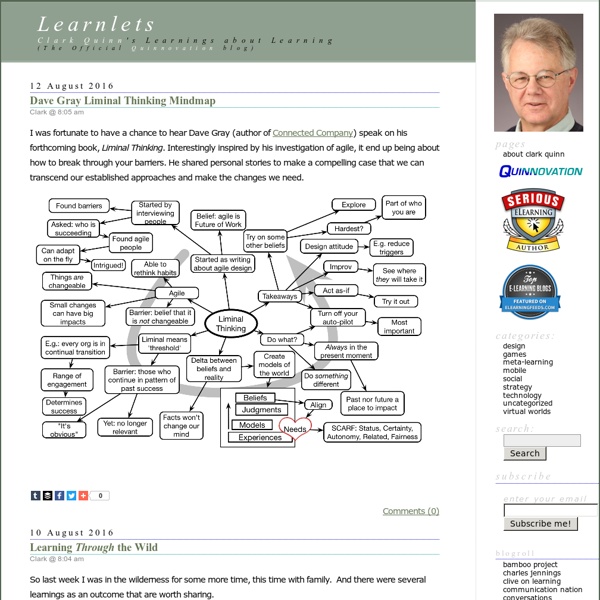
Agility through collaboration Instead of factory-style production teams, agile programming uses far fewer, but better, programmers. The principles of communicating, focusi ng on simplicity, releasing often and testing often are also applicable to developing good instructional programs. Does instructional systems design (ISD) need more agility? An ISD project team should be able to return to the Analysis or Design phase and make changes while instructional content Development is taking place. The root of the problem is that ISD views instruction as separate from work. I think that ISD and agility are fundamentally incompatible. Things are moving so fast, and increasingly the work will be solving new problems, designing new solutions/products/services, etc, that we won’t be able to anticipate the actual work needs. Collaborative co-design is one more way to integrate work and learning, and give our organizations more agility.
Cammy Bean's Learning Visions Translating Constructivism into Instructional Design: Potential and Limitations Clive on Learning Instructional design is dead Let me start by saying that for many, many years, my title was some variation of "Instructional Designer." And so, its with some amount of hesitance that I say that the field of instructional design is, well, crap. I'm not a traditional instructional designer, having a Master's degree in education instead of instructional design or instructional technology. That said, I immediately noticed some problems with the field of instructional design and more importantly, in how instructional designers are "trained." There are many reasons why instructional design has become a bit of a joke. Instructional design relies too much on process: there's nothing wrong with having guidelines for design. Ok, so what does this all mean? More than anything, if instructional design is going to survive and thrive as a profession, we need to be leaders--leaders in research, leaders in our organizations, and leaders in our field, not accepting the mediocre.
Janet Clarey Design processes for teaching The following is a first draft of a section from my thesis. It will form part of the newly cut down section on Process within chapter 2 (170 pages down to 50). The following tries to say something about the design processes used for teaching within universities. It starts with a characterisation of instructional design, looks at the limitations (referring to some earlier work about teleological and ateleological processes) and seeks to describe what the literature has to say about how teaching academics actually design/plan their courses. As with previous thesis drafts, this is an early draft, I’ll re-edit and improve later, but thought I’d get this out there. Design processes for teaching This section and its topic, while somewhat related to the discussion on Pedagogy (Section cross reference), has a different focus. This teleological view of the instructional design process has a number of flaws. References Argyris, C. and D. Becher, T. and P. Biggs, J. (1999). Cziko, G. Irlbeck, S., E.
The Rapid eLearning Blog Creating great interactive learning experiences requires a few core building blocks: relevant content, pull versus push, and real-world decisions. With those building blocks you're able to structure effective learning scenarios that are meaningful to the learner and helps meet the objectives of the course. One of those building blocks in creating relevant content or content that is placed in a meaningful context. Essentially, you want to recreate the types of scenarios that are similar to the ones the learner has in real life. This allows them to see the content in ... Read the full article After last week's post on the different drag & drop interaction examples, I had quite a few emails asking for tips on how to create drag and drop interactions for elearning. Sliders are used as a means to make adjustments/selections or as a simple way to navigate content. It helps to look at what others are doing to get ideas and inspiration for your own work. Create ...
Reservations about instructional design The following is at first a rambling diatribe outlining some of my reservations with instructional design as it is practiced. Then it is a summary/reflection on Winn (1990) – “Some implications of cognitive theory for instructional design”. The abstract for Winn (199) This article examines some of the implications of recent developments in cognitive theory for instmctional design. Actually, I’m running out of time, this post will be just the diatribe. Some context The following line of thought is part of an on-going attempt to identify potential problems in the practice of instructional design because I work within a Curriculum Design & Development Unit at a University. The diatribe Back in the mid-1990s I was being put in charge of my first courses. From the start, my experiences with the instructional designers and the system they existed within was not good. Over 15 years on, and not a lot has changed. References Geoghegan, W. (1994). Winn, W. (1990). Like this: Like Loading...
Instructional Design for Sociocultural Learning Environments Scott Grabinger, Ed.D.University of Colorado at Denver and Health Sciences Center, USAScott.Grabinger@cudenver.edu Cary AplinGraduate StudentUniversity of Colorado at Denver and Health Sciences Center Gitanjali Ponnappa-BrennerGraduate StudentUniversity of Colorado at Denver and Health Sciences Center To meet the goal of “preparing people for an ever-changing world”, instructional programs need to apply strategies that focus on the development of critical thinking, problem solving, research, and lifelong learning. Keywords: instructional design, sociocultural learning Instructional design (ID) models describe a systematic process, typically delineated by phases . On the other hand, there are also learning goals that involve critical thinking, problem solving, and lifelong learning skills (Dunlap & Grabinger, 2003). A sociocultural approach to instructional design (SCID), in contrast, focuses on large, often ill-defined, units of instruction in contextualize settings. Roles: Traditional ID
Instructional Design 10 Simple Video Blog Ideas Whether you want to take a stab at being the next big video blogger or just want to supplement your current content with some video, you don’t need fancy hardware or software. What you do need, though, are some ideas. Well, here are ten easy-to-shoot and easy-to-edit video blogging ideas to help inspire you to realize your video blogging dreams, no matter how grand or modest they are. The Video Rant Just because the rant is the easiest and most common video blog format, that doesn’t mean that it’s an instant success. Here’s a good example of a video rant from Loren Feldman. The How To Video Videos that show audience members how to do something are great for both helping your audience achieve some goal, as well as generating more search engine traffic. This video on how to escape from handcuffs is a great example of a how-to video. The Screencast And when it comes to screencast software, there are many options. Video Event Coverage Here’s an example of just such a video. The Video Interview
The Various Roles of Instructional Design (work in progress) Job descriptions in ID (or, ISD) these days are all over the map, with very little consistency. It doesn't help that few HR and Recruiters have any knowledge of, or experience with, the field. So I'm going to propose some roles as I understand them, in the hopes that some day hiring managers will be able to articulate better what they want/need in terms of talent for their training departments or projects. Note that one person can hold multiple roles. These are ROLES not PEOPLE. (Info-graphic from Instructional Designer Capable of performing or at least managing entire ADDIE process. Instructional Systems Designer While this role is often used interchangeably with Instructional Designer, I think there should be some, albeit subtle, distinction. Instructional (Multimedia) Developer Instructional Technologist This role is less commonly found. Instructional Systems Developer