

Pieces of Anna: DIY Wine and Beer Bottle Vases As I mentioned earlier, I decided to get a little crafty with Christmas presents this year. While browsing Pinterest, I stumbled upon this image that inspired me to try my hand at making vases out of wine and beer bottles. A little bit of googling turned up handy tutorials on how to wrap bottles with jute. Some tutorials called for using a hot glue gun, which I don't own (and quite frankly, I can't imagine that getting hot glue on your fingers is all that pleasant). Luckily, I found some tutorials, like this one, which claimed that you could achieve the same results using plain old Elmer's glue. The first step was to obtain some empty wine and beer bottles. Some labels came off rather easily, while others required a little scrubbing.
Make your own fabric prints using the sun The folks who make Inkodye sent over a sample the other day. Inkodye is light-sensitive dye for textiles or any natural fibers, including wood and raw leather. It acts like the Sunprint paper you might have used as a kid, only you can brush this dye on anything you want and it comes in lots of colors. Like orange, of course. For my first test of this magical stuff, I planned to make a safety pin print on fabric. I wrapped cardboard with a piece of old plastic tablecloth to make a waterproof surface. Then I poured a little Inkodye onto a paper plate, and with a foam brush, I painted it onto the fabric. As soon as I was done brushing on the dye, I scrambled to arrange some safety pins on top of the fabric. Outside the back door, I placed the board in direct sunlight. To keep the dye under the pins from developing, I immediately rinsed the fabric under the faucet and then washed it out with laundry detergent. Here's what the fabric looks like when it's dry.
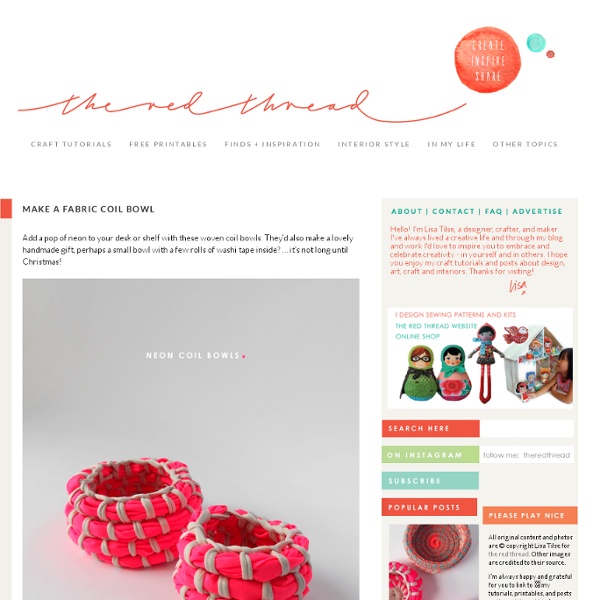
the red thread 27 Wonderful Paper And Cardboard DIY Christmas Decorations black and white Christmas ornaments (via minieco) Paper and cardboard are the simplest craft materials ever. You can handle them very easily, they are cheap and various in colors and textures. You may also craft with your kids of paper and cardboard because it’s simple and they will be delighted. handmade window garland For Christmas (via shimelle) paper ball Christmas ornament (via makermama) The BEST Play-Dough Recipe Have you ever made play dough and it just fell apart?? Well… not this time. This recipe will make play dough that is seriously the closest thing to store-bought you’ll ever make. No falling apart or drying out (as long as stored in a sealed container). It will last up to 6 months.The secret to this recipe?? Ready to make it? Ingredients: 1 C Flour 1 C Water 1/4 C Salt 1 TBSP Vegetable Oil 2 tsp Cream of Tarter Food Coloring (actual coloring or a kool-aid packet will do) Sparkles (If you wanna be a fun mom!) Pour in all ingredients. Stir until everything is mixed well. Once the mixture is (mostly) clump free. Stir. Stir, Stir Stir.Just keep stirring until the Play Dough is formed. Remove from heat, and knead by hand. Once cooled it’s ready to go. Or grab your cookie cutters, plastic scissors, rolling pin, etc.. and let your toddler go to town. What a fun thing to do on a rainy day! # kristanlynn xoxo I’ve linked up here, here, here and here UPDATE- answering your questions:
Quick Tip: Make a Set of Cool Crochet Buttons In this tutorial we’ll be making some cute and easy crochet buttons. The pattern uses US terms and stitches include double crochet (dc); chain (ch); and a magic ring. Supplies Yarn in a main and a contrast colour (I used Drops Paris cotton yarn by Garnstudio).A crochet hook in a size suitable for the yarn you’re using (I used a 4mm hook here).A darning needle for sewing in the ends.A pair of scissors. Step 1: Make a Magic Ring Using the main colour yarn, make a magic ring and secure with a stitch. Step 2: Crochet the Button Chain 2 (counting as 1 dc), and work 11 double crochet in the ring, and pull it to close, creating a circle. Step 3: Needle Join Cut the yarn and pull the end through the loop on your hook. Close the circle by putting the needle through the top of your first double crochet (ie. not the starting two chains)… …and back again through the back loop of the last stitch. Step 4: Embellish Your Buttons You can now embellish your buttons. And your colour ridge button is finished!
How About Orange Here's a look at our upstairs guest bathroom. Last night I covered an accent wall with removable wallpaper. I love it! This bathroom has a peculiar layout. You walk in past the shower stall on the right, and when you hit the sink, you turn right to get to the toilet. Which is under a lovely arch at the end of a passage that is almost long enough to feel like a hallway. The kind folks at Walls Need Love sent the product to review. Like the Sunburst wallpaper I designed last year, this paper is essentially a giant self-adhesive wall decal, and it's easily to peel off and reposition. I measured the wall and cut a length of paper that would leave a little extra overhang at the bottom. After a couple tries I had it, and then it was just a matter of peeling off the backing paper gradually while smoothing down the paper with the tool provided. I cut another piece to place next to the first panel, overlapping the seam by a quarter inch to match the pattern.
Shrinky Bracelet If you grew up in the 80's, like I did, you're probably already familiar with the awesomeness that is Shrinky Dinks...but did you know that you can still buy Shrinky Dinks? Yep, they're still out there - in craft stores, hobby shops, and even on Amazon. But you don't have to buy a Shrinky Dink kit to have all the fun. Just look for #6 plastic containers and you can make your own! There is a great tutorial on Instructables (courtesy of Dabbled) with all the instructions for making your own shrinky projects from #6 plastic containers, so I won't go into too much detail here. 1. 2. 3. 4. 5. 6. 7. Use a pair of pliers to open the rings. 8. Surprise mom with a priceless piece of jewelry made by her little artists! I was also able to make a pendant from a long, skinny piece I had left over after cutting apart the "beads" for the bracelet. Cute, right?
How To Make Vegetable Dye Previous image Next image Choose the color. I found a page from an old book all about creating vegetable dyes! What You Need MaterialsWool (to be dyed)Alum (potassium aluminum sulphate)Cream of TartarLarge saucepan or tall potContainer to store treated wool*Pick a color from the list below to find the herb, plant, or bark you will need. EquipmentStovetopScaleWooden sticks, dowels, or knitting needlesRubber gloves Instructions *Please read any special instructions for your specific color before starting this process. 1. 2. 3.Prepare the Plant Once you choose a color, put the plant in cold water and bring it to a slow boil. 4. 5. Fresh birch leaves = Yellow Use 2.2 pounds or 1 kilogram of birch leaves. Additional Notes:For lichens, you do not need to use mordant. Any other great veggie and plant dye tips out there? (Images: Green Mountain Etsy Shop, Hello Yarn, Gleason's Fine Woolies, GypsyTreeBags, Sweet Georgia Yarns, The Dye Dept., BeadBag)
Thrifty Crafty Girl: Wrought Iron, Except It's Not. Before I start talking about this awesome project, I have to give some props to the blogger who inspired it. Her name is Suzy. She has a sitcom. I haven't found it in my local listings yet, which probably means she held out for the big HBO or Showtime money. Smart girl. See Suzy's blog here. Did you look? Me: Hey, Suze. We sounded more educated in real life. So I did it: That's right... wrought iron. First, you call your family and ask them to save all their toilet paper and paper towel rolls. Once you've acquired a ridiculous amount of toilet paper and paper towel rolls (I didn't count how many I used because I am thoughtless. Cut your toilet paper rolls down the side and unfold it, keeping the curl. Suzy did an awesome quilled monogram project that I would also like to do eventually... but I can only steal one project at a time from her. I used paper towel rolls for the long straight strips, just cut longways instead of with the curl. Toilet paper roll art. Visit Suzy.
/diy/ DIYDSP - Electronic Music Instruments All you need to know about mini-lathe, reviews, mods, capabilites, accesories etc. Informational pictures pictures by sentenal01 - Photobucket (Better known as INFOGRAPHICS) Like the one before, infopictures. HowStuffWorks "Learn how Everything Works!" Instructables - Make, How To, and DIY (one of my favorites, great community, lots of instructions of how to make a lot of stuff) The Gizmologist's Lair (lost of info, lots of stuff) Hack N Mod - Amazingly Cool Hacks, Mods, and DIY Projects IKEA Hackers (lots of furniture mod and DIY) Kipkay Videos (some guy do a lots of stuff) Vintage Projects and Building Plans (vintage diy) Four-Three-Oh!
How to do sashiko stitching - How to Sashiko Stitch - A Threaded Needle - (Powered by CubeCart) How to do sashiko stitching: Materials for sashiko stitching are minimal: fabric to stitch your designs on, a sashiko needle, thread, scissors, a sashiko pattern, and some white fusible lightweight non woven interfacing. It is worth it to buy sashiko needles, they make stitching easier. You can stitch on any fabric but it is important to test it by stacking up some stitches on your needle and pulling them through. It is a good practice to pre wash your fabrics before you begin. Transfer your design: Start by transferring the sashiko design to your fabric. Tip: Use a piece of interfacing larger than your sashiko project, and trace the cutting, sewing and any other pattern markings onto it as well. Lift the interfacing and position it on the back of your fabric, again with the glue side down. Begin your stitching: Thread your needle with a comfortable length of thread (about 24 – 30″) and choose a long vertical or horizontal line (if possible) to begin your stitching.