100 Items to Disappear First
100 Items to Disappear First 1. Generators (Good ones cost dearly. Gas storage, risky. Noisy...target of thieves; maintenance etc.) 2. Water Filters/Purifiers 3. Portable Toilets 4. From a Sarajevo War Survivor: Experiencing horrible things that can happen in a war - death of parents and friends, hunger and malnutrition, endless freezing cold, fear, sniper attacks. 1.
Survivalism
Movement of individuals or households preparing for emergencies and natural disasters Use of the term survivalist dates from the early 1960s.[2] History[edit] 1930s to 1950s[edit] The origins of the modern survivalist movement in the United Kingdom and the United States include government policies, threats of nuclear warfare, religious beliefs, and writers who warned of social or economic collapse in both non-fiction and apocalyptic and post-apocalyptic fiction. The Great Depression that followed the Wall Street Crash of 1929 is cited by survivalists as an example of the need to be prepared.[4][5] 1960s[edit] The increased inflation rate in the 1960s, the US monetary devaluation, the continued concern over a possible nuclear exchange between the US and the Soviet Union, and perceived increasing vulnerability of urban centers to supply shortages and other systems failures caused a number of primarily conservative and libertarian thinkers to promote individual preparations. 1970s[edit] Bruce D.
The Silver Bear Cafe
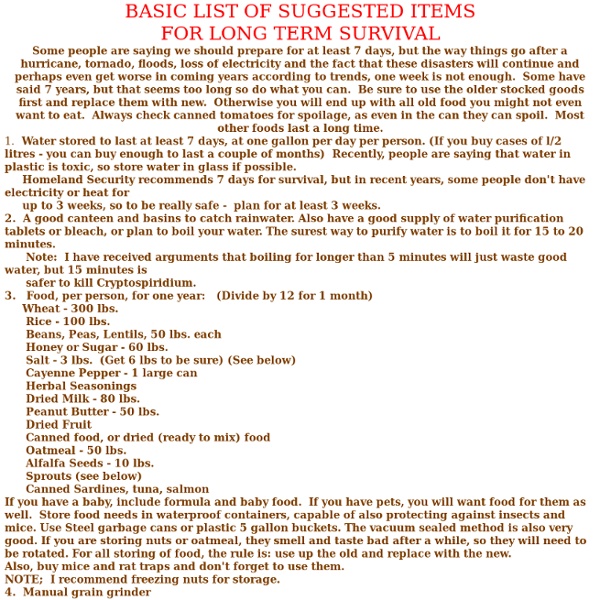
Dehydrated Food: What to Store and How Much to Store Peggy Layton This article is a continuation of the last two in which I discussed The Advantages Of Storing Dehydrated Foods and How To Store Bulk Foods. The basic food items recommended for storage and the quantities to store are listed below. These are only suggestions. Every individual and family is unique in what they like and will eat. Grains: (300 lbs. per person per year or 75 lbs. for three months.) Some other grains to choose from are rice, oats, corn, six-grain and nine-grain cereals, farina, germade, barley, buckwheat, rye and super grains like: quinoa, amaranth, triticale, Kamut®, spelt and millet. White rice verses brown rice: Brown rice doesn’t store very long. White rice is the best choice for long-term food storage. Legumes: (75 lbs. per person per year or about 19 lbs. for three months.) Beans are a great source of protein and, when combined with rice, become a complete protein. Milk and dairy products: Sweeteners: Fruits:
NLP Meta Model, by John David Hoag
The function of the Meta Model is to help us identify and transform problematic deletions, distortions and generalizations in our thinking and communication with others, How The Language We Use Can Delete, Distort and Generalize Our Thinking and Communication "The basic principle behind the Meta Model is Korzybski's notion that 'the map is not the territory.' That is, the models we make of the world around us with our brains and our language are not the world itself but representations of it." -- Dilts and DeLozier, Encyclopedia of Systemic Neuro-Linguistic Programming and NLP New Coding, 2000. META MODEL VIOLATIONS with examples and additions by John David Hoag 1a. Vague nouns (or pronouns) which create confusion and ambiguity. Negative Examples: a. 1b. Adjectives the meanings of which are unspecified. Negative Examples: a. 1c. Relationships between terms or ideas which are assumed and unspecified. Negative Examples: a. 2. Negative Examples: a. 3. Negative Examples: a. 4. 5. 6. 6a. 6b.
Ten Essentials
A simple dry magnetic pocket compass The Ten Essentials are survival items that hiking and scouting organizations recommend for safe travel in the backcountry. List[edit] According to the Mountaineering: The Freedom of the Hills, 6th edition, the ten essentials are:[3] These are now referred to as the "classic" essentials. In 2003 The Mountaineers revised the essential list as part of the 7th edition of "Mountaineering: The Freedom of the Hills"[5] to keep up with modern equipment. Navigation (map and compass)Sun protection (sunglasses and sunscreen)Insulation (extra clothing)Illumination (headlamp/flashlight)First-aid suppliesFire (waterproof matches/lighter/candles)Repair kit and toolsNutrition (extra food)Hydration (extra water)Emergency shelter (tarp, bivy bag, space blanket) The textbook recommends supplementing the ten essentials with: Not every expedition will require the use of an essential item. Other "essentials"[edit] See also[edit] References[edit] External links[edit]
disastermapper
The Victory Garden . Grow . Plants & Vegetables . Plants for Water Gardens
Plants for Water Gardens Michael Weishan talks with water gardener Andre Golden about solid selections for creating your own healthy and attractive water garden. Water gardening doesn't have to be carried out on a grand and costly scale. It's relatively easy to plant and maintain a successful water garden in a smallish tub, which you can seat, for instance, in a decorative outer container. Nitella sp. stonewort To maintain a healthy water garden a couple of plants are more or less required. Eichhornia crassipes water hyacinth Water hyacinth is a prolific plant that also floats at the surface, its dangling roots acting as natural filters, drawing dirt and suspended debris out of the water for its own nourishment. Pistia stratiotes water lettuce Water lettuce is another prolific plant that floats at the surface, its dangling roots acting as natural filters, drawing dirt and suspended debris out of the water for its own nourishment. Nymphaea 'Helvola' and 'Indiana' hardy water lily Colocasia rubra
NLP
Not to be confused with Natural language processing (also NLP) Neuro-linguistic programming (NLP) is an approach to communication, personal development, and psychotherapy created by Richard Bandler and John Grinder in California, United States in the 1970s. Its creators claim a connection between the neurological processes ("neuro"), language ("linguistic") and behavioral patterns learned through experience ("programming") and that these can be changed to achieve specific goals in life.[1][2] Bandler and Grinder claim that the skills of exceptional people can be "modeled" using NLP methodology, then those skills can be acquired by anyone.[3][4][5][6][7] Bandler and Grinder also claim that NLP can treat problems such as phobias, depression, habit disorder, psychosomatic illnesses, myopia,[8] allergy, common cold,[9] and learning disorders, often in a single session.[10][11][12][13] NLP has been adopted by some hypnotherapists and in seminars marketed to business and government.[14][15]
Top 50 Survival Blogs!