

Wiki B@P Wspieramy naukę BOINC to projekt, wykorzystujący wolne zasoby komputerów (CPU i GPU) do obliczeń związanych z projektami badawczymi. Wystarczy że zainstalujesz program BOINC na swoim komputerze, a już po chwili zaczniesz wspierać rozwój nauki na świecie. BOINC@Poland jest drużyną narodową i zrzesza największą liczbę zapaleńców przetwarzania rozproszonego w Polsce. Realizujemy projekty z zakresu ekologi, medycyny, biologi, astronomi, matematyki, fizyki, chemi i innych działów nauki. Mamy na celu nie tylko popularyzację BOINC w kraju, lecz również stworzenie czołowej drużyny na świecie, odpowiednio reprezentującej Polskę i zrzeszającej jak największą liczbę polskich użytkowników. Jak przyłączyć się do BOINC ? Dodatkowe informacje: FAQ - Forum, TechBlog, IRC
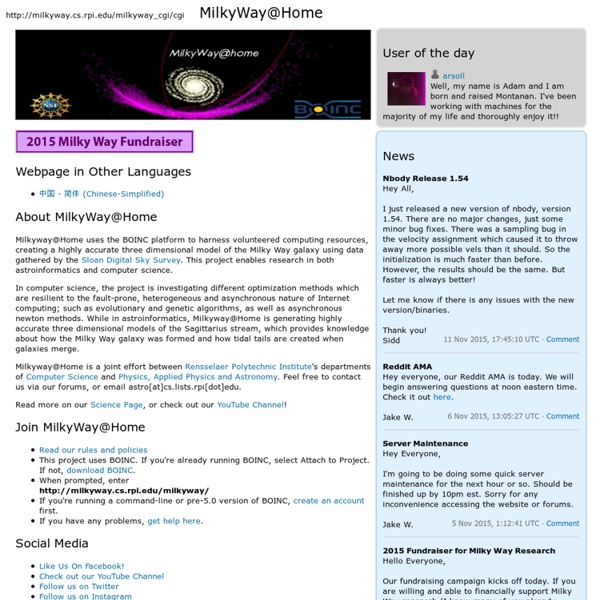
MilkyWay@home - Portal BOINC@Poland Z Wiki B@P Logo MilkyWay@home Galaktyki są wiecznie ewoluującymi systemami, które mogą dostarczyć informacji na temat - jak wszechświat stał się tym, czym jest teraz. Jednej rzeczy, której nauczyliśmy się o galaktykach, jest to, że często łączą się z większymi galaktykami. Wiemy to, ponieważ możemy to zaobserwować. Jednakże tylko tyle można się dowiedzieć na temat tego procesu, gdyż widzimy jedynie dwuwymiarową projekcję. Właśnie te szczątki pływowe będziemy badać przy użyciu Milkyway@home. Projekt nie zajmuje się symulacjami lecz analizą danych. MilkyWay@home będzie analizować dane z Sloan Digital Sky Survey - zakrojonego na szeroką skalę przedsięwzięcia astronomicznego mającego na celu stworzenie trójwymiarowej mapy znacznej części nieba. Projekt związany z Rensselaer Computer Science Department Kliknij poniższy obrazek w celu uzyskania szczegółowych statystyk naszej drużyny: Wiadomości MilkyWay@home
Climateprediction.net | The world's largest climate forecasting experiment for the 21st century. theSkyNet POGS - the PS1 Optical Galaxy Survey You helped name an exoplanet! Hi Everyone, Some great news announced yesterday by the International Astronomical Union - theSkyNet's name suggestion was selected for an exoplanet! The planet around the star Pollux is now named Thestias thanks to djrichmatthews' suggestion. You might notice that Thestias is suspiciously NOT the name we submitted (which was Leda). We're SO EXCITED with this result, congratulations to everyone who suggested, voted and was involved, it was a true team effort and we're so pleased that your name was chosen. -Kirsten and theSkyNet team 17 Dec 2015, 4:18:23 UTC · Comment Area 25,000,000 Yesterday we processed the 25 millionth area of POGS. The two lucky crunchers will be getting Lego and T-shirts 8 Dec 2015, 1:14:10 UTC · Comment Server Crash and New Galaxies Gday All, As lots of you noticed, we had a fairly major crash over the weekend. Fortunately with the magic of AWS and a fairly conservative backup scheme this only caused moderate cursing from theSkyNet team.
GIMPS Home LHC@home - Portal BOINC@Poland Z Wiki B@P LHC@home wspiera projekt Wielkiego Zderzacza Hadronów (Large Hadron Collider - LHC), który znajduje się w laboratorium CERN pod Genewą. Mieści się na głębokości 100m pod ziemią. Akcelerator zastąpił słynny LEP (Wielki zderzacz elektronowo-pozytonowy), w 2008 roku. Dwa strumienie protonów rozpędzane się do prędkości bliskich prędkości światła, które następnie doprowadzane są do "czołowego zderzenia". Ilość danych uzyskana z każdego eksperymentu wykonanego w LHC stanowi niemałe wyzwanie pod względem obliczeń i przechowania. LHC@home na sucho, za pomocą wirtualizacji stara się dobrać optymalne parametry torów cząsteczek w celu osiągnięcia jak najlepszej stabilności rozpędzanych cząstek. Historia LHC@home Drużyną Dave'a Andersona, dyrektora projektu SETI@home i BOINC, przy pomocy drużyny zapalonych studentów pod kierownictwem Bena Segala stworzyła interfejs BOINC dla SixTrack. Działanie LHC@home Za każdym razem, kiedy w LHC instalowany jest nowy magnes, mierzy się jego właściwości.
McAfee Web Gateway - Notification Universe@Home GR SOURCES Ulx’s research, physics, astronomy New models and television program about U@H (in polish) We have finished a bunch of models, which will be published shortly. However, still a lot more are waiting for investigation. In the case of ULXs we are working on the influence of more primordial matter composition on formation of these mysterious objects. In polish public television appeared in the end of previous year a program about scientific computing considering also our project. Intel 64-bit Mac OS 10.5 or later support I had compiled Mac OS version of ULX application. Apologise if application will crash on your system (please report this to me) as I have no experience in Mac OS compiling. If the application provide right results I will also add support for BHspin app. 18 Jan 2016, 13:32:35 UTC · Comment New ULX application Last week we prepared the ULX application which is closely related to the previous (now obsolete) X-ray application. New BHspin application As you might have noticed we added a new application recently.