

SNAP: Stanford Network Analysis Project Microformats "Web 2.0" is the New A number of people have been riffing on the how “Web 2.0” is the new vendor lock-in. The week started with a post by Alex Iskold entitled Towards the Attention Economy: Will Attention Silos Ever Open Up? where he wrote At a quick glance there maybe nothing wrong with the way things are today. Of course, not every “Web 2.0” company is like Netflix and some do provide APIs for getting out your data. Praising companies for providing APIs to get your own data out is like praising auto companies for not filling your airbags with gravel. Back in the day, I thought Steve Gillmor’s AttentionTrust was a step in the direction of a Free Data movement but since then all I’ve seen out of that crowd was either irrelevant (e.g. In a follow up post to the piece by Alex Iskold entitled Attention mashups, Dave Winer gets to the heart of the matter in his characteristic blunt style when he writes But whose data is it?? Now playing: Rick Ross - Hustlin' (remix) (feat.
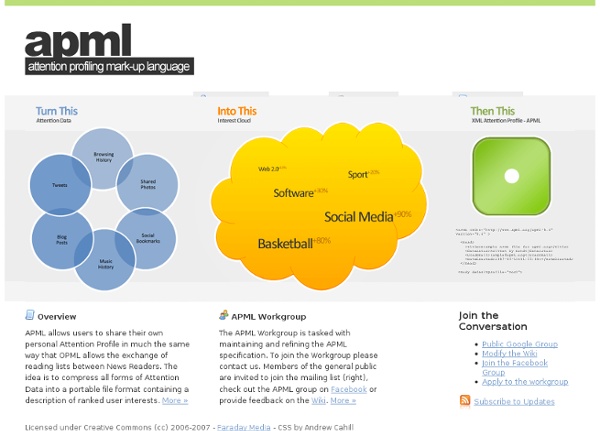
Basics of Attention Profiling through APML at CleverClogs “If you want to inform yourself of the basic principles of attention profiling or need to explain the concept to others then please read on. Feel free to add your clarifications, your conclusions and your constructive criticism to this deliberately non-geek conversation.” In recent months quite a few bloggers covered the growing adoption of APML, a proposed standard for attention profiling. Those about to give up reading here already, please don’t. What is attention profiling and what are the benefits? As usual, this post concludes with a news radar. I encourage you to participate in this deliberately non-geek conversation about attention profiling, either by posting a comment or by writing a blog post of your own. Attention Profiling I like introducing attention profiles as consolidated, structured descriptions of people’s interests and dislikes. In today’s post I confine myself to describe services that are capable of handling attention profiles based on the proposed APML standard.
Statistics with R Warning Here are the notes I took while discovering and using the statistical environment R. However, I do not claim any competence in the domains I tackle: I hope you will find those notes useful, but keep you eyes open -- errors and bad advice are still lurking in those pages... Should you want it, I have prepared a quick-and-dirty PDF version of this document. The old, French version is still available, in HTML or as a single file. You may also want all the code in this document. 1. This work is licensed under a Creative Commons Attribution-NonCommercial-ShareAlike 2.5 License.
Alliance The Key To Consistent Creativity and Productivity How long can you concentrate and focus on one thing before your energy and attention begins to falter? How long does it take you to engage in a particular thing to make the effort of engagement worth it? The answers to those two questions make up (what I’m calling) your engagement threshold, and figuring out your engagement threshold is probably the most important thing you can do to become more consistently creative and productive. A long time ago, I wrote a post called A General Theory of Productivity, in which I said that one of the components of an effective productivity system is “Ideal Time.” I’ve been working with that idea in one form or the other for the last year (and change), and your ideal time is identical to your engagement threshold. Your engagement threshold consists of three factors: How long you can work on one thingHow long it’ll take you to get something meaningful doneA consideration of the particular task at hand I’ll explain each of these, in sequence.
Homepage Welcome to GMPG Rough Type: Nicholas Carr's Blog: Sharecropping the long ta A while back I wrote that Web 2.0, by putting the means of production into the hands of the masses but withholding from those same masses any ownership over the product of their work, provides an incredibly efficient mechanism to harvest the economic value of the free labor provided by the very many and concentrate it into the hands of the very few. Richard MacManus’s new analysis of web traffic patterns helps illustrate the point. Despite the explosion of web content, spurred in large part by the reduction in the cost of producing and consuming that content, web traffic appears to be growing more concentrated in a few sites, not less. Using data from Compete, MacManus shows that the top ten sites accounted for 40% of total internet page views in November 2006, up from 31% in November 2001, a 29% increase. The greater concentration comes during a period when the number of domains on the web nearly doubled, from 2.9 million to 5.1 million. More on this subject: The sharecroppers’ tools.