

Oui, les OGM sont des poisons ! (Cet article paraît dans le "Nouvel Observateur" daté du 20 septembre 2012) C’est une véritable bombe que lance, ce 19 septembre à 15 heures, la très sérieuse revue américaine "Food and Chemical Toxicology" - une référence en matière de toxicologie alimentaire - en publiant les résultats de l’expérimentation menée par l’équipe du français Gilles-Eric Séralini, professeur de biologie moléculaire à l'université de Caen. Une bombe à fragmentation : scientifique, sanitaire, politique et industrielle. Elle pulvérise en effet une vérité officielle : l’innocuité du maïs génétiquement modifié. Lourdement toxique et souvent mortel Même à faible dose, l’OGM étudié se révèle lourdement toxique et souvent mortel pour des rats. En 2006, c’est comme un véritable thriller que commence cette recherche, dont le maître d’œuvre, Gilles-Eric Séralini, divulgue lui-même les conclusions dans un ouvrage à paraître la semaine prochaine ("Tous cobayes !" Nom de code In Vivo Pathologies lourdes, tumeurs mammaires
Nocivité des OGM pour la santé : de nouveaux résultats accablants Edifiant. Une nouvelle étude scientifique menée sur des rats de laboratoires pendant deux ans montre les conséquences gravissimes sur la santé provoquées par la consommation d’un maïs OGM, le NK 603 de Monsanto résistant à l’herbicide Round Up. Le professeur de biologie moléculaire Gilles-Eric Séralini a mené cette étude dans le plus grand secret. © Dean Sewell / Greenpeace La menace est là, bien réelle en France aussi Le maïs OGM NK 603 peut être présent dans l’alimentation animale (destinée au bétail notamment) mais aussi dans des aliments vendus directement aux consommateurs. L’évaluation des OGM en Europe : manque d’indépendance et de sérieux A l’heure actuelle, les risques des OGM sont évalués par l’Autorité Européenne de Sécurité des Aliments (EFSA). L’EFSA doit cesser d’être l’antichambre des industriels des biotechnologies. La complaisance doit cesser ! Greenpeace demande une réponse immédiate de la part de l’Union européenne.
Edheads - Activate Your Mind! Brazil nuts nutrition facts and health benefits Amazon's forest holds some of the unique plant species like Brazil nuts, acai berry, etc., that can be found nowhere else on the planet earth. Native Amazonian cherished these delicious nuts since ages, which provide them much-needed protein, fats and other essential nutrients. Botanically, brazil-nut tree belongs within the family of Lecythidaceae, of the genus: Bertholletia. Scientific name: Bertholletia excelsa. Brazil nut trees are found conspicuously in the non-flooded forest regions of Brazil, Bolivia, and Peru. Each mature tree bears up to 300 fruit pods in a season. Internally, each fruit features 10-25 seeds arranged in orange-like segments. Health benefits of Brazil nuts Brazil nuts are high in calories, contains good quantities of vitamins, anti-oxidants and minerals. Brazil nut oil, obtained from these nuts, has many traditional medicinal applications as emollient and massage therapy. Selection and storage Culinary uses Here are some serving tips: Safety profile 1. 2.
Les OGM ont perdu contre les mauvaises herbes L'Académie américaine des sciences organisait le 10 mai un sommet sur les plantes génétiquement modifiées résistantes aux herbicides. Une réunion de crise. Les agriculteurs américains ont l'impression d'avoir été floués par les semenciers qui leur avaient dit qu'avec les OGM résistants aux herbicides ils n'auraient plus jamais de problèmes avec les mauvaises herbes. Il leur suffisait de pulvériser du glyphosate - une molécule créée par Monsanto aujourd'hui dans le domaine public - pour être tranquilles. Un seul passage était nécessaire pour tout détruire sauf les cultures dotées d'un gène de résistance. Les mauvaises herbes deviennent résistantes elles aussi au Roundup, elles se multiplient très vite et envahissent les champs de soja, de maïs, de coton et de colza. Chaque année, de nouvelles plantes sauvages développent des résistances. Graves conséquences Des alternatives aux OGM sont d'ores et déjà recherchées. » OGM: l'UE pourrait annuler l'interdiction du MON 810
Gilles-Éric Séralini Un article de Wikipédia, l'encyclopédie libre. Gilles-Éric Séralini, né le à Bône en Algérie[1], est un universitaire français[2],[3], professeur de biologie moléculaire depuis 1991, chercheur à l'Institut de biologie fondamentale et appliquée (IBFA) de l'université de Caen et codirecteur du pôle Risques de l'université de Caen[4] (pôle associé au CNRS). Il s'est fait notamment connaître du grand public pour ses études sur les OGM et les pesticides et, en particulier, une étude toxicologique controversée et fortement médiatisée[5] publiée en septembre 2012, avant d'être retirée en novembre 2013, portée par le CRIIGEN, dont il est membre fondateur, mettant en doute l'innocuité du maïs génétiquement modifié NK 603 et du Roundup sur la santé de rats[6]. Biographie[modifier | modifier le code] Gilles-Éric Séralini est né en Algérie en 1960 d'un père technicien dans les télécommunications et d'une mère institutrice. Travaux[modifier | modifier le code] Controverses[modifier | modifier le code]
Shock study, replicates Milgram's findings Nearly 50 years after the controversial Milgram experiments, social psychologist Jerry M. Burger, PhD, has found that people are still just as willing to administer what they believe are painful electric shocks to others when urged on by an authority figure. Burger, a professor at Santa Clara University, replicated one of the famous obedience experiments of the late Stanley Milgram, PhD, and found that compliance rates in the replication were only slightly lower than those found by Milgram. And, like Milgram, he found no difference in the rates of obedience between men and women. "People learning about Milgram's work often wonder whether results would be any different today," Burger says. Milgram found that, after hearing the learner's first cries of pain at 150 volts, 82.5 percent of participants continued administering shocks; of those, 79 percent continued to the shock generator's end, at 450 volts. —K.I.
30 Relationship Tips For Women Who Love Men 1) If a man wants you, nothing can keep him away. 2) If he doesn't want you, nothing can make him stay.... 3) Stop making excuses for a man and his behavior. Likewise, don't make excuses for your own bad behviour. Take action, make change, and created the life you deseve. 4) Allow your intuition (or spirit) to save you from heartache. 5) Stop trying to change yourself for a relationship that's not meant to be. 6) Slower is better. 7) Never live your life for a man before you find what makes you truly happy. 8) If a relationship ends because the man was not treating you as you deserve, then heck no, you can't 'be friends.' 9) Don't settle. 10) Don't stay because you think 'it will get better.' 11) The only person you can control in a relationship is you. 12) Avoid men who've got a bunch of children by a bunch of different women. 13) Always have your own set of friends separate from his. 14) Maintain boundaries in how a guy treats you; if something bothers you, speak up. Good luck!
9 CRITIQUES, 9 réponses sur l'étude de Séralini Après la publication de l’étude de Gilles-Eric Séralini, première étude sur la vie entière de rats nourris au maïs NK 603 et qui fait apparaître la toxicité de cet OGM sur ces rats, de nombreuses critiques et questions se sont fait jour sur les conditions de réalisation de l’étude et sa crédibilité. Le Dr Joël Spiroux, co-auteur et directeur adjoint de l’étude, président du Criigen (Comité de recherche et d’information indépendant sur le génie génétique), répond. Première critique : 200 rats est un trop faible échantillon pour une étude solide… - L'échantillon des 200 rats, 20 rats par lot, correspond au nombre de rats utilisé par Monsanto dans son étude sur trois mois. En revanche, nous avons étudié beaucoup plus de paramètres toxicologiques. Le type de rats employé, les "Sprague-Dawley", est connu pour développer facilement des tumeurs… - Oui mais ce sont les lignées de rats utilisés dans le monde entier pour les recherches toxicologiques. - Détrompez-vous. - Absolument faux.
OGM : "Inconscience ? Lâcheté ? Collusion criminelle ?" Professeur de biologie moléculaire et chercheur à l'Institut de Biologie fondamentale et appliquée de l'université de Caen, Gilles-Eric Séralini publie le 26 septembre "Tous cobayes!" (Flammarion), le résultat d'une étude menée dans le plus grand secret pendant deux ans sur deux cents rats nourris au maïs transgénique. Conclusion ? Il y avait une méfiance diffuse de l’opinion sur l’impact des OGM pour la santé humaine. - Oui, nous venons de réaliser l'étude la plus longue et la plus détaillée au monde sur la toxicité d'un maïs transgénique et sur celle du Roundup, l’herbicide le plus utilisé qui soit. Le grand scandale, celui dont je ne me remets pas, c’est que les agences sanitaires n’ont jamais exigé des industriels une étude de toxicité de longue durée. > A lire : l'intégralité de l'interview de Gilles-Eric Séralini et du dossier "Oui, les OGM sont des poisons !" Téléchargez le magazine : - sur PC / Mac - sur iPhone / iPad - sur Android
Walking Through Doorways Causes Forgetting We’ve all experienced it: The frustration of entering a room and forgetting what we were going to do. Or get. Or find. New research from University of Notre Dame Psychology Professor Gabriel Radvansky suggests that passing through doorways is the cause of these memory lapses. “Entering or exiting through a doorway serves as an ‘event boundary’ in the mind, which separates episodes of activity and files them away,” Radvansky explains. “Recalling the decision or activity that was made in a different room is difficult because it has been compartmentalized.” The study was published recently in the Quarterly Journal of Experimental Psychology. Conducting three experiments in both real and virtual environments, Radvansky’s subjects – all college students – performed memory tasks while crossing a room and while exiting a doorway.
How Samsung is out-innovating Apple Mobile-gadget rivals are leapfrogging Apple with useful features not on iPhones, iPadsThis success is most apparent with Apple's biggest mobile rival, SamsungSamsung is more nimble than Apple at improving its devices through software updatesWith Galaxy Note, Samsung has a category of phone people didn't know they wanted (CNN) -- There's no arguing that Apple set the standard for modern mobile devices with the iPhone and the iPad. It didn't take long after those two products launched for competitors to rush out their own copycat devices. Even then, it took another few years before Android was good enough to go toe to toe with iOS, Apple's mobile operating system. But it's no longer about being just as good as Apple. You have to be better. The evidence is everywhere, but it's most apparent in products made by Apple's biggest mobile rival, Samsung. Samsung's sprawling empire Apple CEO remains confident with company Mark Cuban not bullish on Apple None of that mattered.
Faiblesse des études de mise sur le marché PARIS (AFP) - Le chercheur Gilles-Eric Séralini et la députée européenne Corinne Lepage ont critiqué mardi "l'extrême faiblesse" des études sur lesquelles reposent les autorisations de mise sur le marché délivrées au niveau de l'UE pour les OGM. Tous deux participaient à une conférence de presse de l'organisme de recherche sur les OGM Criigen (Comité de recherche et d'information indépendantes sur le génie génétique), dont ils sont membres fondateurs. "Les critiques qui ont été faites à l'encontre de l'étude du Pr Séralini, elles devraient aussi être appliquées aux études qui ont permis la validation des OGM et dont on constate l'extrême faiblesse", a déclaré Corinne Lepage. Gilles-Eric Seralini, professeur de biologie moléculaire à Caen, est l'auteur d'une étude controversée sur la toxicité des OGM faite sur des rats, sur une durée inhabituelle de deux ans. Le maïs NK603, de la firme Monsanto, est un maïs transgénique résistant à l'herbicide Roundup, produit par le même fabriquant.
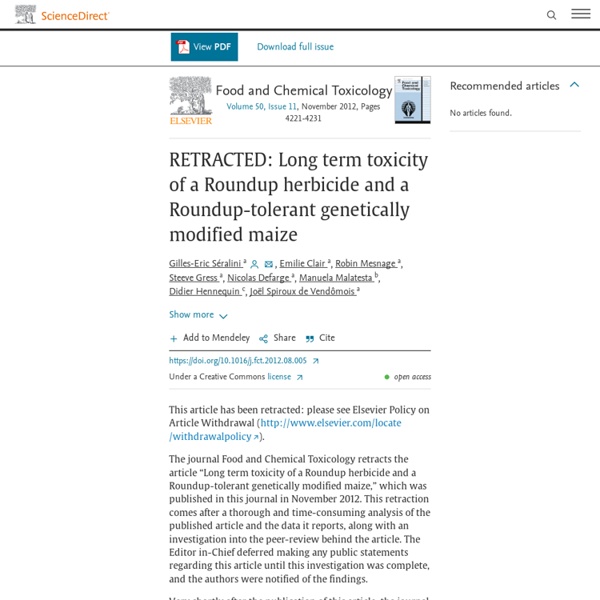
L'étude anti-OGM ou le syndrome de la recherche unique (Agence Science-Presse) Le problème derrière une étude française qui prétend démontrer la nocivité des OGM, c’est qu’elle ne s’appuie peut-être pas sur le bon type de rat, qu’une partie de son échantillon est trop petite, que la quantité de maïs consommée aurait été sujette à caution, et qu’elle a fait le tour des médias avant que quiconque ait pu la lire. Cliquer sur la photo pour agrandir La Une du Nouvel Observateur : Oui, les OGM sont des poisons! (19 septembre 2012) L’étude, parue dans Food and Chemical Toxicology (19 septembre 2012) Qui est Gilles-Eric Séralini, par le Nouvel Observateur Qui est Gilles-Eric Séralini, par Alerte-Environnement Qu’est-ce que le NK603, dans le contexte européen (Le Monde) Les médias ont été nombreux à prétendre que l'équipe Séralini était la première à faire une étude à long terme (deux ans plutôt que 3 mois). Billet du statisticien Michael Grayer sur les questions soulevées par la partie statistique de cette étude.