

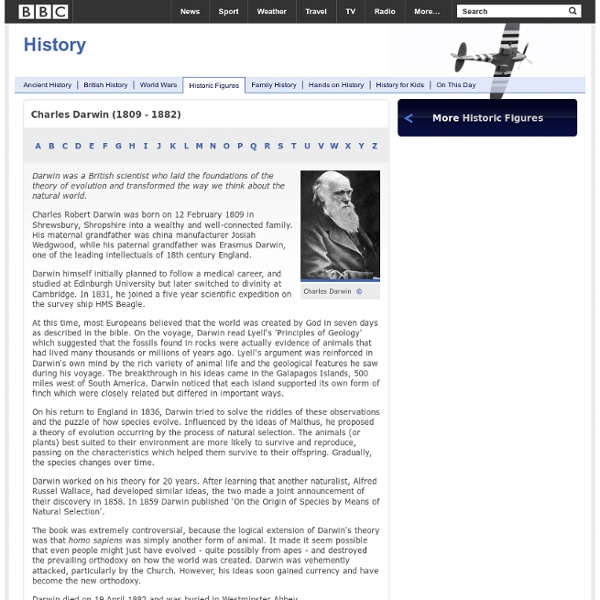
Darwinism Charles Darwin in 1868 Darwinism is a theory of biological evolution developed by Charles Darwin and others, stating that all species of organisms arise and develop through the natural selection of small, inherited variations that increase the individual's ability to compete, survive, and reproduce. Also called Darwinian theory. The meaning of "Darwinism" has changed over time, and varies depending on its context.[4] In the United States, the term "Darwinism" is often used by creationists as a pejorative term in reference to beliefs such as atheistic naturalism, but in the United Kingdom the term has no negative connotations, being freely used as a shorthand for the body of theory dealing with evolution, and in particular, evolution by natural selection.[5] The term was coined by Thomas Henry Huxley in April 1860,[6] and was used to describe evolutionary concepts in general, including earlier concepts such as Spencerism. Conceptions of Darwinism[edit] 19th-century usage[edit] Notes[edit]
National Center for Science Education - Defending the Teaching of Evolution in Public Schools. en español "Creationism" refers to the religious belief in a supernatural deity or force that intervenes, or has intervened, directly in the physical world. Within that broad scope, there are many varieties of creationist belief. Some forms of creationism hold that natural biological processes cannot account for the history, diversity, and complexity of life on earth. Such "anti-evolution" creationists have been leading opposition to the teaching of evolution since the 1920s. For more than two decades, the National Center for Science Education has been opposing efforts by creationists to weaken or block the teaching of evolution. Please note: the term creationism as used in this section refers to anti-evolution creationism. Click menu items on the left for in-depth articles or get started with some of these top resources:
Darwin's Theory Of Evolution An introduction to the John Scopes (Monkey) Trial The early 1920s found social patterns in chaos. Traditionalists, the older Victorians, worried that everything valuable was ending. Younger modernists no longer asked whether society would approve of their behavior, only whether their behavior met the approval of their intellect. Who would dominate American culture--the modernists or the traditionalists? William Jennings Bryan, three-time Democratic candidate for President and a populist, led a Fundamentalist crusade to banish Darwin's theory of evolution from American classrooms. The Scopes Trial had its origins in a conspiracy at Fred Robinson's drugstore in Dayton. The conspirators summoned John Scopes, a twenty-four-year old general science teacher and part-time football coach, to the drugstore. Rappalyea initially wanted science fiction writer H. A carnival atmosphere pervaded Dayton as the opening of the trial approached in July of 1925. On Thursday, July 16, the defense called its first witness, Dr. The trial was nearly over.
Creation–evolution controversy The creation–evolution controversy (also termed the creation vs. evolution debate or the origins debate) involves a recurring cultural, political, and theological dispute about the origins of the Earth, of humanity, and of other life.[1] This debate rages most publicly in the United States of America, but to a lesser extent also proceeds in Europe and elsewhere,[2] often portrayed as part of a culture war.[3] Christian fundamentalists dispute the evidence of common descent of humans and other animals as demonstrated in modern palaeontology, and those who defend the conclusions of modern evolutionary biology, geology, cosmology, and other related fields. They argue for the Abrahamic religions' accounts of creation, framing it as reputable science ("creation science"). The debate is sometimes portrayed as being between science and religion, but as the United States National Academy of Sciences states: History[edit] [edit] Creationism in theology[edit] A simplified depiction of human evolution
Teaching of evolution in U.S. schools Protestant religious schools: There is little conflict over evolution within most Christian home schooling programs and Christian religious schools. Creation science and Intelligent Design are taught there as the only valid belief systems concerning the history of the world, its life forms and the rest of the universe. Naturalistic and theistic Evolution is generally rejected. However, there seems to be an increasing trend among some Christian high schools and colleges to abandon creation science in favor of theistic evolution -- the concept that evolution of the species happened on earth over billions of years, and that God used evolution as a tool to create the species that we see today. "Experts say theistic evolution is showing up in a growing number of Christian colleges. For example, Wheaton College in Wheaton, Ill., recently invited a guest speaker from Kansas State University to lecture on the topic.
Understanding Evolution Looking for information on controversies in the public arena relating to evolution? The Understanding Evolution website deals with the science and history of evolutionary biology. This site is here to help you understand what evolution is, how it works, how it factors into your life, how research in evolutionary biology is performed, and how ideas in this area have changed over time. However, in the United States, there has been controversy in the public arena relating to evolution. Since these controversies do not deal with the science of evolutionary biology, we do not extensively address them on our site. Nevertheless, many other websites do discuss the public controversy. Why do/should our schools teach evolution? What does the law say about teaching evolution in public schools? What happened at the Dover Trial? What happened at the Scopes Monkey Trial? What statements do different religious groups make on evolution? What is creationism? What is the intelligent design movement?
Americans' Creationist Views on Human Origins (Infographic) | Beliefs in God & Evolution by Ross Toro, LiveScience contributor | June 14, 2012 06:25pm ET Despite new discoveries in biological and social science, there has been virtually no change in Americans' views of the origin of the human species. According to a recent Gallup study, most Americans believe in God and about 85 percent describe themselves as having a religious identity, so it is not surprising as a result to find that 78 percent of Americans today hold a view of human origins that involves actions by God — a belief that he either created humans as depicted in the book of Genesis or guided a process of evolution. The finding is slightly less than the percentage who felt this way in 1982 and there is no evidence in this trend of a significant movement toward a more scientific viewpoint on human origins. The study also found that 46 percent of Americans believe that God created humans in their present form within the last 10,000 years. Embed: Paste the code below into your site.
How Creationism Works" Every religion in the world has its own version of the origins of life and matter. In Abrahamic religions, including Christianity, Judaism and Islam, these explanations rest on the premise that God created the universe and everything in it. This is the basic tenet of creationism in the West. In the United States, the public debate between Christian creationism and evolution, once considered dead in the wake of the Scopes Monkey trial, is back on its feet. What is Creationism? Creationism is a blanket term incorporating all beliefs that the origins of the universe and life are attributable to supernatural or miraculous means. In the beginning God created the heaven and the earth. The creation of the universe and all that it contains took a total of six days. While the account of creation in Genesis is the basis for all Christian creationism, there are actually many different types of creationists within Christianity.
How Evolution Works" The theory of evolution is one of the best-known scientific theories around. Try to make it through a day without using or hearing the word "evolution" and you'll see just how widespread this theory is. Evolution is fascinating because it attempts to answer one of the most basic human questions: Where did life, and human beings, come from? The theory of evolution proposes that life and humans arose through a natural process. A very large number of people do not believe this, which is something that keeps evolution in the news. In this article, we will explore the theory of evolution and how it works. Let's start off by taking a look at the basic principles of the theory of evolution, look at some examples and then examine the holes.