What Is Web 2.0
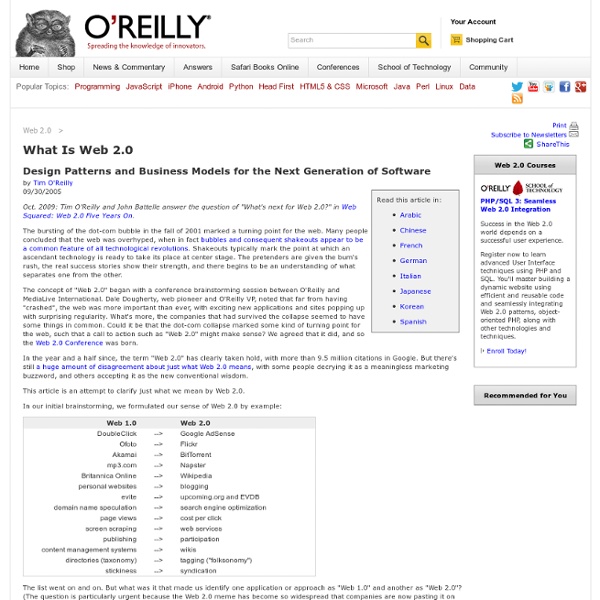
by Tim O'Reilly 09/30/2005 Oct. 2009: Tim O'Reilly and John Battelle answer the question of "What's next for Web 2.0?" in Web Squared: Web 2.0 Five Years On. The bursting of the dot-com bubble in the fall of 2001 marked a turning point for the web. Many people concluded that the web was overhyped, when in fact bubbles and consequent shakeouts appear to be a common feature of all technological revolutions. Shakeouts typically mark the point at which an ascendant technology is ready to take its place at center stage. The concept of "Web 2.0" began with a conference brainstorming session between O'Reilly and MediaLive International. In the year and a half since, the term "Web 2.0" has clearly taken hold, with more than 9.5 million citations in Google. This article is an attempt to clarify just what we mean by Web 2.0. In our initial brainstorming, we formulated our sense of Web 2.0 by example: The list went on and on. 1. Netscape vs.
http://www.oreillynet.com/pub/a/oreilly/tim/news/2005/09/30/what-is-web-20.html
Rich Internet Applications
Backbase Customer Experience Platform (CXP) helps you create rich, interactive web portals and mobile applications. Allowing you to create, and manage deeply relevant customer experiences on any device. Delighting your customers and driving measurable business results. Backbase CXP comes with a complete set of integrated customer experience management functions, including: integrated content management, what-you-see-is-what-you-get editing, intelligent forms-based dialogs, secure application integration, cross device delivery, smart targeting, digital marketing tools, and integrated analytics. At the same time, Backbase CXP offers robust enterprise security and application integration technology that helps you integrate your existing systems and applications with ease, enabling you to leverage your previous IT investments. Learn more →
All Things Web 2.0
« QUOTE OF THE WEEK: "Bad Code is Good Business" | Sacred Cow Dung Home | High-Performance Social Networking - Part II: The Natural Life-Cycle of a Personal Network » March 10, 2006 All Things Web 2.0 - "THE LIST" The most current listings are now available as a continuously updated Open Directory at “All Things Web 2.0 – The Directory”
Web 2.0
A tag cloud (a typical Web 2.0 phenomenon in itself) presenting Web 2.0 themes Web 2.0, also called Participative (or Participatory)[1] and Social Web[2], refers to World Wide Web websites that emphasize user-generated content, usability (ease of use, even by non-experts), and interoperability (this means that a website can work well with other products, systems, and devices) for end users. The term was invented by Darcy DiNucci in 1999 and popularized several years later by Tim O'Reilly and Dale Dougherty at the O'Reilly Media Web 2.0 Conference in late 2004.[3][4][5][6] Web 2.0 does not refer to an update to any technical specification, but to changes in the way Web pages are designed and used. The transition was progressive and we can not precisely say when the change occurred.[2] History[edit] Web 1.0[edit]
FREE website monitoring by mon.itor.us
Here's what our monitoring tools can do for IT Consultants, ISPs, ISVs, Web Developers and Web Designers Imagine how much you could grow your business if you weren't chained to your desk. Monitor.Us makes this possible.
Creating Passionate Users
« Female-friendly tech shirts | Main | Reverse-engineering user reviews » The "Dumbness of Crowds" Community. Wisdom of Crowds. Collective Intelligence. The new emphasis on net-enabled collaboration is all goodness and light until somebody gets an eye I poked out.
AJAX explained
AJAX is in the news all the time now and it is assumed that everyone knows what it means. Many people don't, so here is my quick summary of what AJAX is and some examples of applications. AJAX is an acronym for Asynchronous Javascript And XML. Microsoft invented this concept in the late 90's but referred to it as XMLHttpRequest, also sometimes referred to as DHTML or Dynamic HTML.
Google’s Social Design Best Practices
Tucked away as part of the new Open Social initiative launched last week, Google engineers offered an interesting best practices document of social design dos and don’ts. Social Design Best Practices The list of best practices are as follows:
250+ Tools and Resources For Coding the Web
HOT STORY: Google Reader Stats are Bullshit (With Proof) We're all living on the web, and we all seem to be starting our own websites, so it's time we all learned the languages that make it run. We've gathered over 250 resources to help you get going.
Related:
web2.0
•
web2.0
•
collaborate
•
papier
•
news
Related: