

Enthalpy Enthalpy is a defined thermodynamic potential, designated by the letter "H", that consists of the internal energy of the system (U) plus the product of pressure (P) and volume (V) of the system:[1] Since enthalpy, H, consists of internal energy, U, plus the product of pressure (P) and the volume (V) of the system, which are all functions of the state of the thermodynamic system, enthalpy is a state function. The unit of measurement for enthalpy in the International System of Units (SI) is the joule, but other historical, conventional units are still in use, such as the British thermal unit and the calorie. The enthalpy is the preferred expression of system energy changes in many chemical, biological, and physical measurements, because it simplifies certain descriptions of energy transfer. The total enthalpy, H, of a system cannot be measured directly. Enthalpy of ideal gases and incompressible solids and liquids does not depend on pressure, unlike entropy and Gibbs energy. Origins[edit] or
Entropy (information theory) 2 bits of entropy. A single toss of a fair coin has an entropy of one bit. A series of two fair coin tosses has an entropy of two bits. The number of fair coin tosses is its entropy in bits. This random selection between two outcomes in a sequence over time, whether the outcomes are equally probable or not, is often referred to as a Bernoulli process. The entropy of such a process is given by the binary entropy function. This definition of "entropy" was introduced by Claude E. Entropy is a measure of unpredictability of information content. Now consider the example of a coin toss. English text has fairly low entropy. If a compression scheme is lossless—that is, you can always recover the entire original message by decompressing—then a compressed message has the same quantity of information as the original, but communicated in fewer characters. Shannon's theorem also implies that no lossless compression scheme can compress all messages. . The average uncertainty , with
Complex adaptief systeem Een complex adaptief systeem (Engels: complex adaptive system) of kortweg CAS is in de systeemtheorie een complex systeem waarvan de onderling verbonden componenten de mogelijkheid hebben zich aan te passen en te "leren" van eerdere ervaringen. De term complex adaptive system is bedacht aan het Santa Fe Instituut door John Henry Holland, Murray Gell-Mann en nog enkele anderen. De wetenschappelijke studie van CAS richt zich in de eerste plaats op hun complexe, emergente en macroscopische eigenschappen. Los van de systeemtheorie is er geen enkel deelgebied van de wetenschap dat gebruikmaakt van de term. Mogelijke definities[bewerken] Beschrijving[bewerken] Kenmerken[bewerken] Voorbeelden[bewerken] Voorbeelden van complexe adaptieve systemen zijn: Literatuur[bewerken] Externe links[bewerken]
Conjugate variables (thermodynamics) In thermodynamics, the internal energy of a system is expressed in terms of pairs of conjugate variables such as temperature and entropy or pressure and volume. In fact, all thermodynamic potentials are expressed in terms of conjugate pairs. For a mechanical system, a small increment of energy is the product of a force times a small displacement. A similar situation exists in thermodynamics. The thermodynamic square can be used as a tool to recall and derive some of the thermodynamic potentials based on conjugate variables. In the above description, the product of two conjugate variables yields an energy. Just as a small increment of energy in a mechanical system is the product of a force times a small displacement, so an increment in the energy of a thermodynamic system can be expressed as the sum of the products of certain generalized "forces" which, when unbalanced, cause certain generalized "displacements" to occur, with their product being the energy transferred as a result. is:
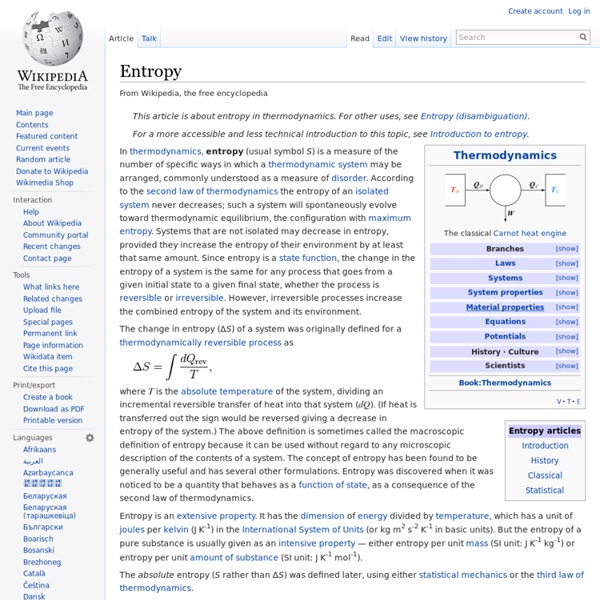
Entropy Figure 1: In a naive analogy, energy in a physical system may be compared to water in lakes, rivers and the sea. Only the water that is above the sea level can be used to do work (e.g. propagate a turbine). Entropy represents the water contained in the sea. In classical physics, the entropy of a physical system is proportional to the quantity of energy no longer available to do physical work. History The term entropy was coined in 1865 [Cl] by the German physicist Rudolf Clausius from Greek en- = in + trope = a turning (point). The Austrian physicist Ludwig Boltzmann [B] and the American scientist Willard Gibbs [G] put entropy into the probabilistic setup of statistical mechanics (around 1875). The concept of entropy in dynamical systems was introduced by Andrei Kolmogorov [K] and made precise by Yakov Sinai [Si] in what is now known as the Kolmogorov-Sinai entropy. The formulation of Maxwell's paradox by James C. Entropy in physics Thermodynamical entropy - macroscopic approach References
The Value of Simplicity in Design - DZone Web Dev As a software developer I can tell you for sure that I am not a User Experience (UX) expert, but I can give you an opinion from experience on what looks good or what is easier to use versus something that is not. What ‘looks good’ is obviously a highly subjective point of view, but what ‘works well’ or is easy to use is (again from my lack of experience as a UX expert) I assume easier to measure with a variety of metrics (think time spent on page, time spent looking for x on page, time between related clicks/keypresses, number of required navigation steps to get from x to y etc). The reason for this post is that I’ve come across this quote a few times in multiple places over the past few days: “… perfection is attained not when there is nothing more to add, but when there is nothing more to remove” - from French author, Antoine de Saint Exupéry In software development at the lowest level, there’s a number of guiding principals that are related to simplicity. Topics:
Boltzmann constant The Boltzmann constant (kB or k), named after Ludwig Boltzmann, is a physical constant relating energy at the individual particle level with temperature. It is the gas constant R divided by the Avogadro constant NA: It has the same dimension (energy divided by temperature) as entropy. Bridge from macroscopic to microscopic physics[edit] where R is the gas constant (8.314 4621(75) J K−1 mol−1[1]). The left-hand side of the equation is a macroscopic amount of pressure-volume energy representing the state of the bulk gas. Role in the equipartition of energy[edit] Given a thermodynamic system at an absolute temperature T, the thermal energy carried by each microscopic "degree of freedom" in the system is on the order of magnitude of kBT/2 (i. e., about 2.07×10⁻²¹ J, or 0.013 eV, at room temperature). Application to simple gas thermodynamics[edit] Kinetic theory gives the average pressure p for an ideal gas as Substituting that the average translational kinetic energy is gives History[edit]
8. Reductio ad Absurdum – A Concise Introduction to Logic 8.1 A historical example In his book, The Two New Sciences,[10] Galileo Galilea (1564-1642) gives several arguments meant to demonstrate that there can be no such thing as actual infinities or actual infinitesimals. One of his arguments can be reconstructed in the following way. He also proposes that we take as a premise that there is an actual infinity of the squares of the natural numbers. Now, Galileo reasons, note that these two groups (today we would call them “sets”) have the same size. If we can associate every natural number with one and only one square number, and if we can associate every square number with one and only one natural number, then these sets must be the same size. But wait a moment, Galileo says. We have reached two conclusions: the set of the natural numbers and the set of the square numbers are the same size; and, the set of the natural numbers and the set of the square numbers are not the same size. 8.2 Indirect proofs (P→(QvR)) This argument looks valid.
Sun Bug Equation of state Overview[edit] The most prominent use of an equation of state is to correlate densities of gases and liquids to temperatures and pressures. One of the simplest equations of state for this purpose is the ideal gas law, which is roughly accurate for weakly polar gases at low pressures and moderate temperatures. However, this equation becomes increasingly inaccurate at higher pressures and lower temperatures, and fails to predict condensation from a gas to a liquid. In practical context, the equations of state are instrumental for PVT calculation in process engineering problems and especially in petroleum gas/liquid equilibrium calculations. Historical[edit] Boyle's law (1662)[edit] The above relationship has also been attributed to Edme Mariotte and is sometimes referred to as Mariotte's law. Charles's law or Law of Charles and Gay-Lussac (1787)[edit] Dalton's law of partial pressures (1801)[edit] Mathematically, this can be represented for n species as: The ideal gas law (1834)[edit] = volume