

Planets For Kids - Solar System Facts and Astronomy World Sunlight Map Watch the sun rise and set all over the world on this real-time, computer-generated illustration of the earth's patterns of sunlight and darkness. The clouds are updated daily with current weather satellite imagery. The Mercator projection used here is one way of looking at the spherical earth as a flat map. Used since the 16th century for navigation, straight lines on this map can be used accurately as compass bearings but the size and shape of continents are distorted. Compare this with Peters, Mollweide or equirectangular projection maps. Also available is a semi-realistic view of dawn and dusk from far above the Earth, a look at the moon, and information about how this works.
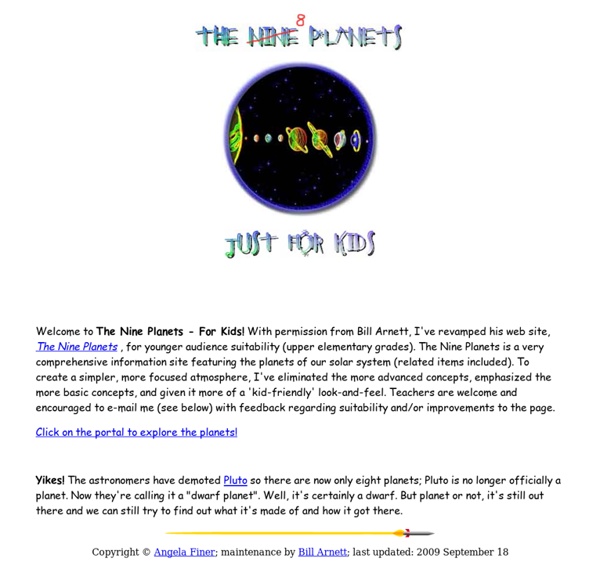
The Solar System Our solar neighborhood is an exciting place. The Solar System is full of planets, moons, asteroids, comets, minor planets, and many other exciting objects. Learn about Io, the explosive moon that orbits the planet Jupiter, or explore the gigantic canyons and deserts on Mars. What Is The Solar System? The Solar System is made up of all the planets that orbit our Sun. Everything in the Solar System orbits or revolves around the Sun. How Did The Solar System form? This is an important question, and one that is difficult for scientists to understand. Scientists believe that the Solar System evolved from a giant cloud of dust and gas. At the center of this spinning cloud, a small star began to form. Further away from the center of this mass where the star was forming, there were smaller clumps of dust and gas that were also collapsing. A Great Storm Once ignited, the Sun's powerful solar winds began to blow. The Solar System Has Over 100 Worlds It is true that there are only eight planets.
Solar System, Solar System Information Our Cosmic Neighborhood From our small world we have gazed upon the cosmic ocean for thousands of years. Ancient astronomers observed points of light that appeared to move among the stars. Since the invention of the telescope, three more planets have been discovered in our solar system: Uranus (1781), Neptune (1846), and, now downgraded to a dwarf planet, Pluto (1930). The four planets closest to the sun—Mercury, Venus, Earth, and Mars—are called the terrestrial planets because they have solid rocky surfaces. Nearly every planet—and some of the moons—has an atmosphere. Moons, Rings, and Magnetospheres There are 140 known natural satellites, also called moons, in orbit around the various planets in our solar system, ranging from bodies larger than our own moon to small pieces of debris. From 1610 to 1977, Saturn was thought to be the only planet with rings. Most of the planets also have magnetic fields, which extend into space and form a magnetosphere around each planet.