
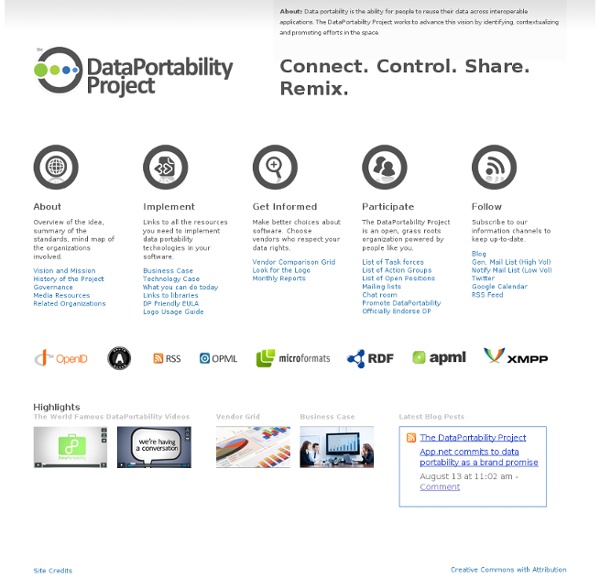
Vision & mission - The DataPortability Project - The DataPortability wiki Vision Data portability enables a borderless experience, where people can move easily between network services, reusing data they provide while controlling their privacy and respecting the privacy of others. For the user With data portability, you can bring your identity, friends, conversations, files and histories with you, without having to manually add them to each new service. Each of the services you use can draw on this information relevant to the context. As your experiences accumulate and you add or change data, this information will update on other sites and services if you permit it, without having to revisit others to re-enter it. For the Service Provider With cross-system data access, interoperability, and portability, people can bring their identities, friends, conversations, files, and histories with them to your service, cutting down on the need for form-filling which can drive people away. Data portability is a new approach, where it is easier to use and deliver services.
MyID.is takes logical step, links Web ID with real world - Ars Technica Ars asked Charles Nourit, founder and CEO of MyID.is, whether this kind of service should be coming from the world's governments instead of the private sector. After all, our governments provide our identification in real life, why not on the Web? "Yes, the governments should do this," Nourit replied, "but attempts so far have failed. For now, MyID.is plans to make money through the initial setup fees it charges. Allowing users to publish content through MyID.is (certified, of course) to social media services is still in the works, as are the single sign-on tools. Further Reading Found via TechCrunch
2008 Is The Year of Data Portability Marshall Kirkpatrick has posted that Microsoft will be joining the Data Portability work group. Marshall and the Read/Write/Web team appear to be huge advocates of this work group. I am a huge advocate myself even though there are more questions then answers. It appears that 2008 is rapidly shaping up to be a ground-shifting year in regards to data portability. Just last week Yahoo announced that they would begin supporting OpenId as a login standard. That has been just one of the massive steps that have taken place. OpenSocial has attempted to define itself as one of the leading standards. There are going to be many challenges facing the evolution of data portability but the creation of the Data Portability workgroup, will surely help to make 2008 an interesting year.
Libraries Below is a list of libraries, products, and tools implementing current OpenID specifications and related specs. While several of these implementations have been tested, they are maintained by members of the OpenID community or vendors and are not necessarily known to work. Please review the documentation and test your own implementation thoroughly before releasing to the public. To discuss these implementations, please consider joining the code@openid.net mailing list. To participate in interop testing, also join the openid-connect-interop@googlegroups.com mailing list. Table of Contents OpenID Connect is an interoperable authentication protocol based on the OAuth 2.0 family of specifications. Apache mod_auth_openidc Apache Relying Party module for OpenID ConnectLicense: Apache 2.0Relying Party: YesIdentity Provider: NoTarget Environment: Apache Web Server Thinktecture.IdentityServer.v3 Java Nimbus OAuth 2.0 SDK with OpenID Connect extensions MITREid Connect Google OAuth Client Library for Java
Specifications OpenID specifications are developed by OpenID working groups and go through three phases: Drafts, Implementer’s Drafts, and Final Specifications. Implementer’s Drafts and Final Specifications provide intellectual property protections to implementers. Final Specifications are OpenID Foundation standards. Final Specifications OpenID Connect specifications: OpenID Connect Core – Defines the core OpenID Connect functionality: authentication built on top of OAuth 2.0 and the use of claims to communicate information about the End-UserOpenID Connect Discovery – (Optional) Defines how clients dynamically discover information about OpenID ProvidersOpenID Connect Dynamic Registration – (Optional) Defines how clients dynamically register with OpenID ProvidersOAuth 2.0 Multiple Response Types – Defines several specific new OAuth 2.0 response types Implementer’s Drafts Drafts Obsolete Specifications Final OpenID 2.0 specifications: OpenID 2.0 Drafts: Early OpenID specifications:
The inexorable rise of work markets The role and prominence of online markets for work have soared dramatically over the last few years, but this is just the beginning. I have been following the rise of online markets for work since Elance was founded in 1999, writing about them in my 2002 book Living Networks and dedicating a large chunk of Getting Results From Crowds to how to effectively manage work markets. Prominent VC Fred Wilson of Union Square Ventures has just written a post The Nature Of The Firm and Work Markets, referencing, as I did in both of these books, the seminal work of Ronald Coase. Coase argues that transaction costs that make “trading bilaterally through contracts” expensive spur the organization of firms. He goes on to reference one of their portfolio companies, WorkMarket, that plays at the heart of this space. Indeed, while what I call ‘service marketplaces‘ have already significantly changed the work landscape, this is just the beginning.
DataPortability looks set to massively increase the value of the Net to users Over the last few weeks excitement has been mounting over the DataPortability movement, which has a mission of giving users control over their data. It brings together a range of existing initiatives, including APML, OpenID, RSS, and others to enable personal data to be shared between applications and vendors. The initiative is spearheaded by Chris Saad, with a broad global team involved, and rapidly growing membership of the group. The latest hot news is that Microsoft is joining the DataPortability group. Other recent new participants include Facebook, LinkedIn and Flickr. Many of the big names in technology and other key social networking sites are believed to be on the verge of announcing their participation. Last year I wrote many times and about the trend to openness on the web, and the reinvigoration of the concept of infomediaries. Michael Pick has created a neat 2 minute video explaining the key concepts of DataPortability – see below.
Explorer le futur en France et en français Ceci est le premier billet de blog que j’écris en français. Je suis Australien, né à Canberra, mais mon père travaillais pour l’ONU et j’ai passé presque tout ma jeunesse à Genève. Je vivais ainsi à quelques kilomètres de la France et j’y allais tous les samedis pour skier. Je vais passer de la fin avril à la fin mai en Europe, commençant avec un keynote à The Next Web à Amstersdam sur The Future of Crowds et enchaînant par la suite avec diverses conférences et ateliers, entre autres, à Londres, Luxembourg, Cologne, Moscou et Milan. Durant cette visite, mais aussi dans les années à venir, j’ai l’intention d’augmenter mon visibilité et de travailler beaucoup plus en France. Mon mètier consiste principalement à travailler avec de grandes entreprises et gouvernments, et parfois des startups, pour envisager le futur et développer des stratégies utiles dans un monde incertain.
Gestion de la mémoire - Blog Haypo Comme je commençais à accumuler pas mal de liens intéressants sur la gestion de la mémoire, je me suis décidé à écrire un article. J'espère qu'il vous sera utile, au moins pour la culture générale. Multithreading et malloc() L'implémentation actuelle du célèbre allocateur de mémoire malloc() de la GNU libc est peu performante pour un programme multi-threadé. La prochaine version de FreeBSD (7.0) aura aussi un nouvel allocateur de mémoire : jemalloc, écrit par Jason Evans. Selon un benchmark « NetBSD versus FreeBSD », les performances restent stables au delà de 4 threads (sur une machine ayant 4 processeurs) pour le nouvel allocateur de FreeBSD, alors que pour NetBSD et Linux les performances s'écroulent. La version actuelle de la GNU libc utilise ptmalloc2, implémentation inspiré de celle de Doug Lea (dlmalloc) version 2.7. Mesure de la mémoire des processus Il propose un patch pour le noyau qui permet de compter le nombre de processus partageant une page mémoire. Noyau Linux Et Python ?
Yammer and why activity streams are a key foundation for integrated applications and organizations I caught up with some of the Yammer team this morning, including Chief Customer Officer David Obrand, while they are in town for the Yammer on Tour series. I was particularly interested in talking with them about Yammer’s shift to activity streams. In the massive convergence of enterprise social platforms that we’ve seen over the last years, one of the major emerging spaces is activity streams. Last year I wrote about activity streams in the context of Tibbr’s launch. Tibbr put activity streams squarely on the map, by integrating status messages from people with notifications generated by enterprise software including ERP, CRM, and HR systems. Employees are able to follow their colleagues and they can also follow updates on any activity, including events, projects, or even invoices. Yammer is now playing in the activity stream space, putting itself forward as a horizontal layer that ties together a wide variety of enterprise software systems.
Réduire sa latence sous Win XP C'est un pote qui m'a passé l'astuce. Au début, j'étais septique, il s'agit de bidouiller la base de registres pour réduire de 150ms sa latence. Ca donne envie quand même ! En fait, il suffit de comprendre à quoi sert la modif pour piger que c'est pas dangereux, que ça touche en rien à la sécurité de votre ordi, et qu'en plus c'est pas mal efficace. Que fait-on par cette modif ? Attention toute fois, pour faire des "feintes" de sorts en arènes vous devez avoir de la latence pour que l'ennemie continue de vous voir caster et gaspille son Cs. Voici la procédure pour cela : 1ère Etape ! Tapez "regedit" dans "Exécuter" pour lancer l'éditeur du Registre.Dans l'arborescence de gauche cherchez: HKEY_LOCAL_MACHINE\\\\SYSTEM\\\\CurrentControlSet\\\\Services\\\\Tcpip\\\\Parameters\\\\Interfaces\\\\ Vous devriez avoir dans ce dossier "Interfaces" un ou plusieurs sous-dossiers du genre: {7DBA6DCA-FFE8-4002-A28F-4D2B57AE8383}. 2ème Etape ! Validez toussa, faites un reboot du PC et voilà fini !
Themes of the day: Consumerization of IT, Crowdsourcing for small business, Crowdsourcing in PR These are frantically busy days, which is squeezing my ability to blog and capture some of the fascinating stuff flying by. In coming months I think I’ll try to do more ‘mini-blogging’, just capturing quick thoughts and impressions rather than writing up every interesting speaking engagement or media appearance I do. Yesterday I gave three presentations, and I’d love to write (at least) a full blog post about what we covered for each one. However that’s not possible, so I’ll just share quick thoughts about each topic and what I will try to write more about later. The day started by giving the keynote at a Consumerization of IT event run by CIO Magazine, supported by HP and Microsoft. My topic was The Future of IT Consumerization. As we shift to an economy of individuals, the primary locus of technology is moving from organizations to people. My focus in this webinar was on what small and mid-sized businesses need to know about crowdsourcing.
ping (logiciel) Un article de Wikipédia, l'encyclopédie libre. Ping exécuté dans une invite de commande DOS Ping est le nom d'une commande informatique permettant de tester l'accessibilité d'une autre machine à travers un réseau IP. La commande mesure également le temps mis pour recevoir une réponse, appelé round-trip time (temps aller-retour). Ping utilise une requête ICMP Request et attend une réponse Reply. Normalement le paramètre TTL (Time to Live) d'un paquet indique le nombre maximal de routeurs intermédiaires que l'on peut encore traverser pour atteindre la cible. Mike Muuss a écrit ce programme en décembre 1983 pour déboguer un comportement anormal sur réseau IP. Exemple de ping sous Windows, vers l'adresse IP du serveur DNS de Wikipédia : Exemple de ping sous Linux, vers fr.wikipedia.org : fping est similaire à ping et dispose d'options supplémentaires et permet de tester de nombreuses cibles simultanément. Exemple de (f)ping(6) sous Linux, vers une adresse IPv6 :