background preloader

A Day in the Life of a Connected Educator – Using social media in 21st century classrooms

A Day in the Life of a Connected Educator – Using social media in 21st century classrooms
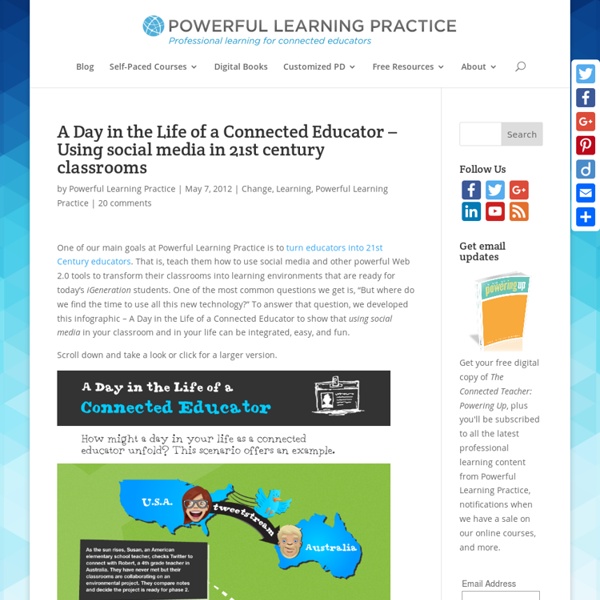
One of our main goals at Powerful Learning Practice is to turn educators into 21st Century educators. That is, teach them how to use social media and other powerful Web 2.0 tools to transform their classrooms into learning environments that are ready for today’s iGeneration students. One of the most common questions we get is, “But where do we find the time to use all this new technology?” To answer that question, we developed this infographic – A Day in the Life of a Connected Educator to show that using social media in your classroom and in your life can be integrated, easy, and fun. Scroll down and take a look or click for a larger version. Get connected Would you like to become a connected educator? Explore more about the life of a Connected Educator and 21st Century teacher & learner in The Connected Educator: Learning and Leading in a Digital Age by Sheryl Nussbaum-Beach and Lani Ritter Hall. Tweet all about it What does a typical day in a 21st century classroom look like?

Part 1 of 2: Power of a 21st Century Continuum - Virginia Beach, VA What does creativity really look like? Are students more creative in their early years than in the latter parts of their schooling? Does this fly in the face of what we know about creativity, that it is grounded in deep knowledge and requires the patience to ruminate over a period of time? So at an early age, what are kids doing instead? This is a window into a conversation that teachers, administrators, local employers, parents and Board members had in the development of a continuum for 21st century skills. So far, we have treated 21st century skills as a typical initiative — it has generated keynote speeches, and amorphous goals but it has not gained any real traction in curriculum, assessment and instructional design. “The initial demands to renovate the schoolhouse were based on the theoretical notion that one day, the world would be different and the competitive advantage would go to those nations that trained their workforce to adapt to those realities. Continuum in action.

15 Sites for Finding Images and Clip Art for Education A while back I did a top 10 sites for finding images and clip art for education. However, a lot of things have changed since then and a few of those sites no longer exist. That being said a handful of new and exciting sites have been developed for education for finding images which led me to creating a new list. *Keep in mind when searching for images for students it is always a good idea to have adult supervision/filtering solution. ** The following list is in alphabetical order... To view my Images for Education board on Pinterest click here.

For 'Connected Educator Month,' Tips From 33 Educators We Admire Stacy BrownErin Olson, an English teacher in Iowa who is featured in our post, uses Twitter-like technology to enhance classroom discussion. Go to related 2011 article » The U.S. Department of Education has declared August Connected Educator Month, and since we’d be nothing without the teachers we’ve connected with over the years, we’re enthusiastically on board. To celebrate, we asked every educator who has written a guest post for us, been featured in a Reader Idea, or collaborated on one of our features to answer two simple questions: What is one important thing you’ve learned from someone in your Personal Learning Network (P.L.N.), however you define that network? Reading their responses, below, is a crash course in how to be a “connected educator.” So read what they have to say, follow the links to their work both within and outside The Learning Network, and, when you’re done, tell us how you’d answer those two questions yourself. Aliza Aufrichtig | Flocabulary The Year in Rap Contest

20 Ways To Improve Your Professional Learning Network In 2013 Networking is a prime form of 21st century learning. The world is much smaller thanks to technology. Learning is transforming into a globally collaborative enterprise. Just this month, a tech news article showcased how Harvard scientists are considering that “sharing discoveries is more efficient and honorable than patenting them.” As educators, we aim to be connected to advance our craft. Learning networks are based on the theory of connectivism, or learning from diverse social webs. What are some ways to grow your PLN and improve the quality of your interactions? 1. PLNs are all about working together. 2. Nings are online rings of people with similar interests. 3. Meetups are common thread interest groups that meet in the real world. 4. PLNs rely on open sharing of information. 5. After all, PLNs are all about learning. 6. 7. Show common respect for the people in your network. 8. I keep my social life on Facebook and my professional life on Twitter, LinkedIn, and Google+. 9. 10. 11.

Innovative 21st Century Teaching and Learning: Deliberate Practice and Skill Development One of the clear facets of the Australian Curriculum is the requirement for teachers to explicitly develop skills in the students. These skills include both the subject specific skills as well as what are now termed the general capabilities (another name for interdisciplinary skills). The challenge for teachers is figuring out HOW they are going to be more explicit about developing the required skills. K. One of the structures that we use as we facilitate teacher’s Australian Curriculum planning is the formative rubric. The thinking behind the formative rubric is this. It does take time to articulate it well as it challenges the teachers to get really clear about WHAT demonstrable behaviour it is they are looking for. Another benefit of going through the process is that the teachers suddenly realise their mastery of a particular area and can coach and give away their understandings and mastery to others. Any thoughts or comments?

ToonDoo - World's fastest way to create cartoons! Resetting Education: Social networks for the classroom These days, there are social networks for every kind of social circle—whether its friends and family (Facebook), shared interests (Twitter, Pinterest), health (HealthTap), and even neighbors (Nextdoor). Social networks for education were a logical next step. This is nothing new to higher education, which has used sites like Blackboard for years. How do you create a social network for a K-12 classroom when (1) some of your students may not have Internet access at home, and (2) the Internet can pose a very real danger to kids? The solution isn’t to just hide from the Internet and pretend it doesn’t exist. “There are new demands on people to be smarter, more strategic networkers in this new environment,” says Lee Rainie, Director of the Pew Internet & American Life Project and the author of Networked: The New Social Operating System. Thus, the Web and technology in general can’t just be ignored; they have to be acknowledged and made a basic language of the classroom.

How To Create a Personal Learning Environment to Stay Relevant in 2013 “Our understanding of learning has expanded at a rate that has far outpaced our conceptions of teaching. A growing appreciation for the porous boundaries between the classroom and life experience…has created not only promising changes but also disruptive moments in teaching.” EDUCAUSE Review, 2012 This quote from Disrupting Ourselves: The Problem of Learning in Higher Education (Bass, 2012), gives a good a reason as any for educators to develop a Personal learning Environment [PLE]; a space where we can keep up with the experimental modes of learning, instruction, changing pedagogy and instructional methods that surfaced in 2012. In a previous post I introduced the concept of PLEs and touched on why educators may want to consider developing a PLE for 2013. In this post I’ll outline how educators can develop their own PLE, where to start, and I’ll provide specific action steps, and what tools to use. We need to disrupt ourselves: The model of higher education is at a turning point.

3 Practices for 21st Century School Leaders In an interview with James Bellanca, education scholar Linda Darling-Hammond clearly delineates 3 practices administrators must engage in to bring our schools into the 21st century. (The interview can be found in the book 21st Century Skills: Rethinking How Students Learn.) "School leaders in the next decades need to engage in three practices that we haven't always seen as part of school administration. First is constructing time for teachers to work together on the development of curriculum and assessments. Second is designing and implementing comprehensive professional development programs. This includes formation of professional learning communities, providing coaching and mentoring for teachers who have been identified as needing additional assistance, and encouraging peer support teams that address the special needs of struggling students. These 21st century educational leadership practices are clear.

Home - A Primary Teacher Planning Website - All Aboard for New Ideas Connected Educator Month 36 Educational Podcasts to Energize Your Teaching - Fusion Yearbooks Educational podcasts are exploding in popularity these days, and it’s no wonder why: just like radio programs of yore, they’re compelling to listen to (you just try to stop listening to a good podcast episode once you’re hooked). But unlike those radio shows, podcasts are easily ported around with you, so you can listen while you’re out walking the dog, cooking dinner after a long day, or commuting to and from work. Because just about anyone can make a podcast, they can range the gamut from professionally polished episodes to those that are a little rougher around the edges — but this second kind of podcast still does an excellent job of connecting us listeners with a passionate community of educators with a thing or two to say. Altogether, these features make podcasts on pedagogy some of the best professional development around. You get to choose what you listen to, how you listen to it, and when you listen to it, too.

“Do Not Tell Me You Do Not Have Time” to meet the needs of 21st century learners Tim Holt’s new post — “Ballad of a Frustrated Staff Developer” — has stirred some thoughtful comment at our Voices from the Learning Revolution group blog. Tim, who’s an IT leader and tech integration specialist in El Paso, Texas, was clearly letting off some serious steam when he penned his poetic plea DO NOT TELL ME. It begins . . . Do not tell me You do not have time. You cannot complete the assignment Or come to training Or take a course Or read a blog Or expand your own learning Because . . . From there, Tim recounts many of the “excuses” he’s heard from teachers about why they can’t more fully engage in shifting their instruction to meet the needs of 21st century learners. And you would say Do not tell me You do not have time So Do not tell me You do not have time Because Gandhi and King and Einstein Lincoln and Jefferson and Newton Jesus and Mohammed and Buddha All had the same Amount of time Strong stuff. Please understand. About the author

Related: