Canadian Obesity Stats 2012
Obesity has been linked with m any chronic diseases, including hypertension, type 2 diabetes, cardiovascular disease, osteoarthritis and certain types of cancer.Note 1 To assess the health risks of obesity, the World Health Organization and Health Canada use guidelines based on Body Mass IndexNote 2 (BMI), a measure that examines weight in relation to height. BMI is defined as weight in kilograms divided by the square of the height in meters (Table 1). In 2012, 18.4% of Canadians aged 18 and older, roughly 4.7 million adults, reported height and weight that classified them as obese. In 2012, 41.3% of men and 26.9% of women reported height and weight that classified them as overweight. When those who were classified as obese were combined with those who were overweight, 59.9% (7.7 million) of men and 45.0% (5.8 million) of women had an increased health risk because of excess weight. Description for Chart 1 In the 35 to 44 age group, significantly more men than women were obese. End notes
Prince William Dermatology
Overweight and Obesity in the U.S. « Food Research & Action Center
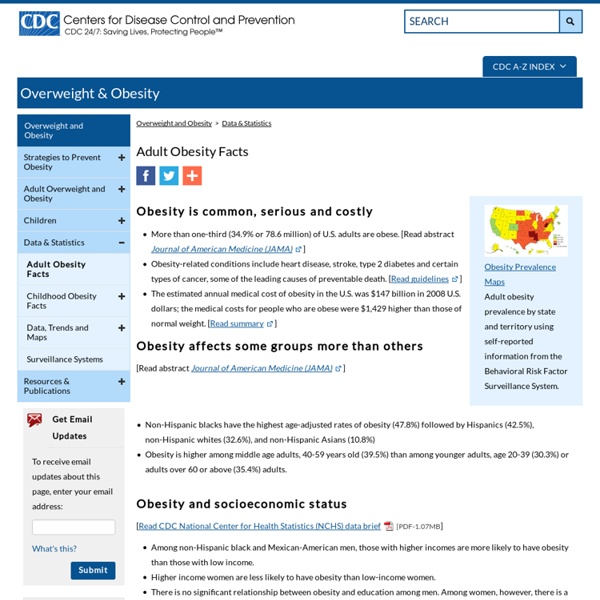
Overweight and Obesity in the U.S. In the U.S.: 68.5% of adults are overweight or obese; 34.9% are obese.31.8% of children and adolescents are overweight or obese; 16.9% are obese.30.4% of low-income preschoolers are overweight or obese.Disparities exist based on race-ethnicity, gender, age, geographic region, and socioeconomic status. Obesity rates have more than doubled in adults and children since the 1970’s (National Center for Health Statistics, 2009). Adult Overweight and Obesity in the U.S. More than two-thirds of U.S. adults are overweight or obese (Ogden et al., 2014). Racial-Ethnic Disparities Recent national data show that 82.0 percent of Black women and 77.2 percent of Hispanic women are overweight or obese compared to 63.2 percent of White women (Ogden et al., 2014). The table below highlights these and other selected data on adult overweight and obesity from the National Health and Nutrition Examination Survey (NHANES). U.S. Source: Ogden C.
Systems Concepts and Tools
provide training and consultancy support in the use of systems concepts in evaluation. This includes the material below, workshops, evaluation design, and one-on-one mentoring and advice. Contact me for more details about what I can do for you and your work. Why? Because I believe strongly that the systems field can contribute strongly to the development of the evaluation field. How so ? The systems field comprises methodologies, methods and tools that are deeply evaluative. For me, systems concepts provide me with very powerful ways of exploring inter-relationships, perspectives and boundaries. •Inter-relationships are the key to understanding how programs behave. More than evaluation, the systems field has thought deeply about these three concepts and come up with approaches that can transform the way in which evaluation does its job. The material in this section indicates what is possible and how people have used systems concepts in evaluation. The methods are : Causal Loop Diagrams
Prince William Neuroscience Center
Relationship Between Poverty and Overweight or Obesity « Food Research & Action Center
One of the common myths that exists is that all or virtually all low-income people are far more likely to be obese. Overall, the research for a greater risk of obesity is more consistent for women and children (especially White women and children) of low-income or low-SES than for men. While all segments of the U.S. population are affected by obesity, one of the common myths that exists is that all or virtually all low-income people are far more likely to be obese. In this generalization, two facts commonly are overlooked: (1) the relationship between income and weight can vary by gender, race-ethnicity, or age and (2) disparities by income seem to be weakening with time. The studies below highlight some of the more recent research on the complicated relationship between obesity and poverty. Adult Poverty and Obesity The Relationship Based on General Trends How the Relationship Varies by Gender and Race-Ethnicity How the Relationship Has Changed Over Time Childhood Poverty and Obesity
Evaluating Systems Change - Design
This post is a response to "How Might We Zoom Out to Evaluating With a Systemic View?" Read more of the conversation here. Much of the work we do in the philanthropic and nonprofit sectors is about changing systems to accelerate social progress. By its very definition, a system is an arrangement (pattern, design) of parts which interact with each other within the system's boundaries (form, structure, organization) to function as a whole. At FSG Social Impact Advisors, we have become increasingly involved in evaluating initiatives that involve multiple sites and varied project implementation strategies. What is the system? Some wonderful folks from the Ball Foundation, who partner with mid-size urban school districts committed to transforming schooling and learning, take a systems view of their work and the evaluation of it. Evaluating with a systems perspective also means being intentional about the learning throughout an evaluation process.
Prince William OB/GYN Associates - Home
Le souhait de Jamie Oliver pour le prix TED Prize: enseigner l’alimentation à chaque enfant | Talk Transcript
Sadly,in the next 18 minutes when I do our chat,four Americans that are alivewill be deadfrom the food that they eat. My name's Jamie Oliver. I'm 34 years old.I'm from Essex in Englandand for the last seven yearsI've worked fairly tirelesslyto save lives in my own way.I'm not a doctor;I'm a chef,I don't have expensive equipmentor medicine.I use information, education. I profoundly believe that the power of foodhas a primal place in our homesthat binds us to the best bits of life.We have an awful,awful reality right now.America, you're at the top of your game.This is one of the most unhealthy countries in the world. Can I please just see a raise of handsfor how many of you have children in this room today? (Laughter) Right? (Applause) I came here to start a food revolutionthat I so profoundly believe in.We need it. Pastor Steve:an inspirational man, one of my early allies in Huntington, West Virginia.He's at the sharp knife-edge of this problem.He has to bury the people, OK? JO: Yes you are.
Welcome to Prince William OB/GYN, Mannassas, Virginia - The Prince William OB/GYN Official Site