

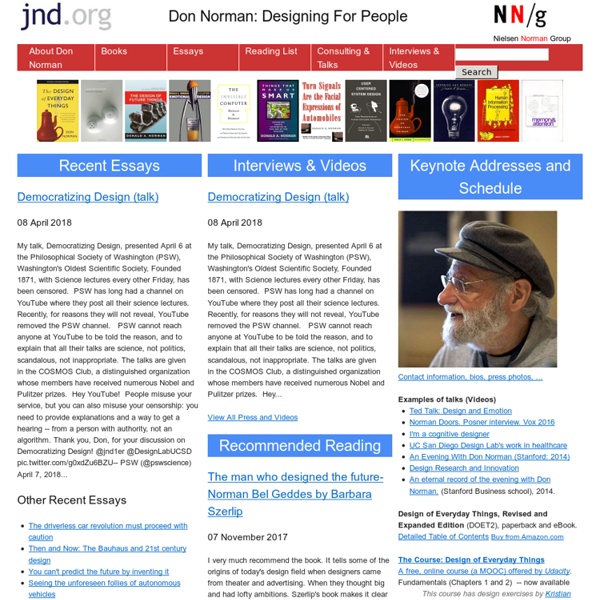
Donald Norman Donald Arthur "Don" Norman (born December 25, 1935) is the director of The Design Lab at University of California, San Diego.[1][2] He is best known for his books on design, especially The Design of Everyday Things. He is widely regarded for his expertise in the fields of design, usability engineering, and cognitive science.[3] He is also a co-founder and consultant with the Nielsen Norman Group. Much of Norman's work involves the advocacy of user-centered design.[4] His books all have the underlying purpose of furthering the field of design, from doors to computers. Norman has taken a controversial stance in saying that the design research community has had little impact in the innovation of products, and that while academics can help in refining existing products, it is technologists that accomplish the breakthroughs.[5] Norman is an active Distinguished Visiting Professor at the Korea Advanced Institute of Science & Technology (KAIST), where he spends two months a year teaching.
industrial design magazine + resource / Columns category Posted by An Xiao Mina | 25 Nov 2013 | Comments (0) Hacking away at San Francisco's Freespace, a pop-up space for artists, designers, developers and other creatives. I've been spending a lot of time at hackathons lately. It's not a surprise; here in the Bay Area, hackathons and coding sessions are a way of life, a social scene as common as a cocktail party in New York. The idea is what it sounds like: a bunch of people come together and "hack" on a project. It can be a group project or an individual project, something you've been working on for a while or something you're starting. David Kelley David Kelley About As founder of IDEO, David Kelley built the company that created many icons of the digital generation—the first mouse for Apple, the first Treo, the thumbs up/thumbs down button on your Tivo’s remote control, to name a few.
Design Thinking: A Useful Myth Posted by Don Norman | 25 Jun 2010 | Comments (62) A powerful myth has arisen upon the land, a myth that permeates business, academia, and government. It is pervasive and persuasive. Samsung plans to add more interaction methods to its future tablets While Apple is in the lead when it comes to tablet sales, other companies have been trying to catch up by offering competitively priced Android tablets for sale. One of these companies is Samsung, and while it has multiple tablets in different sizes and price ranges, it looks like it’s not stopping there. According to a recent interview Samsung’s product marketing manager had with Laptop Mag, the company will be pushing new ways to interact with the tablet to make their devices stand out.
Why Design Contests Are Bad Posted by Don Norman | 28 Jul 2010 | Comments (20) Every year the world holds many contests for industrial designers. Lots of submissions, lots of time spent by jurors reviewing them, lots of pretty pictures afterwards. Fun to read, wonderful for the winners. What's the problem? Analytical design and human factors ET on analytical design and human factors Analytical Design The purpose of analytical displays of information is to assist thinking about evidence. Consequently, in designing an analytical graphics, the first question should be: What are the evidence-thinking tasks that this display is supposed to serve? Analytical grapics should be constructed to serve the fundamental cognitive tasks in reasoning about evidence: describing the data, making comparisons, understanding causality, assessing credibility of data and analysis. Thus the logic of design replicates the logic of analysis; design reasoning emulates evidence reasoning.
《UCDA》About UCDA: Principles - we are now trying to pose a new concept to the world, which we call “Universal Communication Design”. We find ourselves in a society surrounded by too much information. While we have gained convenience and speed through media diversification, on the other hand the information we must put in view, must read, and must understand has overwhelmingly expanded. In particular, important notifications and contracts related to consumers’ lives and property, unending varieties of forms that assist day-to-day business, expressions that are difficult to understand, and information difficult to comprehend are all abundant. The thought has taken root that we should develop products easy for all kinds of consumer to use via Universal Design, beginning with Japan’s excellent industrial products, in public facilities, and in the home.
Why Great Ideas Can Fail Posted by Don Norman | 26 Aug 2010 | Comments (15) Designers are proud of their ability to innovate, to think outside the box, to develop creative, powerful ideas for their clients. Sometimes these ideas win design prizes. However, the rate at which these ideas achieve commercial success is low. Many of the ideas die within the companies, never becoming a product. Among those that become products, a good number never reach commercial success.
The future of user interface design: understanding context & behavior Whether you design software or physical products, the role of the designer is the same: to build a bridge between the user’s intent and the actual outcome of that intent. The most successful designs are the ones that make the intermediary disappear, or be so unobtrusive or intuitive that we completely fail to notice it. Think about the brilliance of the hammer as that “bridge” — when you want to hang a picture on the wall, there is no doubt in your mind which tool to use, which side to hold, and how to apply it. The hammer is so easy to use, not only because it is well designed, but because of our cumulative experience with hammers, which creates such a familiarity that the tool is almost universal.
Design Without Designers Posted by Don Norman | 7 Oct 2010 | Comments (33) I will always remember my first introduction to the power of good product design. I was newly arrived at Apple, still learning the ways of business, when I was visited by a member of Apple's Industrial Design team. He showed me a foam mockup of a proposed product. "Wow," I said, "I want one! 5 Signs of a Great User Experience If you've used the mobile social network Path recently, it's likely that you enjoyed the experience. Path has a sophisticated design, yet it's easy to use. It sports an attractive red color scheme and the navigation is smooth as silk. It's a social app and finding friends is easy thanks to Path's suggestions and its connection to Facebook. In short, Path has a great user experience.
Why Design Education Must Change Posted by Don Norman | 26 Nov 2010 | Comments (94) Traditionally what designers lack in knowledge, they make up for in craft skills. Whether it be sketching, modeling, detailing or rendering, designers take an inordinate amount of pride in honing key techniques over many years.