

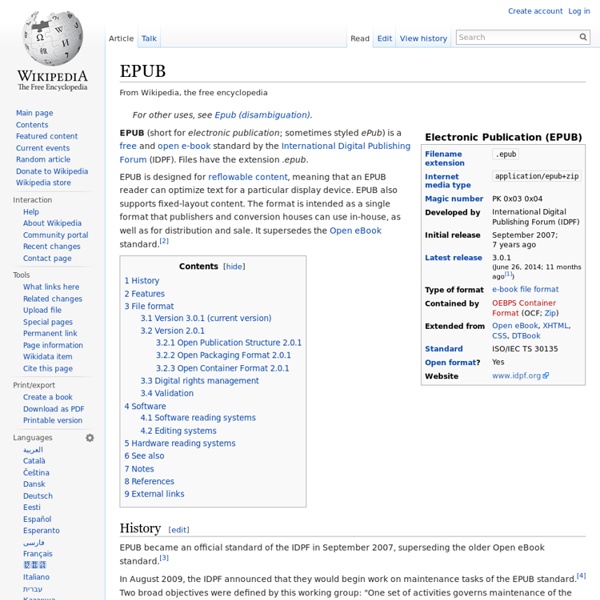
http://en.wikipedia.org/wiki/EPUB
DjVu DjVu has been promoted as an alternative to PDF, promising smaller files than PDF for most scanned documents.[4] The main difference between DjVu and PDF is that DjVu is a pure raster file format while a PDF file can contain both vector and raster graphics. The DjVu developers report that color magazine pages compress to 40–70 kB, black and white technical papers compress to 15–40 kB, and ancient manuscripts compress to around 100 kB; a satisfactory JPEG image typically requires 500 kB.[5] Like PDF, DjVu can contain an OCR text layer, making it easy to perform copy and paste and text search operations. Free browser plug-ins and desktop viewers from different developers are available from the djvu.org website. DjVu is supported by a number of multi-format document viewers and e-book reader software on Linux (Okular, Evince), Windows (SumatraPDF), and iOS (Stanza). History[edit]
Portable Document Format Portable Document Format (PDF) is a file format used to present documents in a manner independent of application software, hardware, and operating systems.[1] Each PDF file encapsulates a complete description of a fixed-layout flat document, including the text, fonts, graphics, and other information needed to display it. In 1991, Adobe Systems co-founder John Warnock outlined a system called "Camelot"[2] that evolved into PDF. While Adobe Systems made the PDF specification available free of charge in 1993, PDF was a proprietary format, controlled by Adobe, until it was officially released as an open standard on July 1, 2008, and published by the International Organization for Standardization as ISO 32000-1:2008,[3][4] at which time control of the specification passed to an ISO Committee of volunteer industry experts. History[edit] In 2008 Adobe Systems' PDF Reference 1.7 became ISO 32000:1:2008.
iBooks Author iBooks Author (iBA) is an e-book authoring application by Apple Inc. Documents created with iBooks Author may be exported as PDF files or be published to the Apple iBooks Bookstore. iBooks Author is available free of charge. Apple released iBooks Author on January 19, 2012 at an education-focused special event in New York City.[2] Simultaneously, Apple also released iBooks 2 and a new iBooks Bookstore category for textbooks.[3] The software is proprietary and available only for Mac OS X. Apple offers it for free download in the Mac App Store.
Amazon Kindle Naming and evolution[edit] The Kindle name was devised by branding consultant Michael Cronan who was asked by Lab 126 to name the product. Cronan and partner Karin Hibma suggested Kindle, meaning to light a fire.[3] They felt this was an apt metaphor for reading and intellectual excitement.[4] Kindle hardware has evolved from the original Kindle introduced in 2007 and a Kindle DX line (with a larger screen) introduced in 2009. The range now includes devices with a keyboard (Kindle Keyboard), devices with touch-sensitive screens (Kindle Paperwhite), a tablet computer with a reader app and a color display (Kindle Fire), and a low-priced model with an on-screen keyboard (Kindle). In the last three months of 2010, Amazon announced that in the United States, their e-book sales had surpassed sales of paperback books for the first time.[10]
Hard disk drive A disassembled and labeled 1997 HDD laying atop a mirror. Overview of how an HDD functions The two most common form factors for modern HDDs are 3.5-inch in desktop computers and 2.5-inch in laptops. HDDs are connected to systems by standard interface cables such as SATA (Serial ATA), USB or SAS (Serial attached SCSI) cables. As of 2012[update], the primary competing technology for secondary storage is flash memory in the form of solid-state drives (SSDs).
Secure Digital Secure Digital (SD) is a nonvolatile memory card used extensively in portable devices, such as mobile phones, digital cameras, GPS navigation devices, handheld consoles, and tablet computers. The Secure Digital standard was introduced in August 1999 as an evolutionary improvement over MultiMediaCards (MMC). The Secure Digital standard is maintained by the SD Association (SDA). iOS iOS (previously iPhone OS) is a mobile operating system developed by Apple Inc. and distributed exclusively for Apple hardware. The user interface of iOS is based on the concept of direct manipulation, using multi-touch gestures. Interface control elements consist of sliders, switches, and buttons. Interaction with the OS includes gestures such as swipe, tap, pinch, and reverse pinch, all of which have specific definitions within the context of the iOS operating system and its multi-touch interface. Internal accelerometers are used by some applications to respond to shaking the device (one common result is the undo command) or rotating it in three dimensions (one common result is switching from portrait to landscape mode). Major versions of iOS are released annually.
Apple iWatch release date, news and rumours What time is it? If you check your smartwatch, you may find that it's a text message past a Twitter notification but if you check the zeitgeist, you'll find that it's wearable tech time. After more than a year of relegation to "next big thing" status, the smartwatch is finally breaking out into the mainstream with the likes of the Samsung Galaxy Gear and Sony Smartwatch 2 following where Kickstarter phenomenon Pebble led. But we're yet to see a watch with true wow-factor and, for that, many are looking to Apple. Rumors of an Apple smartwatch have abounded since Pebble first hit the big time. iPhone The resounding sales of the iPhone have been credited with reshaping the smartphone industry and helping make Apple one of the world's most valuable publicly traded companies in 2011–12.[21] The iPhone is the top-selling phone of any kind in some countries, including the United States[22] and Japan.[23] History and availability Development of what was to become the iPhone began in 2004, when Apple started to gather a team of 1000 employees to work on the highly confidential "Project Purple",[24] including Jonathan Ive, the designer behind the iPhone.[25] Apple CEO Steve Jobs steered the original focus away from a tablet, like the iPad, and towards a phone.[26] Apple created the device during a secretive collaboration with AT&T Mobility—Cingular Wireless at the time—at an estimated development cost of US$150 million over thirty months.[27] Apple rejected the "design by committee" approach that had yielded the Motorola ROKR E1, a largely unsuccessful[28] collaboration with Motorola. Legacy
Apple TV Apple TV (marketed as TV) is a digital media player and a microconsole developed and sold by Apple Inc. It is a small network appliance and entertainment device that can receive digital data from a number of sources and stream it to capable TV for playing on the TV screen. The most recent version of Apple TV is the third generation, introduced on March 7, 2012, incorporating the higher resolution (1080p) video standard. MacBook Pro The MacBook Pro is a line of Macintosh portable computers introduced in January 2006 by Apple Inc., and now in its third generation. Replacing the PowerBook G4, the MacBook Pro was the second model, after the iMac, to be announced in the Apple–Intel transition. It is also the high-end model of the MacBook family and is currently produced with 13- and 15-inch screens, although a 17-inch version has been offered previously. The first generation MacBook Pro appeared externally similar to the PowerBook G4, but used the Intel Core processors instead of PowerPC G4 chips.
MacBook Air The MacBook Air is a line of Macintosh ultraportable notebook computers from Apple Inc. The Air was designed to balance both performance and portability, consisting of a full-sized keyboard design, a machined casing made of aluminium, and a very light and thin structure. The MacBook Air is available in two sizes, with the length of the diagonal display determining the model size: 13.3-inch and 11.6-inch (or 33.78 cm and 29.46 cm, respectively). A range of model choices with different specifications are produced by Apple, and as of 2013, all Air models use solid-state drive (SSD) storage and Intel Core i5 or i7 central processing units (CPUs).[2] In the Macintosh product line, the MacBook Air sits below the thicker and higher-performance MacBook Pro. History[edit]
Home » The M-DISC™