

Theosophy Theosophy comes from the Greek theosophia (θεοσοφία), which combines theos (θεός), "God"[3] and sophia (σοφία), "wisdom," meaning "divine wisdom." From the late 19th century onwards, the term theosophy has generally been used to refer to the religio-philosophic doctrines of the Theosophical Society, founded in New York City in 1875 by Helena Blavatsky, William Quan Judge, and Henry Steel Olcott. Blavatsky's major work, The Secret Doctrine (1888), was one of the foundational works of modern theosophy.[4] As of 2015[update], members of organizations descended from, or related to, the Theosophical Society were active in more than 52 countries around the world. Etymology[edit] The term theosophia appeared (in both Greek and Latin) in the works of early church fathers, as a synonym for theology:[6] the theosophoi are "those who know divine matters Traditional and Christian theosophy[edit] Antiquity and medieval ending c. 1450 CE[edit] 16th and 17th century[edit] 18th century[edit] Theosophy:
Legal grounds AGAINST Benn Act & Letwin Amendment - the Government has supremecy over LEGISLATURE as its not an actor. And The Proper Denial of Royal Assent Twenty-one eminent constitutional lawyers expressed this view in a letter to the Times (3 4 19): ‘Any attempt to advise refusal of Royal Assent to a Bill passed by Parliament would stand constitutional principle on its head. It would presume a governmental power to override Parliament, yet it is in Parliament, not the Executive, that sovereignty resides’. But it is the eminent-21 who stand constitutional principle on its head. The true principle is: it is in Parliament (not the Executive, and not the Legislature) that sovereignty resides. The name Parliament, or parliamentum, came (from the Old French: parlement, parler) into use in England in the 14th century (the Modus Tenendi Parliamentum, probably 1321), but by the 15th century it had come to mean a legislature (OED 3rd edition, 2005); and, indeed, that’s what it was. And if it were just one of them, that one would have to be the executive. A distinctive aspect of the Queen’s constitutional duty is for her to act only on advice.
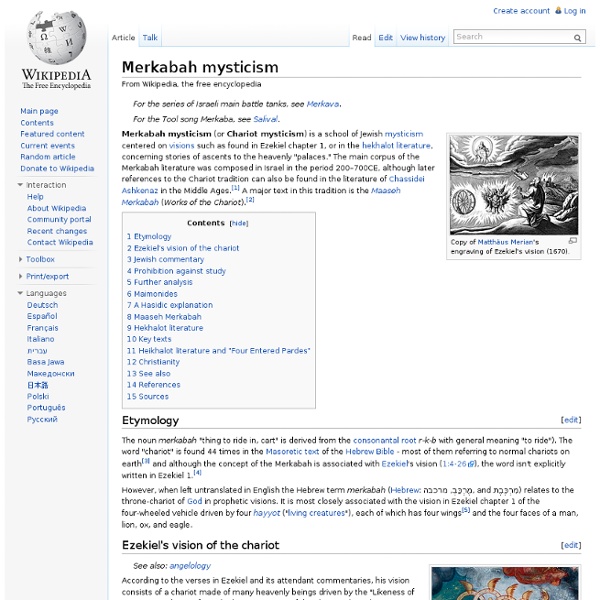
Jewish mysticism Academic study of Jewish mysticism, especially since Gershom Scholem's Major Trends in Jewish Mysticism (1941), distinguishes between different forms of mysticism across different eras of Jewish history. Of these, Kabbalah, which emerged in 12th-century Europe, is the most well known, but not the only typologic form, or the earliest to emerge. Among previous forms were Merkabah mysticism (c. 100 BC – 1000 AD), and Ashkenazi Hasidim (early 13th century AD) around the time of Kabbalistic emergence. Kabbalah means "received tradition", a term previously used in other Judaic contexts, but which the Medieval Kabbalists adopted for their own doctrine to express the belief that they were not innovating, but merely revealing the ancient hidden esoteric tradition of the Torah. This issue is crystallised until today by alternative views on the origin of the Zohar, the main text of Kabbalah. Three aims in Jewish mysticism[edit] Historical forms of Jewish mysticism timeline[edit] See also[edit]
Boris close to victory – 33 Labour and Tory rebels to back deal Brexit: Bridgen reveals he will vote for Boris' deal Boris Johnson secured changes to the Withdrawal Agreement and Political Declaration with the European Union and is now fighting to get his Brexit deal over the line, with the historic vote in the House of Commons scheduled for Saturday. Government whips are working to get the Prime Minister’s plan ratified by Parliament and have calculated it will pass - IF they can persuade enough Labour MPs, and the Tory rebels to back it. There are 650 MPs in Westminster. Of these, Sinn Fein’s seven members do not vote, and nor does Speaker John Bercow or his three deputies. Neither are the votes of the four vote tellers - two Conservative MPs in favour, two Labour MPs against - included in the overall result. This means the Government will need at least 320 votes to be certain of a majority. Assuming every Conservative MP who is able to vote backs the deal, this gives the Government 287 votes - short of a majority. Brexit news: What happens next?
Major Trends in Jewish Mysticism Major Trends in Jewish Mysticism is a work on the history of the Jewish Kabbalah by Gershom Scholem, published in 1941.[1] Topics[edit] In his introduction to Major Trends in Jewish Mysticism, Scholem blames Jewish scholars of the Haskalah period, who, because of what he decried their antagonism and neglect of the study of Kabbalah, allowed the field be all but monopolized by "charlatans and dreamers".[2] Scholem's chapter on Merkabah mysticism and Jewish gnosticism deals mainly with the mystical books the Lesser Hechalot and the Greater Hechalot, tracts written and edited between the 2nd and 6th centuries C.E. In the book, Scholem, citing other scholars, observed similarities between the Sefer Yetzirah (Book of Creation) and early Islamic gnosticism.[4] Scholem subsequently explores the works of the German Jewish school of Hasidim, and of the works of Abraham Abulafia. Commemoration[edit] See also[edit] Gershom Scholem References[edit] Jump up ^ Huss, Boaz, and Joel A.
Letwin Amendment created & passed practically overnight, 322 votes won, Bercow ecstatic, 322= Vernal Equinox, Masonic. Predicted a Masonic link with vote numbers: BJ deal meeded '33' to win as of Friday The Prime Minister is legally obliged to write to the EU asking them to grant a three-month extension Saturday, 19th October 2019, 2:52 pm Boris Johnson has to request a three-month delay to Brexit after rebel MPs foiled his attempt to push the new Withdrawal Agreement through Parliament today. Sign up to our Politics newsletter The i politics newsletter cut through the noise That amendment declared that approval of the deal should be postponed until the Withdrawal Agreement Bill (WAB), which would write it into British law, is debated next week. Sir Oliver's motion was approved by a majority of 322 with 306 voting against. Deadline missed European leaders have said they do not want a further delay to Brexit, but are unlikely to veto it if the only alternative is a no-deal exit at the end of this month. But the Prime Minister will try to push through the WAB as quickly as possible.
Gershom Scholem Gerhard Scholem who, after his immigration from Germany to Israel, changed his name to Gershom Scholem (Hebrew: גרשום שלום) (December 5, 1897 – February 21, 1982), was a German-born Israeli philosopher and historian. He is widely regarded as the founder of the modern, academic study of Kabbalah, becoming the first Professor of Jewish Mysticism at Hebrew University of Jerusalem.[1] His close friends included Walter Benjamin and Leo Strauss, and selected letters from his correspondence with those philosophers have been published. Scholem is best known for his collection of lectures, Major Trends in Jewish Mysticism (1941) and for his biography Sabbatai Zevi, the Mystical Messiah (1957). Life[edit] Gerhard Scholem was born in Berlin to Arthur Scholem and Betty Hirsch Scholem. Gerhard Scholem met Walter Benjamin in Munich in 1915, when the former was seventeen years old and the latter was twenty-three. Scholem wrote his doctoral thesis on the oldest known kabbalistic text, Sefer ha-Bahir.
Untitled Document Valerie Russell Assignment 1 Exploring Functions of the form y = a sin(bx + c) Let's explore the graph of y = sin(x) and y = 2 sin(x) for x (the domain) in the interval [-π , π ] and determine the range of the functions. Exploring a If we multiply the y-coordinate of every point on the graph of y = sin(x) by 2, we obtain all of the points on the graph of y = 2 sin(x). increases. x-axis. Now let's see what happens when a has a negative value: Exploring b Let's explore the graph of y = sin(x) and y = sin(3x). Let's see what happens if b is a multiple of π: Hence, both a and b affect the shape of the curve. Exploring c Now let's explore the graph of y=sinx and y=sin(x+π/6). y = sinx and y = 3sin(2x-π) Extension y = a sin(bx + c) + d What happens if we add a constant to the sine function? Hence, while both a and b affect the shape of the curve, c and d affect the curves location. Here's an exercise: a) What are the maximum and minimum volume of air in the runners lungs? Solutions: