

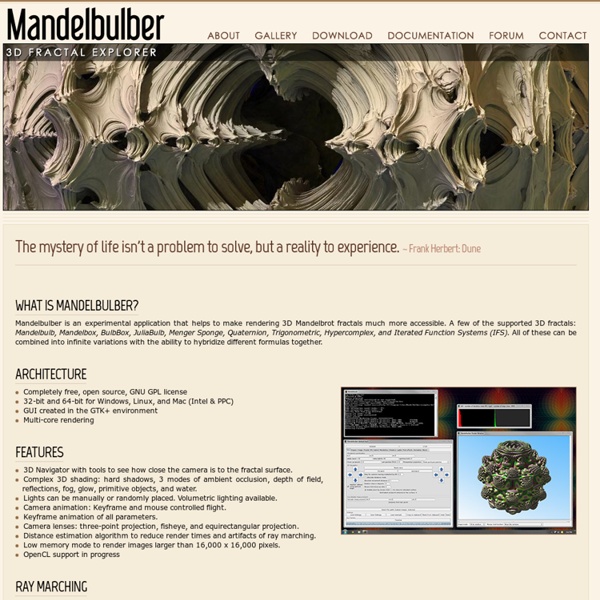
What is a Mandelbox - Mandelbox A Mandelbox is a box-like fractal object that shares several properties with the well known Mandelbrot set; it is a map of continuous, locally shape preserving Julia sets. This means the object varies at different locations, since each area uses a Julia set fractal with a unique formula. Like the Mandelbrot set a Mandelbox is calculated by applying a formula repeatedly to every point in space. That point v is part of a Mandelbox if it does not escape to infinity. In fact it replaces the Mandelbrot equation z = z2 + c with: v = s*ballFold(r, f*boxFold(v)) + c where boxFold(v) means for each axis a: if v[a]>1 v[a] = 2-v[a] else if v[a]<-1 v[a] =-2-v[a] and ballFold(r, v) means for v's magnitude m: if m<r m = m/r^2 else if m<1 m = 1/m The standard Mandelbox uses this formula with s=2, r=0.5 and f=1. Unlike the Mandelbrot set a Mandelbox can exist in any number of dimensions. Properties It is probably a multi-fractal, which means it doesn't have a single fractal dimension measure, however:
Documentation:Contents - POV-Wiki Welcome to the POV-Ray version 3.7.x documentation repository ... if you're looking for the most up to date documentation, you've found it! This content is used to generate the documentation included with the distribution, so occasionally it can get ahead of the current release. The content has been divided into the following five major sections: New to POV-Ray? You'd most likely want to begin with the tutorial section. Introduction to POV-Ray 1.1 Introduction 1.1.1 Program Description 1.1.2 What is Ray-Tracing? 1.1.3 What is POV-Ray? 1.1.4 Features 1.1.4.1 Changes and New Features Summary 1.1.4.1.1 Version 3.7.1 1.1.4.1.2 Version 3.7.0 1.1.5 Trademarks 1.1.6 The Early History of POV-Ray 1.1.6.1 The Original Creation Message 1.1.6.2 The Name 1.1.6.3 A Historic 'Version History' 1.1.7 How Do I Begin? 1.1.8 Notation and Basic Assumptions 1.2 Getting Started 1.2.1 Our First Image 1.2.1.1 Understanding POV-Ray's Coordinate System 1.2.1.2 Adding Standard Include Files 1.2.1.3 Adding a Camera 1.2.2 Basic Shapes
Images des mathématiques « Comme dans un rêve… » Le 17 novembre 2011 - Ecrit par Aurélien Alvarez Le jeudi 24 novembre de 19h à 22h, venez nombreux au vernissage de l’exposition d’art fractal 3D « Comme dans un rêve… » de Jérémie Brunet. Après le succès de sa première exposition en janvier dernier, venez découvrir les derniers tableaux de Jérémie Brunet, lauréat du concours international « Benoit Mandelbrot Fractal Art Contest 2011 » ainsi que son dernier livre et son DVD reprenant ses meilleures vidéos de voyages fantastiques au pays des fractales 3D. Rendez-vous donc : Atelier RIPS, 16 rue Jacquemont, Paris 17 (les 3 fenêtres à droite de l’entrée) Entrée libre du 25 au 27 novembre de 15h à 20h. Nous avons déjà eu de multiples occasions de parler des fractales sur Images des maths. Par leurs qualités graphiques, les fractales sont passionnantes à explorer et permettent de créer des œuvres statiques ou des vidéos d’une grande originalité, nous transportant dans des univers à la fois abstraits et familiers.
WebGL Water Loading... Made by Evan Wallace This demo requires a decent graphics card and up-to-date drivers. If you can't run the demo, you can still see it on YouTube. Interactions: Draw on the water to make ripples Drag the background to rotate the camera Press SPACEBAR to pause and unpause Drag the sphere to move it around Press the L key to set the light direction Press the G key to toggle gravity Features: Raytraced reflections and refractions Analytic ambient occlusion Heightfield water simulation * Soft shadows Caustics (see this for details) ** * requires the OES_texture_float extension** requires the OES_standard_derivatives extension Tile texture from zooboing on Flickr
Index of /Software/+Formulas+Parameters Index of /Software/+Formulas+Parameters Name Last modified Size Description Parent Directory - Algorithmic worlds - Blog A blog about algorithmic art and fractal aesthetic. Click here to subscribe to the RSS feed. February 27th 2011 Recently I've been using a different type of algorithm. It is still related to pattern piling, but I'll explain this in another post. Here I just want speak a bit about the algorithm. A few years ago, a new type of fractal imagery appeared (or at least I hadn't encountered it before), involving fractal patterns apparently filling densely the plane. Dense fractal patterns are exactly what I am after, so I was naturally very interested in these new techniques. Let z be a complex number and define Iabs(z) to be equal to z if the imaginary part of z is positive and its complex conjugate if it is negative. z = log(Iabs(z)+p) Here the branch cut of the logarithm has been chosen to lie on the negative real axis. The Ducks Mandelbrot-type fractal. It might not be obvious in the picture above, but there are some very intricate structures between the two curved arcs.
3D Fractal Art (Mine and in general) So I thought I should finally share some of my favourite pieces that I've done so far, and also talk a bit about how I go about the creation process. The first issue on my mind is something that came up in an e-mail with a new friend of mind, Jing-reed, who has recently left a few very kind comments at the bottom of my Mandelbulb 3D tutorial pages. I told him that I've had a rule, since I started: Never load other people's parameters to work off of. I tried this a few times way back, but producing anything in this way always made me feel a bit empty... Like the piece wasn't really, truly mine. And this still holds true... Ok, now, on to some of my artwork... The first piece I was really proud of, and still today is my favourite, would be "Fury" : I remember I came upon it by accident, when I first learnt how to use the cutting tool. One such example, although it's got a touch of organic-ness in it too, is Mechaniclysm: Then, my most recent two pieces, I am especially proud of =)
Fractals for the compleat idiot Fractals for the compleat idiot by Kathy Roth August 21, 2000 Here is my effort to explain the basics of fractals-please feel free to comment. Fractals start with a process called iteration. You can start with the Mandelbrot formula: z=z^2 +c (z=z squared + c). This is really: z(new) = z(old) ^2+ c. For the Mandelbrot equation, z is set at the beginning and most often is (0,0). So a point on the x-axis would be (2,0) and a point on the y-axis would be (0,2) and a point in the lower left would be (-2-,2). (The second number is actually multiplied by i, the square root of minus 1- more on this later.) So to see what color a particular pixel turns out, you put it into the equation z= z^2 + c z(new) = z(old) ^2 + c. Start with the point (2,0) on the x axis. the square root of minus one, so this number is 2+ 0i= 2. For z=0 and c=pixel=(2,0) z= 0^2 +2= 2 Then you put the 2 in for the old z and get a new new z- this is the iteration part. z= 2^2 +2=6 z=6^2+2=38 etc. Try another pixel- (-0.2,0.2) etc. z=z^2 + c.