Four Major Shifts in Literacy
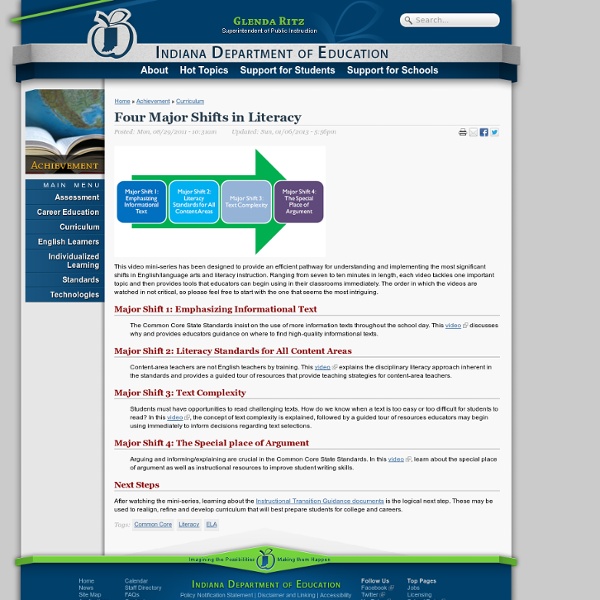
Balancing Informational Text and Literature
This is a 10 minute video which features a discussion between NYS Commissioner of Education John B. King Jr., David Coleman (contributing author to the Common Core) and Kate Gerson (a Sr. Fellow with the Regents Research Fund) addressing Shift 1 – PK-5: Balancing Informational Text and Literature. By unpacking Shift 1, the discussion addresses the role of the elementary teacher and the benefits of giving informational text the time it deserves in the elementary classroom. After watching this video, educators might ask themselves: What is Shift 1? What does it demand? Participants might also work together to select informational texts for a single unit, ensuring that these texts both challenge students with grade level complexity as modeled in Appendix B of the CCSS, but also “teach” new ideas, concepts, or ways of making an argument. This is just one way of conducting professional development around this video.
50 Important Links for Common Core Educators
Educators across the nation are working hard this summer to begin developing updated curricula that will fit into the new Common Core State Standards, which will be fully applied in 45 U.S. states (Texas, Alaska, Nebraska, Virginia, and Minnesota have opted out of statewide participation) by 2015. Yet despite the hubbub about the new standards, which were created as a means of better equipping students with the knowledge they need to be competitive in the modern world, many teachers still have a lot of unanswered questions about what Common Core will mean for them, their students, and their schools. Luckily, the Internet abounds with helpful resources that can explain the intricacies of Common Core, offer resources for curriculum development, and even let teachers keep up with the latest news on the subject. We’ve collected just a few of those great resources here, which are essential reads for any K-12 educator in a Common Core-adopting state. Groups and Organizations Useful Resources
Text Difficulty and Adolescents
I recently received the following letter and thought you might be interested in my responses: "I found your August 21, 2011 blog post on "Rejecting Instructional Level Theory" eye-opening and helpful. I'm a high school English teacher and instructional coach specializing in adolescent literacy remediation, so I've worked with leveled text a lot. If you have a moment, I'd love to hear your thoughts on a couple of follow-up questions:" Are the implications of your findings different for adolescents needing remediation? It depends on how low the students are and how much scaffolding is available. Is "accessible text" still important for fluency-building? Same issue. What about sheer volume? That makes so much sense, and yet, surveys tell us (as do teachers) that even with the easier materials, adolescents aren’t reading much.
9 Ways the CC Will Change Classroom Practice Harvard Education Letter
Volume 28, Number 4July/August 2012 By ROBERT ROTHMAN Nine Ways the Common Core Will Change Classroom Practice, continued Nine Ways the Common Core Will Change Classroom Practice In a recent survey, William Schmidt, a University Distinguished Professor of education at Michigan State University, found some good news and bad news for supporters of the Common Core State Standards. Those teachers might want to take a closer look. In Mathematics 1. This is an excerpt from the Harvard Education Letter.
Related:
Related:

