

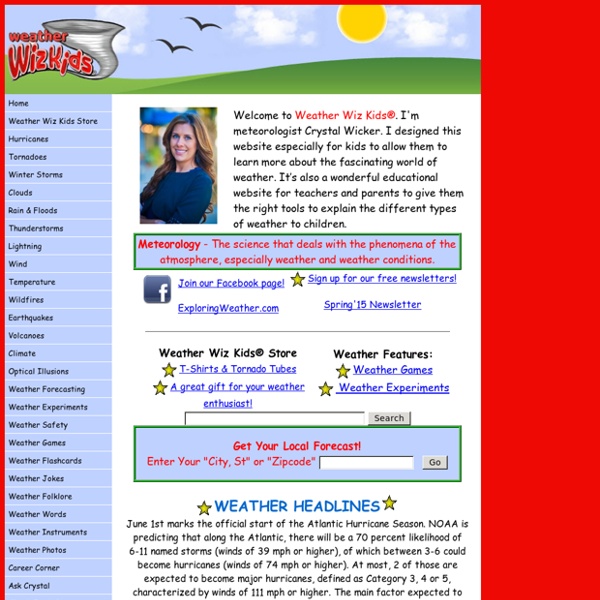
http://www.weatherwizkids.com/index.htm
Related: WeatherNWS Education Resources This page offers information for children, teens and adults. Materials range from coloring books, puzzles and games, to lesson plans, brochures, satellite images, and career information for weather related fields, such as meteorology, hydrology and climatology. Classroom Materials Student Sites Graphics, Photos, Images
Hurricanes - Tree House Weather Kids Movie: NOAA A hurricane is one of nature’s biggest storms. It is a huge, swirling body of air hundreds of miles wide, with strong winds and rain. Hurricanes form over warm tropical oceans. The best educational iPad apps for kids Overview A six year old boy and his meteorologist dad set out to produce an app that would appeal to young children and have educational value. They succeeded and created this fantastic app that teaches children about weather. This practical app allows children and adults to keep track of weather forecasts around the world and look at an avatar who dresses accordingly. Ultimately children are encouraged to use this app alongside a parent as an everyday tool for dressing appropriately and looking at trends in the weather. Children and adults read facts about the weather, check the weather in places all over the world, look at weather appropriate clothing, view the temperature in Fahrenheit and Celsius and graph their findings to compare their results.
Frost Experiment If you live someplace where the temperatures drop below freezing then you are familiar with Frost. We have left for school on many a morning and have seen the grass covered in a white shiny frost. With my oldest daughter being six and my youngest three, you can imagine that I have been asked on several occasions “MOM WHAT’S THAT!” Kindergarten Weather Unit (Freebie!) A brief note before I get started: Welcome to my blog! Here I will share with the world all my wonderful teaching experiences, worksheets, lesson plans and any other teacher related business I come across. It's a little blank now, but you can expect to see me post at least once or twice a week, and Friday Freebies! I'd love comments about any of my original work or posts. Thanks for stopping by and come back soon!
Overview - GLOBE.gov Overview Elementary GLOBE is designed to introduce primary (K-4) students to the study of Earth System Science. The complete instructional unit includes: Science-based storybooks designed to introduce students to key concepts in water, soil, clouds, seasons, aerosols, and Earth system studies. www.cstone.net/~bcp/K/KMrSci.htm Kindergarten - Science - Weather - Overview The March Science lessons are an introduction to weather. The emphasis in kindergarten will be on observation and description of daily weather changes. How people are affected by the weather and the identification of the four seasons and the local weather patterns during the different seasons will be the main focus. Technical explanations of meteorological phenomena will be studied in grades two and four.
OKSci Framework [licensed for non-commercial use only] / Kindergarten Weather K-ESS2-1 Students who demonstrate understanding can: Use and share observations of local weather conditions to describe patterns over time. K-ESS3-2 Students who demonstrate understanding can: Ask questions to obtain information about the purpose of weather forecasting to prepare for, and respond to, severe weather. By making observations about what the weather is like, patterns in local weather can be observed. Making observations about local weather can lead to questions about weather forecasting and how it helps keep people safe. Introduction to the OKSci Framework