

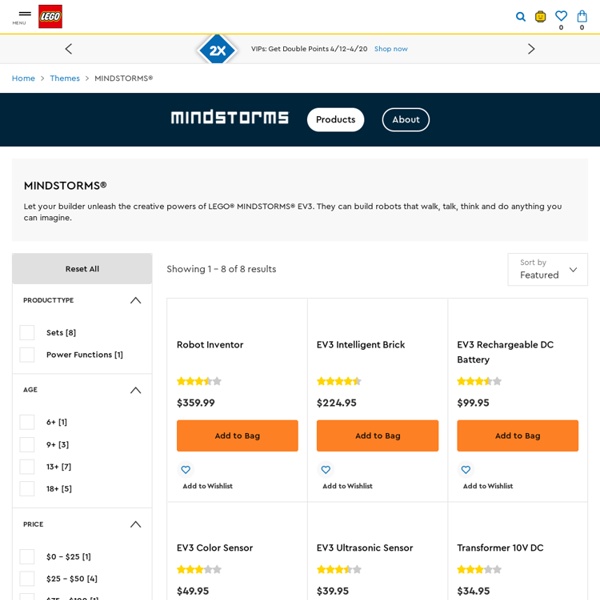
https://www.lego.com/en-us/themes/mindstorms
The Electronic Components and Semiconductor Superstore Berkeley Logo (UCBLogo) The current version is 6.0, posted 14 Sep 2008. 6 Jan 2009: The bug in the version for PowerPC-based Macs that required X11 to run Logo has been fixed. Re-download UCBLogo if you had that problem. Here are links to version 5.3 for frozen platforms DOS (or by HTTP), or Mac pre-OS X (or by HTTP). If you downloaded 6.0 before Tues 9/30/2008, 10:30pm PST, and it didn't run on your PowerPC-based Mac, download it again -- that's been fixed. Also consider David Costanzo's FMSLogo, an updated version of George Mills' MSWLogo, a multimedia-enhanced version for MS Windows based on Berkeley Logo. Here are links to other versions of Logo. If you got here by Googling "logo" and are looking for someone to design a logotype (an identifying symbol) for your organization, you're in the wrong place. Now FREE for personal use: The second edition of Computer Science Logo Style, a three-volume series intended mainly for teenagers and their teachers, or for adults who aren't professional programmers.
ISSE : An Interactive Source Separation Editor Le projet Thymio II est une évolution du robot Thymio, les deux développés dans le cadre d'une collaboration entre l'Ecole Polytechnique Fédérale de Lausanne (EPFL groupe MOBOTS) et l'École Cantonale d'Art de Lausanne (écal). Pour Thymio II, le développement a été réalisé dans le cadre du programme NCCR Robotics et l'association Mobsya a contribué au développement et gère sa production. L'objectif du projet Thymio II est de permettre au grand public d'accéder à la robotique par un robot programmable et riche en possibilités, afin de permettre l'exploration des technologies liées à la robotique. Accessoirement cet objectif peut s'appliquer de façon plus spécifique aux écoles, avec l'utilisation de la robotique comme outil pédagogique. Pour atteindre cet objectif nous avons choisi un mode de diffusion très spécifique: Tout ceci nous permet de diffuser le robot Thymio II à prix minimal, basé sur des marges bien plus basses que ce qui est pratiqué dans le commerce.
Bodystorming Bodystorming is a technique sometimes used in interaction design or as a creativity technique. The idea is to imagine what it would be like if the product existed, and act as though it exists, ideally in the place it would be used. Its going through an idea with improvised artifacts and physical activities to envision a solution. Opinions on this method[edit] The proponents of this idea like to point out the fact that you get up and move, trying things out with your own body, rather than just sitting around a table and discussing it while having to imagine it in the abstract (as in the case of brainstorming). References[edit] Oulasvirta, Antti; Kurvinen, Esko; Kankainen, Tomi (July 2003).
How to Pick the Right Electronics Board for Your DIY Project Bee-Bot Home Page Screenshots Here you’ll find a host of example plots with the code that generated them. mplot3d The mplot3d toolkit (see mplot3d tutorial and mplot3d Examples) has support for simple 3d graphs including surface, wireframe, scatter, and bar charts. (Source code, png, hires.png, pdf) Thanks to John Porter, Jonathon Taylor, Reinier Heeres, and Ben Root for the mplot3d toolkit. Streamplot The streamplot() function plots the streamlines of a vector field. (Source code) This feature complements the quiver() function for plotting vector fields. Ellipses In support of the Phoenix mission to Mars (which used matplotlib to display ground tracking of spacecraft), Michael Droettboom built on work by Charlie Moad to provide an extremely accurate 8-spline approximation to elliptical arcs (see Arc), which are insensitive to zoom level. (Source code, png, hires.png, pdf) Pie charts The pie() command allows you to easily create pie charts. (Source code, png, hires.png, pdf) Scatter demo (Source code, png, hires.png, pdf)
38 outils en ligne pour éditer et gérer des images, sons et vidéos L’URFIST de Paris (Unité Régionale de Formation à l’Information Scientifique et Technique) qui propose des formations pour des personnels des universités a mis en ligne en octobre 2014 un support de formation de Corinne Habarou (chargée de veille sur les outils Web et du site de l’URFIST de Paris) sur des outils en ligne à maîtriser pour manipuler des fichiers média, accéder à des fonctionnalités rapidement sans maîtriser à fond un logiciel à installer : les services multimédia en ligne (voir la présentation à la fin de cet article). Sélection d’outils en ligne pour éditer et gérer des médias Bref, il s’agit ici d’une présentation pédagogique d’applications Web pour éditer, retoucher et gérer des médias (image fixe et animée, audio). Le support didactique met en avant des applications gratuites et/ou libres avec leurs avantages et leurs limitations couvrant une pléiade de possibilités de manipulations des médias. Plan de la présentation : Les services multimédia en ligne Manipuler le son
Brainstorming Origin[edit] Advertising executive Alex F. Osborn began developing methods for creative problem solving in 1939. He was frustrated by employees’ inability to develop creative ideas individually for ad campaigns. In response, he began hosting group-thinking sessions and discovered a significant improvement in the quality and quantity of ideas produced by employees. Osborn's method[edit] brainstorming activity conducting Osborn claimed that two principles contribute to "ideative efficacy," these being : Defer judgment,Reach for quantity.[3] Following these two principles were his four general rules of brainstorming, established with intention to : Applications[edit] Osborn notes that brainstorming should address a specific question; he held that sessions addressing multiple questions were inefficient. Groups[edit] Osborn envisioned groups of around 12 participants, including both experts and novices. Variations[edit] Nominal group technique[edit] Group passing technique[edit] Incentives[edit]
KELVIN® Educational Cargo-Bot – iPad The first game programmed entirely on iPad® Be Logical. Play Cargo-Bot Presenting Cargo-Bot. The first game programmed entirely on iPad using Codea™ Get it for free on the App Store. Cargo-Bot is a puzzle game where you teach a robot how to move crates. It features 36 fiendishly clever puzzles, haunting music and stunning retina graphics. Built with Codea Cargo-Bot is the first game on the App Store developed using Codea, an iPad app for rapidly creating games and simulations. Get Codea on the App Store. Cargo-Bot was developed by Rui Viana using Codea. Fred Bogg coded the entire music engine using Codea's sound API, as well as composing the Cargo-Bot score.