13 Lucky Tips for Activists
By Errol Schweitzer, October 1998 INEVITABLE DISCLAIMER (from IWW.org Editor): As instructed by the author of this document (which was originally intended for the enviornmental and/or animal rights movement), we have reproduced it here. Errol Scweitzer's views do not necessarily reflect those of the IWW or any of the individual members of the organization. We offer this statement as a friendly suggestion to hard working activists and organizers. INEVITABLE DISCLAIMER (from Errol Schweitzer): This (manual) is not meant to offend hard-working activists who are devoting much of their time and energy to social and environmental issues. #1 - Have a Sense of Humor The world is not going to change overnight, no matter how hard you work. #2 - Critique is Necessary and Vital Analyzing what went wrong and what went right about an action or a campaign may help you to not repeat the same mistakes twice. #3 - Treat Everyone as Individuals #4 - Listen to What Others Have to Say and Know Your Audience
Workshop formats: World cafe
Not an original notion - but an interesting one. The World cafe concept has been around a while www.theworldcafe.com. We use this technique often in our workshops (dial-e.net), and at a recent event UTS (University of Technology Sydney) it attracted some interesting comments - so perhaps worth a reminder. You've done some input, you have some group tasks defined and the groups are all working away. In this workshop model (there are lots of variations) 7 groups of 4 each worked away on the task we had assigned them for 15 minutes, supported by a single sheet of A4 on which to record their comments (having white paper tablecloths and lots of pens works even better). On a practical level it makes the facilitators time control task easier, and for participants it makes for a more engaging feedback process. The variations are part of the fun, but it can work well with 16 or 160 !
So what the fuck has occupy done so far?
The World Cafe
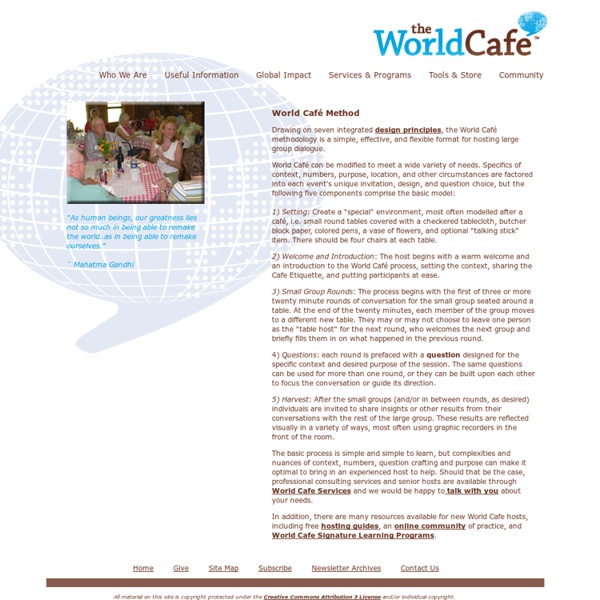
The World Cafe refers to both a vision and a method of dialogue. It evolved out of conversations and experimentation one day at the home of consultants Juanita Brown and David Isaacs. World Café Conversations are an intentional way to create a living network of conversation around questions that matter. A Café Conversation is a creative process for leading collaborative dialogue, sharing knowledge and creating possibilities for action in groups of all sizes. The challenges of life in the 21st Century require us to find new ways to access the wisdom and intelligence inherent in groups both small and large. The methodology of the World Café is simple: The environment is set up like a café, with tables for four, tablecloths covered by paper tablecloths, flowers, some colored pens and, if possible, candles, quiet music and refreshments. In World Café, the formulation of powerful questions is a fundamental art and skill. The seven design principles of World Café are: For more info see
Genetic Crimes Unit
Genetic Crimes Units are the autonomous Occupy Monsanto affinity groups who carry out Decontamination Events around the world. NOTE: This page is currently out of date & will be updated VERY shortly!!! Would you like your decontamination event listed above? Please e-mail GCU@Occupy-Monsanto.com with the Time, Date, and Location of your GCU’s decontamination event.
Knowledge Sharing Tools and Methods Toolkit - home
OCCUPY the DNC | 2012
Occupy Food
Occupy Los Angeles | The Revolution is Happening.... It's Just Not in the News
Geeks Are the New Guardians of Our Civil Liberties
A decade-plus of anthropological fieldwork among hackers and like-minded geeks has led me to the firm conviction that these people are building one of the most vibrant civil liberties movements we’ve ever seen. It is a culture committed to freeing information, insisting on privacy, and fighting censorship, which in turn propels wide-ranging political activity. In the last year alone, hackers have been behind some of the most powerful political currents out there. Before I elaborate, a brief word on the term “hacker” is probably in order. Despite their differences, there are certain websites and conferences that bring the various hacker clans together. Take, for instance, the reaction to the Stop Online Piracy Act (SOPA), a far-reaching copyright bill meant to curtail piracy online. The linchpin was a “Blackout Day”—a Web-based protest of unprecedented scale. The victory hinged on its broad base of support cultivated by hackers and geeks.